This 30-minute full-body workout suits generally healthy adults who want a short, repeatable strength session. Use a dumbbell or kettlebell, a pair of dumbbells for the hinge, and a secure bench or raised support. Warm up for five minutes, alternate squat and row sets for ten minutes, then hinge and press for ten. Use the final five minutes for optional core work and recording results. Beginners can start with one set of each exercise; gym, home and minimal-equipment alternatives are below.
Jump to the exercise plan ↓A short workout works best when you decide what matters before the timer starts. Thirty minutes is enough to practise several useful movements, but it is not enough to do every exercise you have saved on your phone. Pick a small number, prepare the equipment and leave room to rest.
Your 30-minute full-body workout schedule
Prepare suitable weights before starting, without reserving several busy gym stations. The sequence is squat, rest, row both sides, rest, then repeat; the second block follows the same alternating pattern. These are organised strength sets, not a race through a circuit.
| Time | Focus | What to do |
|---|---|---|
| Minutes 0–5 | Warm-up | Easy movement and lighter practice repetitions |
| Minutes 5–15 | Squat and row | Up to 2 sets of each; a row set includes both arms |
| Minutes 15–25 | Hip hinge and press | Up to 2 sets of each, with adequate rest |
| Minutes 25–28 | Optional core | 1–2 short sets of dead bugs, or use this time for extra rest |
| Minutes 28–30 | Record and finish | Log resistance, repetitions and next-session notes |
These blocks are planning windows, not deadlines. If you need more preparation or rest, remove the optional finish or complete fewer sets. Do not rush a heavy repetition to stay on schedule.
Do the sets and rests really fit?
The squat-and-row block allows approximately 40 seconds per squat set, 90 seconds per row set including both arms and a 15–20-second changeover, and three 90-second rests. That is 8 minutes 50 seconds, leaving 70 seconds for setup and transitions. At the upper repetition limit, row steadily rather than stretching every repetition into a long pause.
In the hinge-and-press block, four sets lasting around 40 seconds plus three 90–120-second rests take approximately 7 minutes 10 seconds to 8 minutes 40 seconds. Allow the first 50 seconds of this block for recovery and setup: together with the previous block’s 40-second changeover, that gives about 90 seconds after the final row. Even with three 120-second rests, around 30 seconds remain for the next transition. These are planning estimates: if your controlled repetitions take longer, extend the session, borrow the optional core time or do one fewer set. Keep the two-minute log.
The exercise plan: sets, reps, rest and muscles
A repetition is one complete movement; a set is a group of repetitions. Start with the lower end of each range. Rest after each set before starting the next exercise. For the row, complete both sides before the main rest. On a small screen, swipe the table sideways or focus it and use the arrow keys.
| Exercise | Sets × reps | Equipment | Suggested rest | Main muscles |
|---|---|---|---|---|
| Goblet squat | 2 × 8–12 | One dumbbell or kettlebell | About 90 seconds after each set | Quadriceps, glutes and inner thighs |
| Supported dumbbell row | 2 × 8–12 per side | One dumbbell and secure support | 15–20 seconds to change arms; about 90 seconds after both | Upper back, lats and biceps |
| Dumbbell Romanian deadlift | 2 × 8–10 | Pair of dumbbells | 90–120 seconds after each set | Hamstrings, glutes and trunk stabilisers |
| Incline press-up | 2 × 8–12 | Stable raised support; or dumbbells for a press | 90–120 seconds after each set | Chest, triceps and front shoulders |
| Optional dead bug | 1–2 × 4–6 per side | Floor space; mat optional | 30–45 seconds between sets | Trunk control |
How to choose an appropriate weight
Use a resistance that lets you finish the prescribed repetitions while feeling you could do about two or three more with the same technique. This is an estimate, not a test: you do not need to attempt those extra repetitions. Practise with a light load first. If you cannot reach the lower rep target without swinging, shortening the movement unintentionally or losing control, reduce the load or choose an easier variation.
Different exercises will usually need different weights. One pair of dumbbells is convenient, but convenience should not decide how much you lift. Keep a second suitable load nearby, use adjustable dumbbells with time to change them, or change the exercise. Rest roughly 60–120 seconds for easier work and longer whenever needed; the timing example above budgets 90 seconds rather than relying on the shortest rest.
Minutes 0–5: warm up for the movements
- First two minutes: walk, cycle or march at an easy pace.
- Next minute: practise about five comfortable bodyweight squats and five unloaded hip hinges.
- Next minute: do four light rows on each side, checking that your support is secure.
- Final minute: try five easy incline press-ups and arrange your first working weight.
Five minutes is a starting allowance. A colder environment, a more demanding lift or individual needs may require longer. Before a heavier hinge or press, add an easy rehearsal set within that block and shorten the optional finish. The warm-up should prepare you, not tire you out.
Minutes 5–15: squat and pull
Alternate a squat set and a row set, with a rest between them, for up to two rounds. A row set means the target repetitions on each arm. Begin with your less confident side and match its controlled repetitions on the other side.
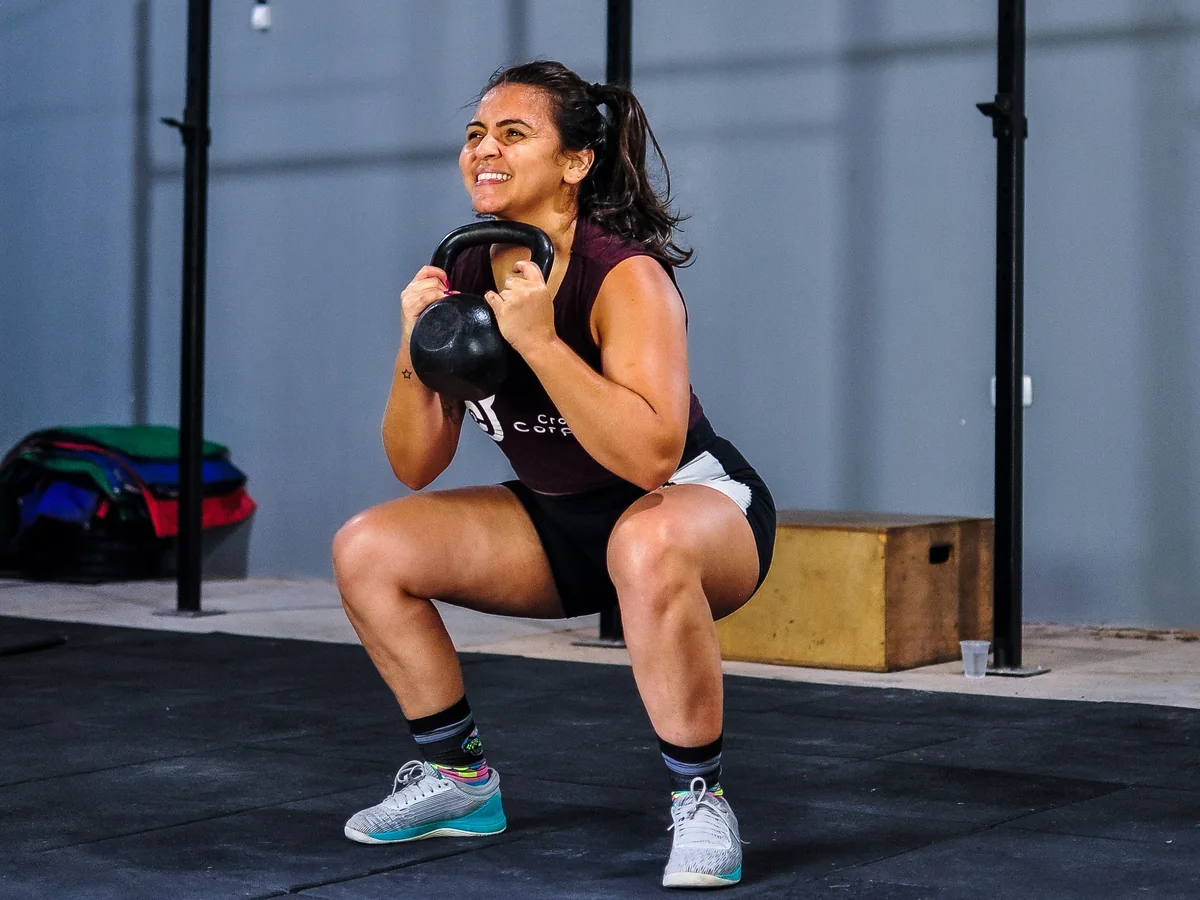
Goblet squat: keep the load close and feet steady
- Stand with your feet around shoulder-width apart, adjusting width and toe angle to a comfortable position. Hold the weight close to your chest.
- Brace your trunk, then bend your hips and knees together. Keep your whole foot grounded and let your knees follow the direction of your toes.
- Lower only as far as you can control comfortably, then push through your feet to stand. Breathe steadily; avoid a prolonged breath-hold.
Common mistakes: lifting the heels, dropping quickly into the bottom or letting the weight drift away from the chest. Your knees can move forwards; forcing them behind your toes is not the goal. Easier option: practise an unloaded squat to a stable chair placed against a wall, touching down gently without dropping onto it.

Supported dumbbell row: move the arm, keep the torso quiet
- Place one hand on a stable bench or fixed support. Use a comfortable split stance, hinge at the hips and let the other arm hang with the dumbbell.
- Draw your elbow towards your hip, bringing the weight towards your lower ribs. Keep your shoulders and hips facing the floor rather than turning upwards.
- Lower the weight smoothly to a comfortable arm extension. Complete the set, change sides, then take the main rest.
Common mistakes: jerking the weight, shrugging towards the ear or rotating the whole body. Substitution: a seated cable row is convenient in the gym; perform 8–12 two-arm repetitions per set. Reduce the weight if you cannot keep the movement controlled.

Minutes 15–25: hinge and push
Alternate the Romanian deadlift and your chosen press, again resting between sets. One pair of appropriately loaded dumbbells and a stable bench or support can be more workable than a circuit requiring four machines. Respect other gym users and leave time to change loads safely.
Dumbbell Romanian deadlift: move the hips back
- Stand tall with dumbbells beside the front of your thighs. Soften your knees and brace your trunk.
- Push your hips backwards as your torso inclines. Keep the weights close to your legs and your back in a comfortable, controlled position.
- Stop when you feel the hamstrings working and cannot hinge farther without losing that position. Stand by bringing your hips forwards; do not lean backwards at the top.
Common mistakes: reaching for the floor, drifting the dumbbells forwards or bending the knees so much that the hinge becomes a squat. The floor is not the target. Easier option: rehearse without weights, moving the hips back towards a wall behind you. If you cannot find a comfortable hinge, get technique help; a floor glute bridge can provide simpler hip-extension work while you learn, but is not the same movement.

Incline press-up, or a dumbbell chest press
- Place your hands around shoulder-width apart on a fixed, stable raised surface. Walk your feet back until your body forms a comfortable straight line.
- Bend your elbows, keeping them roughly 30–60 degrees from your torso, and bring your chest towards the support. Move shoulders and hips together.
- Press back to the start without letting the hips sag. Use a higher support or a wall to make the exercise easier.
Common mistakes: reaching the head forwards while the chest stays back, flaring the elbows straight out, or using furniture that can slide or tip. Dumbbell option: lie on a stable bench with feet supported, hold the weights over your chest and lower with forearms roughly upright. Keep wrists stacked over elbows and press smoothly. Use a comfortable range, not a forced deep stretch.
At home, a dumbbell floor press avoids needing a bench: lie with knees bent and feet flat, lower until the upper arms gently touch the floor, then press up without bouncing. Use weights you can safely get into and out of position; ask for help with setup if unsure.

Choose the version that suits your experience and equipment
Beginners: learn the movements before adding work
Start with one set of each main exercise at the lower rep target, using light resistance. Use the spare time for practice and recovery rather than filling it with extra exercises. A chair squat, supported row, unloaded hinge and wall press-up are reasonable starting choices when comfortable. Add a second set only when the first is controlled and you are recovering between sessions.
Intermediate gym users: make the work more challenging, not more rushed
Use two purposeful sets of each exercise and a load appropriate to your current ability. A cable row or dumbbell bench press can replace the matching movement. Keep roughly two or three repetitions in reserve. If heavy work needs two to three minutes of rest or several warm-up sets, allow a longer session or reduce the exercise count; do not pretend the same volume still fits into half an hour.
A 30-minute full-body workout at home with dumbbells
Use a goblet squat, supported one-arm row, dumbbell Romanian deadlift, floor press and optional dead bug. Check that your row support is genuinely stable; avoid lightweight dining chairs or wheeled furniture. Clear floor space and have suitable loads ready. If you cannot set up a safe row, choose the band option below instead.
Minimal equipment: one resistance band and a stable surface
Use a chair squat, standing band row, glute bridge, wall press-up and dead bug. For the row, follow the band's instructions: stand securely on its centre with both feet, hinge slightly and draw the handles or ends towards your hips. Check for damage and keep it under your feet; never improvise a door anchor. For the bridge, lie with knees bent and feet flat, lift the hips without arching the lower back, then lower smoothly for 8–12 repetitions.
With no weights or band, squats and press-ups remain possible, but there is no equally useful loaded row in this plan. Prone “W” arm raises may practise shoulder control, but should not be presented as an equivalent strength exercise. A suitable band or dumbbell makes a balanced pulling progression easier. Substitutions should serve the intended pattern safely; they do not need to look identical.
Minutes 25–30: optional core, then record your results
Minutes 25–28: a controlled dead bug
- Lie on your back with arms reaching upwards, hips and knees bent. Set your trunk in a comfortable position against the floor and breathe normally.
- Slowly reach one arm and the opposite leg away without allowing your lower back to arch further or your ribs to flare.
- Return, then switch sides. Use a shorter reach or move one limb at a time if needed.
Do 4–6 repetitions per side, rest 30–45 seconds and repeat only if time allows. Common mistake: extending farther than you can control. A short loaded carry is another optional finish if you have a clear, safe walking space; neither extra is compulsory.

Minutes 28–30: make the next session easier to start
Record each exercise, weight or variation, repetitions in each set, and whether you could have done two or three more controlled reps. Note any discomfort or setup problem. For example: “Goblet squat: 8, 8; same weight next time, practise a steadier lowering.” Finish at a comfortable pace.
A four-week progression example for a beginner
Repeat the structure long enough to compare sessions. The example below assumes two weekly sessions, manageable resistance and comfortable technique. Weeks are checkpoints, not deadlines: repeat a week if you need more practice or recovery.
| Week | Squat, row and press | Romanian deadlift | What to check |
|---|---|---|---|
| 1 | 1 × 8; row reps are per side | 1 × 8 with light resistance | Learn setup and control; leave several reps available |
| 2 | Build towards 2 × 8 at the same resistance | Build towards 2 × 8 | Add the second set only if technique and recovery are comfortable |
| 3 | 2 × 9–10 if ready | 2 × 9–10 if ready | Keep rests; repeat week 2 if control deteriorates |
| 4 | Work towards 2 × 10–12 | Stay within 2 × 8–10 | At the top of the range with 2–3 reps in reserve, increase the load by the smallest practical amount next session and return to the lower rep target |
Progress each exercise separately. Your row may improve before your press; that is not a reason to increase both. For the dead bug, first build from four to six controlled reps per side. Improve control before increasing the reach. The progressive muscle-building guide explains how a training log helps across longer blocks.
Using the workout two or three times a week
Start with two non-consecutive strength days. Add a third only if you are recovering, the movements remain comfortable and the extra session fits your wider training. You do not need to add both another day and heavier weights in the same week.
| Option | Strength sessions | Other days |
|---|---|---|
| Two days | Monday and Thursday | Tuesday or Friday: an easy walk or cycle; other days: activity or rest to suit recovery |
| Three days | Monday, Wednesday and Friday | Walking or another comfortable activity between sessions; adjust or skip a strength day if recovery is poor |
The NHS adult activity guidelines recommend strengthening all major muscle groups on at least two days a week, alongside at least 150 minutes of moderate aerobic activity or 75 minutes of vigorous activity. The CDC adult activity guidance gives similar targets and notes that activity can be divided into smaller periods. This strength session is one component of a routine; it does not automatically replace all weekly aerobic activity.
When to get personalised exercise guidance
This is a general educational session, not an individual assessment. If you have not exercised for some time, have a medical condition or are concerned about your health, follow NHS advice to speak to your GP before starting. Pregnancy, recent surgery, persistent joint or back pain, balance difficulties or a previous injury may call for advice from an appropriate clinician or qualified exercise professional before choosing a loaded movement.
Stop an exercise that causes sharp or worsening pain. Do not use the timer to push through symptoms or technique you cannot control. A lighter load, shorter range or different movement may help, but persistent symptoms need assessment rather than repeated experimentation.
Common questions about a short full-body strength workout
Is 30 minutes enough to build strength or muscle?
A focused session can contribute to progress when the work is appropriate, repeated consistently and made gradually more challenging. The 2026 American College of Sports Medicine position stand synthesises evidence that resistance training improves strength and muscle size in healthy adults, while emphasising an individualised approach. It did not test this particular 30-minute routine. Your results depend on your starting point, total training, recovery and nutrition; advanced goals may need more work or longer sessions.
Will this workout burn a specific number of calories or guarantee fat loss?
No reliable universal calorie number applies. Body size, exercise choice, effort and rest affect energy use, and a workout alone cannot guarantee fat loss. For help connecting training with a sustainable wider routine, explore FM Coaching’s fat-loss coaching.
Should I keep adding exercises when the session feels easier?
First improve the planned work: controlled repetitions, an appropriate range and modest load increases. Better performance on the same exercises is easier to track than squeezing more into the timer. If building strength and muscle is your priority, personalised muscle-building coaching can help match training volume and progression to your goals.
Sources and how to use this guide
- NHS: physical activity guidelines for adults aged 19–64 — weekly activity targets and advice on starting exercise.
- CDC: adult activity guidelines — strengthening, aerobic activity and shorter activity periods.
- Currier and colleagues (2026), Resistance Training Prescription for Muscle Function, Hypertrophy, and Physical Performance in Healthy Adults: An Overview of Reviews. Medicine & Science in Sports & Exercise, 58(4), 851–872. DOI: 10.1249/MSS.0000000000003897.
The exercise choices, timing and progression tables are practical programming examples, not a routine validated as a package by those sources. Use them to organise training and adapt the plan to your needs.
A programme built around your schedule
Want a training programme built around your schedule? Explore FM Coaching’s personalised online coaching and 7-day free trial.
Published by FM Coaching. Originally published 12 October 2026; updated with exercise instructions, illustrations and progression examples. This general guide does not replace individual exercise or medical advice.