FM Coaching · Fitness Guides
Beef Protein Powder vs Whey for Bodybuilding: Muscle Growth, Labels and Cost
A label-first investigation of beef protein vs whey: the direct trial evidence, collagen confusion, amino acid quality, allergies and true cost per gram of protein.
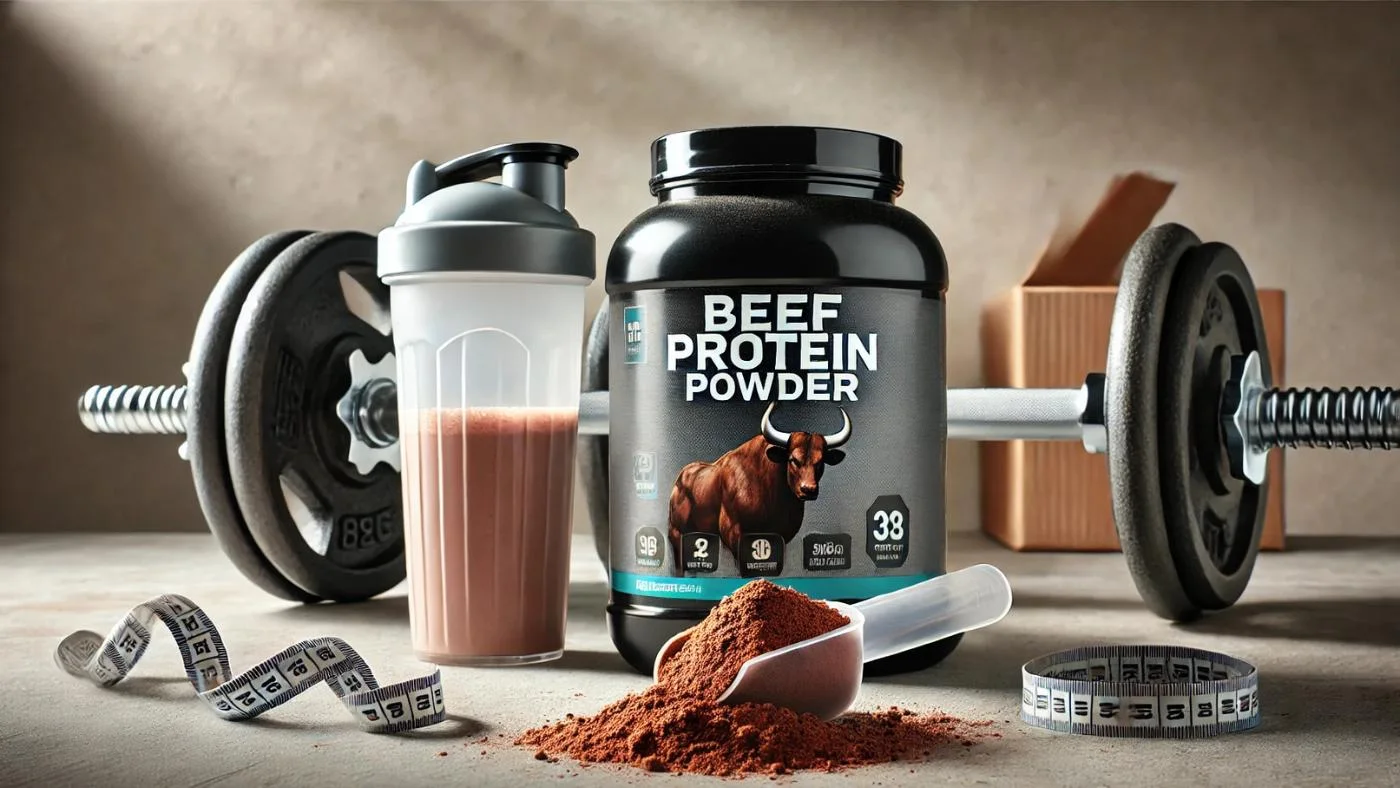
FM Coaching supplement desk · Evidence review · Updated 30 October 2026
The label is the story. Two tubs can both say “beef protein” on the front while offering very different amounts of the amino acids that support muscle building. One may be an adequately formulated beef-derived protein product; another may be dominated by collagen peptides. A convincing name does not settle the question.
So, is beef protein powder better than whey for bodybuilding? Current direct research has not demonstrated an advantage for beef over whey in lean-body-mass outcomes. Whey remains a convenient, extensively studied option. Beef-derived powders can be useful if the particular product meets your nutritional needs, especially when you avoid dairy. But you need to read the ingredient list and amino acid information before comparing them.
We looked at controlled trials, a seven-study meta-analysis and the practical details that marketing pages tend to skip. This is an independent educational comparison, not a product ranking or paid endorsement.
Skip to: The verdict · Label investigation · What studies found · Cost calculation · Which to choose · FAQs
The quick verdict: beef protein vs whey for building muscle
| Question | What matters | Practical answer |
|---|---|---|
| Which builds more muscle? | Resistance training plus sufficient total protein; product quality | Beef has not been shown superior in the available direct trials |
| Which is richer in leucine? | Exact product amino acid profile | Whey is generally leucine-rich; check the beef product's disclosed profile |
| Which if I can't have dairy? | Whether you have lactose intolerance versus milk-protein allergy | Verified dairy-free beef or other non-dairy protein may suit; whey is milk-derived |
| Which is cheaper? | Price per actual gram of protein, not tub size | Calculate from the nutrition panel; no universal winner |
| What if the tub says “hydrolysed”? | Hydrolysis describes processing, not guaranteed muscle-building quality | Check raw material, essential amino acids and testing |
| Can powder replace meals? | Overall food quality and micronutrients | Use it to fill gaps, not to replace a balanced eating pattern |
Key evidence: A systematic review pooled seven randomised trials involving 270 participants and found no statistically significant differences between beef and whey supplementation for lean body mass or fat mass. This is not proof that every beef powder is identical to whey; trial formulations and study quality vary. Read the systematic review.
The beef protein label investigation: six lines to read before you buy
Imagine you are in a supplement shop holding a tub labelled “100% premium beef protein”. Turn it around. The front is advertising; the back is where you can make a better decision.
Line 1 — What is the raw material?
Look for a clear explanation of the protein source. Is it beef-derived protein, hydrolysed bovine collagen, gelatin, bone broth protein, or a blend? These are not interchangeable descriptions. Some products marketed as beef protein are collagen-rich, but not all beef protein powders are simply collagen. Do not infer the formulation from the word “beef” alone.
Line 2 — How much protein is in the portion you will actually drink?
A 30 g scoop is not necessarily 30 g of protein. Check protein per serving and per 100 g. Compare after accounting for added flavourings, sweeteners or carbohydrate. For example, 24 g protein in a 30 g serving is 80% protein by weight.
Line 3 — Can you see the essential amino acids?
Leucine and the other essential amino acids are important substrates for muscle protein synthesis. Whey naturally supplies all nine essential amino acids and is notably leucine-rich. A collagen-heavy protein has a different profile, with more glycine, proline and hydroxyproline, and collagen on its own lacks tryptophan. If the manufacturer provides no meaningful amino-acid breakdown, you cannot assume the product matches whey gram for gram.
Reader's test: Ask the brand for a per-serving amino acid profile, including leucine, lysine and tryptophan, and confirmation of the protein raw material. A vague “complete amino blend” claim is not a measurement.
Line 4 — Are there added ingredients changing the comparison?
Some products add creatine, free amino acids or other ingredients. These may alter the nutritional profile without making the source itself superior. A beef label does not guarantee useful amounts of naturally occurring creatine in the finished powder. Check whether the label actually specifies it.
Line 5 — Is the powder suitable for your digestion and allergy needs?
Whey isolate often contains very little lactose, whereas whey concentrate typically contains more. But both are derived from milk and are not suitable for people with a milk-protein allergy. Beef-based protein is generally dairy-free if the full ingredient and allergen statements confirm it. Other non-dairy options include soy and appropriately formulated plant blends.
Line 6 — Can you verify independent testing?
Third-party checks are especially relevant for tested athletes. Informed Sport provides batch-level prohibited-substance testing, and NSF Certified for Sport maintains a searchable certification directory. A logo on a reseller page is not enough: check the exact product or batch. Certification reduces risk; it is not a guarantee of performance or zero risk.
What does the beef-versus-whey research actually show?
There are three different questions people often combine into one: does protein help when diet is inadequate, does beef perform differently from whey when you compare them directly, and does a particular tub contain enough essential amino acids to make the comparison meaningful?
Study file 01 · The pooled comparison
In 2019, researchers combined seven randomised controlled trials involving 270 people. Overall, beef supplementation did not differ significantly from whey for lean body mass or fat mass. Beef did show favourable changes versus no protein supplement on some outcomes. The sensible interpretation is that beef can be a useful protein source in studied settings, not that beef outperformed whey. Full open-access study.
Study file 02 · The eight-week resistance-training trial
A double-blind study assigned 30 resistance-trained adults to beef protein isolate, whey protein isolate or a carbohydrate control during eight weeks of training. Both protein groups improved lean mass from baseline, and the study found no clear strength advantage for beef over whey. The sample was small, and this trial doesn't validate every modern commercial formulation. Read the trial.
Study file 03 · Protein is not a magic signal on its own
Another controlled study in resistance-trained men compared carbohydrate with or without added beef or whey protein. Training outcomes improved across groups, with no consistent across-the-board superiority for one supplement. That is a useful reminder that training programme and everyday diet remain central. Read the clinical trial.
What these studies cannot tell you
- They do not establish that every product advertised as “beef protein isolate” has the same amino acid profile.
- They do not prove the two sources are biologically identical, nor are non-significant findings proof of perfect equivalence.
- They do not show that adding a powder to an already adequate diet will automatically produce extra muscle.
- They do not override individual allergies, tolerance, budget or preference.
Evidence hierarchy: A direct controlled comparison and a systematic review carry more weight for muscle outcomes than a seller's “absorbs faster” graphic. Nutritional label details still matter because a clinical trial's product may not match the tub in front of you.
Why leucine matters—without turning it into a miracle ingredient
Leucine helps signal muscle protein synthesis, but muscles also require the other essential amino acids and sufficient overall nutrition. The ISSN protein position stand suggests that many active adults can meet their needs with roughly 1.4–2.0 g/kg/day of total protein, adjusted for context. It also discusses typical meal-level high-quality protein servings around 20–40 g; these are not rigid rules for every person. ISSN position stand.
A brand can place a large leucine number on its label while hiding a weak overall amino-acid profile. For bodybuilding, don't buy a powder solely because it highlights one amino acid. Look at the full protein source, essential amino acids, serving size and the rest of your diet.
The cost-per-25 g-protein test (not cost per scoop)
A cheaper tub is not necessarily cheaper protein. Here is a transparent method anyone can use in the UK, USA, Canada or Australia—just keep the currency consistent.
Formula: (Tub price ÷ total grams of protein in tub) × 25 = price per 25 g protein.
| Hypothetical product | Tub details | Total protein | Cost per 25 g protein |
|---|---|---|---|
| Powder A (illustrative whey) | £36; 900 g tub; 24 g protein per 30 g scoop | 720 g | £1.25 |
| Powder B (illustrative beef) | £35; 500 g tub; 23 g protein per 30 g scoop | Approximately 383 g | £2.28 |
These are made-up label examples to show the calculation, not prices or claims about real products. The maths still cannot tell you whether Powder B has an equally useful essential-amino-acid profile. Evaluate quality as well as cost.
Three marketing claims worth challenging
- “Beef protein contains creatine, so it beats whey.” Whole beef contains creatine, but a processed powder's creatine content cannot be assumed. Look for an actual label amount or testing.
- “Hydrolysed means more muscle.” Hydrolysis breaks proteins into smaller fragments; it does not guarantee superior long-term hypertrophy.
- “Zero lactose means better absorption.” Lactose avoidance matters if you do not tolerate lactose. It does not automatically establish better muscle outcomes for everyone.
The five-minute buying decision
| You're choosing for… | What to prioritise | Practical direction |
|---|---|---|
| Best-researched convenient muscle-building powder | Complete essential-amino-acid profile, reliable supplier, value | Whey is a well-supported default if you tolerate dairy |
| Milk-protein allergy | Clearly dairy-free ingredients and allergen controls | A suitable beef or plant protein; seek allergy advice as needed |
| Lactose intolerance | Actual lactose content and your personal tolerance | Some whey isolates may work; non-dairy powders are alternatives |
| Vegan diet | Plant-based complete protein options | Neither whey nor beef qualifies; consider soy or a suitable blend |
| Tested sport | Verification of exact product certification and batch | Prioritise Informed Sport or NSF Certified for Sport listings |
| Budget-conscious bodybuilding | Overall diet, total protein, cost per actual protein gram | Ordinary food may make more sense than either supplement |
Try the three-label audit before buying
For any three powders you're considering, create three columns with (1) protein per 100 g, (2) listed essential amino acids per serving and (3) cost per 25 g protein. Add a fourth note for allergies and independent testing. If a brand will not give you an adequate amino-acid profile, you have useful information before spending money.
Do bodybuilders need beef or whey protein powder at all?
No. Protein powder is a convenience food. If a normal eating pattern meets your protein and energy needs, the powder may add little beyond convenience. You can build protein across meals using foods you enjoy and tolerate—eggs, fish, meat, dairy, soy foods, beans, lentils or combinations that fit your preferences.
Example: An 80 kg resistance trainer using 1.6 g/kg has an illustrative target around 128 g/day. Four meals containing around 30–35 g protein each could cover that without any shake. The actual choice of foods and targets will vary with the person.
Think about the missing piece. If you are regularly short of protein because of work shifts or travel, a convenient supplement may help. If your protein intake is already adequate but you are not progressing, look at programming, sleep, food availability and training consistency before buying another tub.
Beef protein powder vs whey: commonly asked questions
Is beef protein powder good for bodybuilding?
It can be, provided the product supplies useful protein and fits your overall diet. Direct trials have not established that beef outperforms whey for muscle growth.
Is beef protein better than whey for muscle growth?
There is no convincing direct evidence of a general muscle-growth advantage. Whey has more extensive research overall, while an appropriate dairy-free beef formulation may suit specific people.
Is beef protein powder just collagen?
Not always. Some formulas are collagen-rich or based on hydrolysed bovine tissues; others may differ. Check the ingredient source and amino acid panel rather than assuming either answer.
Does beef protein contain all essential amino acids?
It depends on the source and formulation. Collagen itself lacks tryptophan and is not a complete protein when used alone. Request a full amino acid profile if the label is unclear.
Is beef protein dairy-free?
Many beef-derived powders are formulated without dairy, but you must read the full ingredient and allergen statements for the actual product. Manufacturing cross-contact may also matter for allergies.
Can I use whey if I'm lactose intolerant?
Some people tolerate whey isolate, which is generally lower in lactose than concentrate. Milk-protein allergy is different: whey remains a milk protein even when lactose is reduced.
Does beef protein have creatine in it?
Do not assume a clinically meaningful quantity survives processing. Check the stated amount, testing or added creatine ingredient before treating it as a source.
Is beef protein better for digestion?
That is individual. Avoiding lactose may help someone who is lactose intolerant, while sweeteners and other ingredients can affect comfort regardless of protein source.
How much protein should I have after lifting?
Daily protein intake and an overall good diet matter more than chasing a magical 30-minute window. A protein-containing meal or snack around training is convenient, but needs vary.
Does more expensive protein make you gain muscle faster?
Not necessarily. A high price may reflect marketing, flavour, sourcing or smaller production runs; it is not proof of superior training outcomes.
Is beef protein better than collagen for muscle building?
Those are not necessarily two separate categories: some beef powders are collagen-derived. You need the exact protein formulation and essential amino acid profile to make a meaningful comparison.
What should a tested bodybuilder check?
Check the sport federation's current rules and seek an independently batch-tested product through recognised directories. No supplement certification can guarantee zero risk.
FM Coaching's final verdict
If whey suits you, it is a sensible, well-studied way to make a protein target easier. If dairy doesn't suit you, a clearly labelled beef-derived powder or appropriate plant protein may do the job. The wrong comparison is “which tub sounds most anabolic?” The right one is “which product provides the nutrients I need, at a reasonable cost, with ingredients I tolerate?”
Still unsure whether your nutrition actually supports your programme? Start with FM Coaching's online muscle-building coaching, browse the fitness guides library, or explore the seven-day coaching trial. The aim is not to sell you more powder; it is to help you make progress with a plan you can keep using.
Primary research: Beef-versus-whey systematic review (2019); eight-week resistance-training trial (2015); double-blind clinical trial (2017); ISSN protein recommendations. General educational information only, not medical advice.
Sources and verification
- Does beef protein supplementation improve body composition? Systematic review and meta-analysis
- Effects of beef and whey protein isolate on lean mass and strength – controlled trial
- Carbohydrates alone or mixed with beef or whey protein – RCT
- ISSN protein and exercise position stand
- Informed Sport – official supplement testing directory
- NSF Certified for Sport – certified products directory