FM Coaching · Fitness Guides
Body Recomposition After Weight Loss: A Practical 12-Week Plan
A recovery-aware 12-week body recomposition guide after weight loss, with three complete strength workouts, a two-day fallback, nutrition principles and progress reviews.
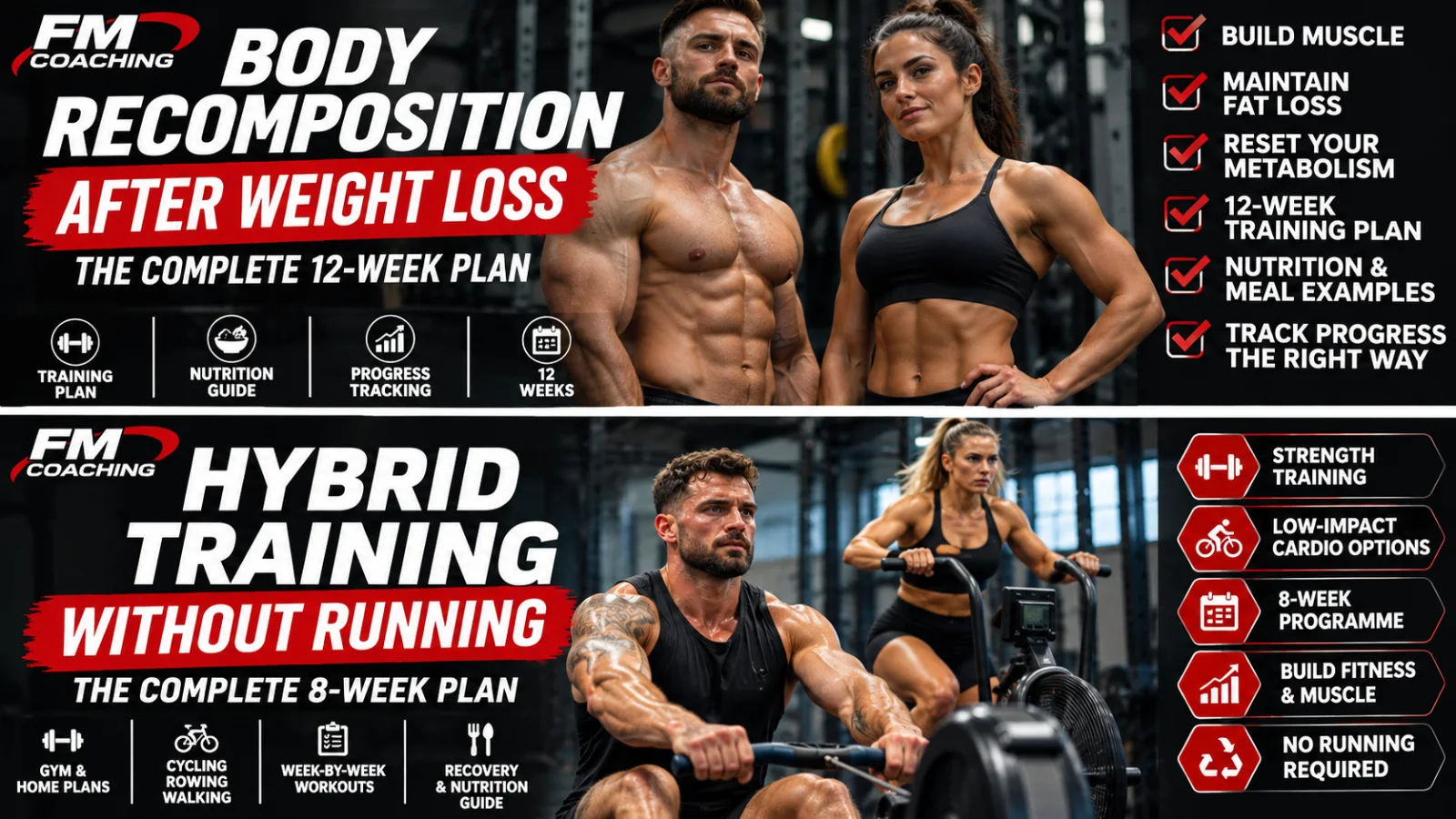
FM COACHING FIELD GUIDE · TRAINING AFTER WEIGHT LOSS · Evidence reviewed 3 November 2026
Already lost weight and now want to look and feel stronger? The next step is not automatically another calorie cut. A practical body recomposition after weight loss plan combines enough food to train and recover, progressive resistance exercise, steady habits and more than one measure of progress. The aim is to build or retain muscle while managing body fat and keeping the changes you have worked for.
Start here: If your weight loss has been rapid, your energy is low or you have been following a very restrictive diet, focus first on medical or dietetic support and a sustainable maintenance pattern. If you are well and cleared for exercise, choose the two- or three-day strength plan below, establish your food routine, and reassess after a fortnight rather than repeatedly cutting calories.
This 12-week framework is an adaptable educational example, not a guaranteed transformation or prescribed calorie target. It is most relevant to adults who have completed a weight-loss phase and want to become stronger. For help deciding whether a recomp phase is sensible, compare FM Coaching's separate recomp vs mini-cut vs lean-bulk guide. That article tackles phase selection; this one covers the practical transition after weight loss.
The first decision: maintain your weight or keep dieting?
The answer depends on your health, training status and goal—not a stranger's photograph. If you have reached a sustainable weight or have spent months dieting, a maintenance-focused period may help you establish energy, normal meals and reliable workouts. If further fat loss is clinically appropriate, it should be planned with support rather than treated as a default. Muscle gain is not guaranteed during energy restriction, particularly for already trained or lean people.
Use this practical decision guide:
- You have reached your goal but feel physically depleted: pause aggressive dieting, prioritise adequate nutrition and recovery, and consult a qualified clinician or dietitian when needed.
- You are new to weight training and otherwise well: start a simple progressive resistance programme; you do not need advanced workouts or daily HIIT.
- You already lift but strength has fallen during weight loss: rebuild consistency and training performance before deciding whether changing energy intake makes sense.
- You are still medically advised to lose weight: combine your care plan with suitable strength training and discuss targets with your treating clinician; this article is not medical weight-management advice.
- You want much more muscle and are already relatively lean: a deliberate muscle-building phase might eventually be more effective than remaining in a deficit. See FM Coaching's online muscle-building service.
What does body recomp actually mean after weight loss?
Body recomposition means the ratio of fat mass to lean tissue changes favourably, sometimes with simultaneous fat reduction and muscle gain. Lean mass is not identical to muscle tissue: it also includes water and other non-fat tissue. Changes on body-composition scales are noisy. A stronger squat is encouraging, but can reflect skill, too. Judge a pattern, not a single measurement.
The 2026 ACSM resistance-training position stand concludes that consistency and individually appropriate progressive training matter more than complicated methods. A 2025 systematic review of resistance exercise during weight loss found better preservation of fat-free mass than diet alone in people living with overweight or obesity. Those findings do not establish that this exact 12-week programme causes a specific amount of muscle gain.
The 12-week body recomposition plan after weight loss
Keep the same broad exercise patterns for long enough to measure change. The weeks below are a coaching framework, not an experiment proving one phase is ideal. Choose either the full three-day gym plan or the two-day fallback; additional activity is optional if your recovery allows.
Weeks 1–2: transition, baseline and skill
- Write down your recent training, meals, sleep and energy. If tracking weight is appropriate for you, use several consistent readings to see a trend, not a daily verdict.
- Pick manageable weights, learn movement patterns and leave approximately three controlled repetitions in reserve on most working sets.
- Choose two or three reliable training days and start with two working sets per exercise. If soreness interferes with daily life, use less volume.
- Eat regular, varied meals rather than trying to compensate for every session. Include protein, carbohydrate, fats, fruit/vegetables and enough overall energy.
- Record a practical baseline: weights and reps for a squat pattern, a push and a pull; optionally waist/hip measurement and clothing fit if those measures feel useful.
Weeks 3–4: create repeatable progress
- Repeat your core workouts, adding a repetition when your technique remains controlled.
- When you reach the top of a rep range comfortably for all working sets, increase resistance by the smallest practical step at a later session.
- Add an optional third set to a few exercises only if you are recovering; more is not automatically better.
- Keep a comfortable amount of cardio for health, such as walking or cycling. Do not use extra cardio to 'earn' food.
- Check that training consistency, hunger, sleep and fatigue are sustainable before changing your plan.
Weeks 5–6: progressive overload with breathing room
- Progress the squat or leg press, Romanian deadlift or hinge, row and press at a pace that allows consistent technique.
- If strength stalls, check sleep, sufficient food, rest intervals and whether you increased workload too quickly before you add yet more sessions.
- For accessories, a controlled 8–15-rep range is often practical; for heavier compound exercises, around 6–12 reps is a workable starting example.
- Keep easy activity easy enough that you can recover for lifting. Weekly activity targets are health guidance, not quotas that require exercise when you are unwell.
Weeks 7–8: recover and assess
- Use a lighter week if accumulated fatigue, persistent soreness or declining performance suggests you need it: reduce working sets and/or loads while keeping movement quality.
- Compare training logs with week 1, not with someone else's results online.
- If you enjoy measurements, review consistent trends over a fortnight or longer; hydration, glycogen, digestion and menstrual-cycle fluctuations can affect short-term weight and waist readings.
- A plateau in weight is not automatically a failed recomp. Equally, a faster lift alone does not prove muscle gain.
Weeks 9–10: build confidence and add specificity
- Resume stable progression and choose one weak movement to practise: perhaps improving squat depth, upper-back control or glute strength.
- Use the workout variations you can repeat safely, not the exercise that looks most dramatic on social media.
- If you are consistently progressing, do not overhaul calories or exercises because of one slow week.
- Keep one day without demanding training and avoid stacking your hardest cardio immediately before heavy lower-body work when possible.
Weeks 11–12: review and decide the next phase
- Repeat comparable sets with controlled technique and record improvements in reps, resistance and workout consistency.
- Ask: Do I have better strength and fitness? Is eating sustainable? Has health, energy and recovery improved? Which goal matters for the next 12 weeks?
- Continue a near-maintenance, progressive approach if it fits. If your main goal now differs, review alternatives in recomp versus lean bulk versus mini-cut.
- If you have persistent exhaustion, dizziness, disrupted menstrual function, pain or compulsive thoughts around food or exercise, seek suitable professional assessment rather than intensifying the plan.
The three-day strength programme: full gym sessions
Train on any three non-consecutive or recovery-friendly days, for example Monday, Wednesday and Friday. Warm up for five to ten minutes with comfortable movement and lighter practice sets. Rest roughly 60–180 seconds between demanding sets as needed for good technique. These loads are not maximum attempts; choose weights that feel challenging but controlled.
Workout A — squat, horizontal push, row
- Goblet squat or leg press — 2–3 sets × 8–12 reps.
- Dumbbell or machine chest press — 2–3 × 8–12.
- Chest-supported row or seated cable row — 2–3 × 8–12.
- Romanian deadlift with dumbbells — 2 × 8–10.
- Dead bug or Pallof press — 2 × 8–12 per side.
Coaching note: Control the lowering phase rather than rushing to increase the load. If a movement causes pain, stop and use a suitable alternative after advice where appropriate.
Workout B — hinge, vertical pull and single-leg work
- Kettlebell deadlift or suitably supervised trap-bar deadlift — 2–3 × 6–10.
- Lat pulldown or assisted pull-up — 2–3 × 8–12.
- Supported split squat or step-up — 2 × 8–10 per side.
- Seated dumbbell shoulder press — 2 × 8–12.
- Side plank — 2 × 20–30 seconds each side, adapted as needed.
Coaching note: Split squats can expose balance or mobility challenges. Hold onto a secure support, shorten the range and build gradually.
Workout C — glutes, push-pull and accessories
- Hip thrust or glute bridge — 2–3 × 8–12.
- Incline push-up or dumbbell incline press — 2 × 8–12.
- Cable row or band row — 2 × 10–15.
- Leg curl or supported hamstring bridge — 2 × 10–15.
- Calf raise or lateral raise — 2 × 10–15, optional.
How to progress: Each movement has a rep range. When you complete the high end with stable technique across all working sets on two suitable sessions, add a small amount of resistance and return toward the lower end. You can also simply keep the weight and improve form. This is double progression, not a requirement to add weight every week.
Only two gym days? The short version still works
- Day 1: Squat/leg press, chest press, row, hip hinge and trunk exercise — two sets each.
- Day 2: Deadlift pattern, pulldown, step-up, shoulder press and glute bridge — two sets each.
- Aim for controlled training you can repeat. Don't cram all three workouts into two exhausting sessions.
- If you work irregular shifts, use the 12-hour shift workout plan for a recovery-first approach to the calendar.
Home workout substitutions
Use a chair squat or dumbbell goblet squat instead of leg press; a stable countertop incline push-up instead of chest press; a securely anchored band row instead of a cable row; a backpack or dumbbell hip hinge instead of a barbell; and a floor glute bridge instead of a hip thrust machine. The key is repeatable resistance and progressive difficulty, not a particular brand of equipment. Secure all equipment and do not use unstable furniture for exercises.
Nutrition after weight loss: enough food to make training productive
Do not automatically keep using the calories that produced weight loss. Maintenance energy needs depend on your body, movement, health and recent changes. An online estimate is just a starting point; a qualified dietitian can help after substantial or medically managed weight loss. If you are in a medically supervised programme or use weight-management medication, discuss food and training changes with your clinician rather than changing treatment yourself.
Protein: a practical range, not a magic number
For many healthy exercising adults, the ISSN protein position stand identifies approximately 1.4–2.0 g per kilogram of body weight per day as an evidence-based range. Needs vary by age, training, medical history and total energy intake. Someone weighing 70 kg could discuss roughly 98–140 g/day as a range, not a required target. You can meet needs with ordinary food; supplements are optional.
If you have kidney disease, other medical conditions or a history of disordered eating, do not use generic protein or calorie calculations as medical instructions. Consult an appropriate clinician or registered dietitian.
The meal-building method
Rather than copying an influencer's menu, build most meals from a protein source, satisfying carbohydrates, colourful plants and dietary fats. For example:
- Breakfast: oats with yoghurt or fortified soya yoghurt, fruit and nuts; add eggs or another protein source if preferred.
- Lunch: chicken, tofu, beans or fish with rice, potatoes or bread plus vegetables.
- Dinner: a lean mince or lentil dish with pasta or potatoes and vegetables, plus a sauce you enjoy.
- Portable option: a sandwich or wrap with protein and salad, and a piece of fruit or yoghurt.
These are food combinations, not calorie prescriptions. Actual portion needs differ. Include enough carbohydrate to fuel sessions and enough dietary fat for normal nutrition. Regular eating is often more valuable than chasing perfection.
Should you eat at maintenance, a deficit or a surplus?
After substantial weight loss, maintaining a stable routine and protecting recovery is often a sensible starting discussion. A small deficit is not universally necessary for recomp; a surplus may eventually be useful if muscle gain becomes the clear priority. If your eating has been very restrictive, avoid changing calories without suitable support. Health, performance and long-term consistency come ahead of an arbitrary scale target.
For a personalised direction, FM Coaching's body-recomposition coaching and fat-loss coaching describe different support options. Coaching does not replace medical nutrition care.
Tracking progress without getting trapped by the scales
Create a small fortnightly scorecard instead of daily judgement:
- Training: did you complete sessions, increase quality reps or improve technique on two or three repeatable lifts?
- Everyday function: are stairs, shopping, carrying bags or walking more comfortable?
- Recovery: how is sleep, hunger, energy and soreness between workouts?
- Optional body measures: if comfortable, compare waist measurements, clothing fit or photos taken under similar conditions no more often than needed.
- Food stability: can you eat a varied diet without compensating for workouts or repeatedly cutting portions?
A sensible decision rule: Keep the same plan when strength is improving, recovery is good and the routine is manageable. Review technique and consistency if performance is flat. Seek appropriate help if food restriction, persistent fatigue or body-image distress is escalating. There is no validated 12-week 'recomp score' in this article.
Three examples of how this works in real life
Example 1 — beginner after weight loss: Someone who has mostly walked and dieted begins two full-body sessions per week, adds a third later if recovery permits, and works toward more varied regular meals. Their first success might be stronger lifts and a sustainable routine—not another kilogram lost.
Example 2 — experienced lifter returning from a cut: Someone who already trains four days a week keeps familiar exercises but reduces unnecessary extra cardio and reviews their energy and recovery. Their best next step may be maintenance and improved performance rather than faster weight loss.
Example 3 — busy parent or shift worker: Someone with fluctuating hours uses the two-day fallback, repeats the same movement patterns, and keeps workouts short enough to fit around sleep. Consistency beats imaginary perfect weeks.
These are illustrative scenarios, not client testimonials, reported results or medical case studies.
Mistakes that undermine post-weight-loss muscle building
- Treating 'recomp' as another crash diet. Muscle-building training needs adequate recovery and nutrition.
- Changing workouts every week. You cannot assess progression when movements and loads always change.
- Confusing water-weight changes with fat regain. Carbohydrates, sodium and menstrual-cycle changes influence short-term measurements.
- Overdoing HIIT and underdoing strength work. A balance of resistance work and recoverable aerobic activity is more sustainable for many people.
- Buying supplements before fixing fundamentals. Ordinary food, progressive exercise, sleep and adherence matter most.
- Comparing your timeline with edited transformations. Real outcomes vary and photographs are not proof of physiological change.
Body recomposition after weight loss — frequently asked questions
Can I build muscle after losing a lot of weight?
Yes, many people can improve strength and muscle development with progressive training and sufficient nutrition. How much muscle you build depends on age, training history, health and recovery; no fixed outcome is guaranteed.
Do I need to lose more fat before building muscle?
Not necessarily. The right direction depends on your health and goal. A sustainable maintenance phase is often a useful option after prolonged dieting. Consult clinical support where relevant.
What is the best 12-week recomp workout plan?
There is no universal best plan. For a healthy adult new to lifting, two or three repeatable full-body strength sessions with manageable progression are a reasonable starting example.
How many calories should I eat to recomp after weight loss?
A single number cannot be set safely from a web article. Your requirements vary, especially after major weight change. Start with appropriate professional advice when needed and review sustainable intake and performance.
How much protein do I need?
For many healthy exercising adults, about 1.4–2.0 g/kg/day is an evidence-supported range, not a universal requirement. Individual health situations can change what is appropriate.
Can I recomp at maintenance calories?
Sometimes, especially if you are new to resistance training or returning after a break. Body composition can still change when total scale weight is stable, but it is not guaranteed.
Does weight gain after starting weights mean I am regaining fat?
No single reading proves that. Training, glycogen, water, digestion and normal body fluctuations can change weight temporarily. Look at longer-term trends and wellbeing.
Is cardio bad for muscle growth?
No. Suitable cardio supports health and fitness. Excessive total training stress or inadequate nutrition and recovery can make progress harder, so plan your total workload.
Can I follow this plan at home?
Yes. Bodyweight, bands and dumbbells can provide progressively challenging resistance. Choose safe, stable setups and technique-friendly exercises.
What if I have lost weight using medication?
Work with your prescribing clinician on nutrition, activity and monitoring. Do not change medication or assume your energy needs from a generic fitness guide.
How quickly will I notice results?
Individual progress varies. Tracking technique, consistency and performance over 8–12 weeks offers more useful information than expecting a specific visual transformation deadline.
What should I do after week 12?
Keep the effective habits, review your goal and decide whether to continue recomp, focus on strength or pursue another appropriate phase. This is a review point, not the end of healthy training.
Sources, editorial standards and next steps
This guide is informed by the ACSM 2026 position stand, the ISSN protein position stand, the 2025 resistance exercise and weight-loss meta-analysis and NICE guidance on nutritional approaches to weight management. The 12-week workouts are original illustrative coaching templates built around established principles—not programmes tested in these studies.
If you want an individual programme based on your schedule and training history, explore FM Coaching's online muscle-building coaching or body-recomposition coaching. FM Coaching is independent of the research organisations. Education only; consult a qualified healthcare professional for medical, nutritional or injury concerns.
Questions and answers
Can I build muscle after losing a lot of weight?
Many people can gain strength and muscle with progressive resistance exercise and adequate nutrition. Results depend on training history, health and recovery.
Do I need to lose more fat before building muscle?
Not necessarily. Maintenance and strength-focused training may be appropriate after weight loss; individual health goals matter.
What is the best 12-week body recomposition workout plan?
There is no universally best plan. A repeatable two- or three-day full-body programme with gradual progression is a practical starting point.
How many calories should I eat after weight loss?
A web article cannot set your individual calorie requirement. Consider your health, activity and recent weight changes, with professional guidance where needed.
How much protein should I eat for muscle building?
For many healthy exercising adults the ISSN describes roughly 1.4–2.0 grams per kilogram daily; this is not a medical prescription.
Can I recomp at maintenance calories?
Sometimes, particularly among beginners and people returning to strength work. Simultaneous changes are possible but are not guaranteed.
Why is my weight rising after starting weights?
Water, glycogen, digestion and other factors can change scale weight. One weigh-in does not establish fat gain.
Is cardio bad for post-weight-loss muscle growth?
No. Cardio supports health and fitness; total workload, food and recovery determine how manageable the programme is.
Can I follow a post-weight-loss muscle plan at home?
Yes. Bands, bodyweight movements and dumbbells can provide challenging, progressive resistance.
What if I lost weight using medication?
Follow your prescribing clinician’s advice about medication, nutrition and exercise; do not change treatment based on this guide.
How quickly should I see recomposition results?
Timelines differ. Review strength, adherence, recovery and optional body measurements over weeks rather than expecting a fixed visual deadline.
What should I do after the 12 weeks?
Review the goal and continue a sustainable programme or choose a different training phase with appropriate individual support.