FM Coaching · Fitness Guides
Bodybuilding Meal Prep UK: 7-Day Plan, Macros and Shopping List
A complete bodybuilding meal-prep system for UK lifters: a real seven-day schedule, measured recipes, nutrition estimates, shopping list and safe batch-cooking plan.
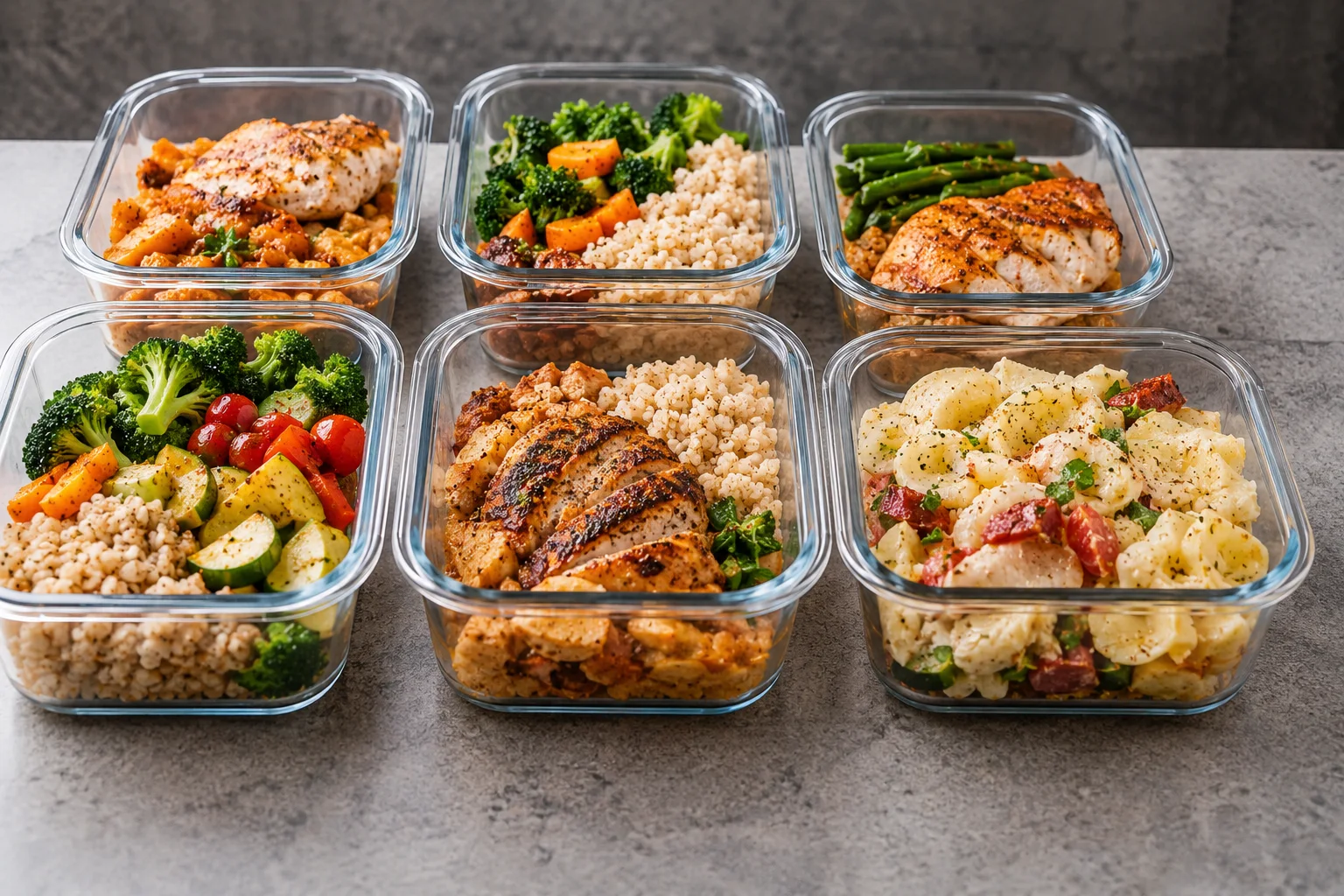
Want to build muscle without spending every evening cooking? This bodybuilding meal-prep guide gives you seven days of realistic UK meals, eight reusable meal templates, raw ingredient weights, an exact consolidated shopping list and a food-safe two-session cooking schedule. You can adapt the same system for a lean bulk, maintenance or a controlled cutting phase.
The quick answer: Choose a protein target, set calories to match your phase, prepare a small rotation of meals you actually enjoy and adjust portions using consistent measurements. You do not need seven different dinners, expensive supplements or a new shopping trip every day. The example plan below averages approximately 2,380 kcal and 174 g protein per day across the week. It is a worked example, not a personalised prescription or a competition peak-week plan.
How to use this guide: The seven-day example fits an illustrative 85 kg adult strength trainee from a protein perspective (about 2.0 g/kg/day). Your calorie needs may be higher or lower. Food values are approximate; verify your specific packaging, dietary needs and any medical restrictions before following it. People with kidney disease, diabetes requiring dietary management, pregnancy, food allergies, or a history of disordered eating should seek personalised professional advice.
At a glance: what this seven-day system includes
| Feature | What you get |
|---|---|
| Seven-day meal schedule | One breakfast, two main meals and one larger snack each day |
| Preparation | Four cooked main meals rotated across the week; two breakfast options; two snacks |
| Example daily range | Approximately 2,300–2,500 kcal, 172–176 g protein, depending on the day |
| Shop once | Specific weights for one person's entire seven-day menu |
| Food safety | Fridge/freezer timing, safe reheating and extra precautions for cooked rice |
| Adjustability | Clear additions or reductions for bulking, maintenance, cutting or vegetarian needs |
A note on ingredient and macro accuracy
All meats are weighed raw; rice, pasta, couscous and oats are weighed dry; canned beans are weighed drained; fruit and vegetables are edible weights; oils are weighed. Eggs are approximately 55 g edible portion each. Calories and macros are estimates calculated from representative generic UK nutrient values and rounded; supermarket brands, fat content and cooking losses change the figures. We deliberately do not claim exact nutritional lab analysis. For a medically prescribed diet, use a registered dietitian and verified product labels. The UK's Composition of Foods Integrated Dataset (CoFID) is a useful reference for typical food composition.
Step 1: Set calories for your bodybuilding phase
The goal is different in a growth phase, a maintenance/recomposition phase and a cut. You cannot make one meal plan appropriate for everyone by giving it the label 'bodybuilding'.
| Phase | Starting approach | What to monitor |
|---|---|---|
| Muscle gain / lean bulk | Begin with a modest surplus above measured maintenance; trained lifters often benefit from a conservative approach | Average weekly body-weight trend, gym performance, waist measurement and appetite |
| Maintenance / recomp | Start near maintenance, combine resistance training and sufficient protein, and review over several weeks | Strength, waist trend, photos under consistent conditions and recovery |
| Fat-loss phase | Use an individually tolerable deficit while retaining resistance training and enough protein | Trend in weight, training quality, hunger, recovery and mood |
| Contest preparation | Use a coach and qualified nutrition/medical support where appropriate; requirements are specialised | Energy availability, menstrual health where relevant, sleep, physical and psychological wellbeing |
A peer-reviewed review of natural bodybuilding nutrition suggests an off-season surplus around 10–20% for novice/intermediate bodybuilders, generally more conservative for advanced lifters. It is a starting framework, not an instruction to force rapid weight gain: the review discusses roughly 0.25–0.5% body-weight gain per week for less advanced competitors and slower progress for advanced athletes. Read the review.
Practical example: Suppose an adult has observed a stable weight and an average daily intake around 2,400 kcal over several weeks. A tentative 5–10% increase would be approximately 2,520–2,640 kcal/day; judge results from the trend, not a single morning weight. This does not mean 2,400 kcal is your maintenance. Do not calculate an extreme deficit from an arbitrary online number.
Step 2: Choose a protein target without obsessing over timing
For most healthy exercising adults, the International Society of Sports Nutrition identifies approximately 1.4–2.0 g protein per kg of body weight daily as sufficient for building and maintaining muscle in combination with training. An off-season bodybuilding review discusses 1.6–2.2 g/kg for bodybuilders. Requirements can vary with training, total calories, experience and individual health.
| Illustrative body weight | Example protein range at 1.6–2.2 g/kg/day |
|---|---|
| 60 kg | 96–132 g |
| 70 kg | 112–154 g |
| 80 kg | 128–176 g |
| 85 kg | 136–187 g |
| 100 kg | 160–220 g |
Getting the total over the day matters more than having a shake immediately after a workout. Dividing protein across 3–5 ordinary meals can be convenient. Include fruit, vegetables, sources of fibre, some dietary fat, and enough carbohydrates to support lifting performance. A bodybuilding meal plan should still resemble a varied diet: follow the NHS Eatwell Guide over the week.
Step 3: The four main meal-prep recipes
These recipes are designed to share staples and reheat well. Each ingredient list is per serving. For the seven-day schedule, cook the number of servings stated in the shopping list. Where cooked rice is involved, chill promptly, refrigerate no longer than 24 hours before reheating, and freeze any portions needed later in the week. See the detailed storage section below.
Meal 1: Turkey, kidney-bean chilli and basmati rice
Per serving: approximately 740 kcal | 52 g protein | 89 g carbohydrate | 15 g fat. Batch total: four portions.
Ingredients: 170 g raw 5%-fat turkey mince; 100 g drained kidney beans; 70 g dry basmati rice; 150 g canned chopped tomatoes; 200 g onion/pepper/carrot or frozen mixed vegetables; 5 g olive or rapeseed oil; chilli, cumin, paprika, garlic and black pepper to taste.
Method: 1) Cook the rice according to the packet. 2) Heat the oil; thoroughly cook the turkey mince, breaking it up as it browns. 3) Add vegetables, chopped tomatoes and drained beans and simmer until vegetables are tender and the meat is cooked throughout. 4) Divide into equal containers; record rice and chilli weights consistently. 5) Chill or freeze promptly following the storage rules below.
Useful swaps: Replace turkey with extra-firm tofu plus extra beans and recalculate protein; replace some rice with extra vegetables for a lower-energy portion; or add 30 g dry rice per portion before cooking for around 110 additional kcal. Check beans and spice mixes for allergens and salt.
Meal 2: Paprika chicken, roast potatoes and broccoli
Per serving: approximately 670 kcal | 57 g protein | 75 g carbohydrate | 16 g fat. Batch total: four portions.
Ingredients: 160 g raw chicken breast; 350 g raw potatoes; 200 g broccoli; 12 g olive/rapeseed oil; 80 g plain 0%-fat yoghurt for a garlic-lemon dip; smoked paprika, dried herbs and lemon to taste.
Method: 1) Heat the oven and follow a safe cooking temperature/time suitable for the chicken; do not rely solely on colour. 2) Cut potatoes into similar-sized pieces, toss with the oil and seasonings and roast until tender. 3) Cook chicken thoroughly, keeping raw-chicken utensils and surfaces separate from ready-to-eat foods. 4) Steam or roast broccoli. 5) Portion and refrigerate/freezer-store; keep yoghurt dip cold until serving.
Useful swaps: Frozen broccoli works; potatoes can become cooked couscous prepared freshly. For a dairy-free option use a suitable dairy-free sauce, noting that its protein and energy may differ.
Meal 3: Tofu, chickpea and spinach tomato curry with couscous
Per serving: approximately 748 kcal | 51 g protein | 76 g carbohydrate | 25 g fat. Batch total: three portions.
Ingredients: 200 g firm tofu; 100 g drained chickpeas; 60 g dry couscous; 150 g chopped tomatoes/passata; 150 g spinach; 5 g olive/rapeseed oil; curry powder, garlic and ginger to taste. Choose a high-protein firm tofu; macros vary substantially by brand.
Method: 1) Pat tofu dry, cube, and cook in a non-stick pan with the oil. 2) Add tomatoes, chickpeas and spices and simmer. 3) Stir in spinach until wilted. 4) Prepare couscous using the packet instructions; portion separately to preserve texture. 5) Cool and store safely.
Useful swaps: Replace couscous with quinoa or rice using equivalent calorie portions, not gram-for-gram replacements. Use lentils instead of chickpeas, recalculating macros. Check for soya and wheat allergies; some curry mixes contain additional allergens.
Meal 4: Lean beef and vegetable wholewheat pasta
Per serving: approximately 726 kcal | 51 g protein | 76 g carbohydrate | 22 g fat. Batch total: three portions.
Ingredients: 150 g raw 5%-fat beef mince; 80 g dry wholewheat pasta; 200 g passata or chopped tomatoes; 150 g chopped onions/carrots/mushrooms; 15 g grated Parmesan; 8 g olive/rapeseed oil; oregano, basil and garlic to taste.
Method: 1) Cook pasta to the packet's instructions. 2) Cook mince thoroughly, then soften the vegetables and combine with passata and herbs. 3) Simmer, portion with pasta and sprinkle Parmesan after reheating if preferred. 4) Refrigerate or freeze as directed below.
Useful swaps: Use 5%-fat turkey mince, lentils or soya mince as alternatives, then recalculate nutrients. For a vegetarian version, choose vegetarian hard cheese; traditional Parmesan is not vegetarian. If you regularly eat red meat, consider substituting some servings with poultry, fish or plant proteins in line with a varied diet.
Step 4: Breakfasts and snacks that actually fit the plan
| Code | Meal and raw/packaged amounts per serving | Approximate energy and protein |
|---|---|---|
| B1 | Overnight oats: 50 g oats, 200 g plain Skyr, 150 ml semi-skimmed milk, 100 g berries, 15 g peanut butter | 519 kcal · 38 g protein |
| B2 | Egg wrap: 2 eggs (about 110 g edible), 1 wholemeal wrap (60 g), 150 g cottage cheese, 100 g peppers/spinach, 5 g oil | 548 kcal · 38 g protein |
| S1 | Skyr snack: 200 g Skyr, 1 medium banana (about 120 g edible), 25 g unsalted mixed nuts | 383 kcal · 28 g protein |
| S2 | Cottage-cheese snack: 200 g cottage cheese, 1 apple (about 150 g), 2 slices wholemeal toast (about 80 g) | 450 kcal · 32 g protein |
Preparation: Refrigerate oats covered, preferably make B1 the night before; keep dairy within its use-by date. Cook egg wraps fresh if possible. Bring chilled snacks to work in an insulated bag with ice packs if needed. Peanut, tree nut, dairy, egg, wheat, soya and gluten allergies require proper swaps, not a simple ingredient deletion.
Your complete seven-day bodybuilding meal plan
The plan below uses four main dishes, two breakfasts and two snacks. Its purpose is to show how to buy, cook and portion consistently — not to imply that everyone needs to eat 170 g protein daily.
| Day | Breakfast | Lunch | Dinner | Snack | Approx. daily energy / protein |
|---|---|---|---|---|---|
| Monday | B1 oats | M1 turkey chilli | M2 chicken tray bake | S1 Skyr & banana | 2,312 kcal / 176 g |
| Tuesday | B2 egg wrap | M3 tofu curry | M1 turkey chilli | S2 cottage cheese | 2,486 kcal / 173 g |
| Wednesday | B1 oats | M2 chicken tray bake | M4 beef pasta | S1 Skyr & banana | 2,297 kcal / 175 g |
| Thursday | B2 egg wrap | M1 turkey chilli | M3 tofu curry | S2 cottage cheese | 2,486 kcal / 173 g |
| Friday | B1 oats | M4 beef pasta | M2 chicken tray bake | S1 Skyr & banana | 2,297 kcal / 175 g |
| Saturday | B2 egg wrap | M3 tofu curry | M4 beef pasta | S2 cottage cheese | 2,472 kcal / 172 g |
| Sunday | B1 oats | M2 chicken tray bake | M1 turkey chilli | S1 Skyr & banana | 2,312 kcal / 176 g |
Weekly average: approximately 2,380 kcal/day and 174 g protein/day, rounded. The plan includes varied food groups but is still an example, not a complete micronutrient analysis. Rotate fruit, vegetables and sources of healthy fat; adjust for your health, preferences and training demands. The protein level fits around 2 g/kg for an 85 kg adult, not for every body weight.
Your exact seven-day UK shopping list (one adult)
These quantities reconcile with the 14 prepared main meals, seven breakfasts and seven snacks above. Buy supermarket pack sizes that cover the amounts; sizes differ between Aldi, Lidl, Tesco, Sainsbury's, Asda and other shops. No unverified current supermarket prices are assumed.
| Food group | Seven-day amount to buy or use | What it's for |
|---|---|---|
| Raw 5%-fat turkey mince | 680 g | 4 × M1 |
| Raw chicken breast | 640 g | 4 × M2 |
| Firm tofu | 600 g | 3 × M3 |
| Raw 5%-fat beef mince | 450 g | 3 × M4 |
| Eggs | 6 medium/large (roughly 330 g edible) | 3 × B2 |
| Skyr or high-protein plain yoghurt | 1,600 g | B1 and S1 |
| Cottage cheese | 1,050 g | B2 and S2 |
| Plain 0%-fat yoghurt | 320 g | Chicken dip |
| Semi-skimmed milk | 600 ml | B1 |
| Dry oats | 200 g | 4 × B1 |
| Dry basmati rice | 280 g | 4 × M1 |
| Dry couscous | 180 g | 3 × M3 |
| Dry wholewheat pasta | 240 g | 3 × M4 |
| Potatoes | 1,400 g | 4 × M2 |
| Wholemeal wraps | 3 × 60 g | 3 × B2 |
| Wholemeal bread | 240 g, about 6 slices | 3 × S2 |
| Kidney beans, drained | 400 g | 4 × M1 |
| Chickpeas, drained | 300 g | 3 × M3 |
| Chopped tomatoes/passata | 1,650 g | M1, M3 and M4 |
| Mixed vegetables for chilli | 800 g | M1 |
| Broccoli | 800 g | M2 |
| Spinach | 450 g | M3 |
| Onions, carrots, mushrooms for bolognese | 450 g | M4 |
| Peppers/spinach for breakfast wraps | 300 g | B2 |
| Frozen berries | 400 g | B1 |
| Bananas | 4 medium, approx. 480 g edible | S1 |
| Apples | 3, approx. 450 g edible | S2 |
| Mixed unsalted nuts | 100 g | S1 |
| Peanut butter | 60 g | B1 |
| Parmesan or vegetarian alternative | 45 g | M4 |
| Olive/rapeseed oil | 122 g total, roughly 135 ml | Cooking; measure instead of free-pouring |
| Pantry extras | Garlic, ginger, paprika, chilli, cumin, curry powder, pepper, herbs, lemon | Flavour; exact amounts to taste |
If you already have oil, spices or frozen vegetables, subtract what is on hand before shopping. Produce trimming and pack sizes create small practical differences; buy a little extra if needed. The list does not include optional additions for a higher-calorie bulk.
The two-session preparation schedule
Sunday: 60–90 minutes of active batch preparation, depending on your kitchen
- Check your food's use-by dates, allergies, available fridge/freezer space and clean containers.
- Prepare and cook the first batch of chilli and chicken. Keep raw-meat boards and knives separate from ready-to-eat ingredients.
- Portion the cooked dishes into shallow containers for quicker cooling. Label with dish, date cooked and portion. Put in the fridge or freezer promptly.
- Freeze later-week portions immediately rather than expecting all Sunday meals to remain safely refrigerated through Friday or Sunday.
- If making rice ahead, cool rapidly and refrigerate for no more than 24 hours before reheating, or freeze promptly for later use. You can also cook fresh rice on the day. Follow the packet's advice.
- Prepare breakfasts only for the next one or two days to protect texture and freshness.
Wednesday: refresh the batch
- Cook the second batch of tofu curry and bolognese, plus any remaining chicken/chilli if preferred.
- Use frozen portions from Sunday for later scheduled days; move one portion to the fridge to thaw safely as needed and reheat thoroughly.
- Restock cut fruit, cold breakfasts and fresh vegetables where necessary.
- Review your appetite, sleep and training schedule; you can swap a Monday and Tuesday meal without breaking the whole system.
This is a workflow, not a promise that every household can cook fourteen meals in 60 minutes. Timings depend on equipment and recipe familiarity.
Critical UK food-safety rules: read before meal prepping
Do not refrigerate an entire seven-day week's cooked meals and assume they are safe. The Food Standards Agency's UK guidance states that cooked leftovers should be cooled, covered and refrigerated or frozen within one to two hours, and leftovers kept refrigerated should be consumed within 48 hours. Use smaller containers for faster cooling; keep fridges appropriately cold and avoid cross-contamination. FSA student guide.
Cooked rice needs extra care: chill as rapidly as possible (ideally within one hour); keep refrigerated for no more than 24 hours before reheating; reheat until steaming hot throughout; and reheat only once. The main risk is mishandling or storing rice before reheating, not the act of reheating itself. UK government's food fact checker.
Freeze portions intended for later days promptly, follow safe thawing instructions, and never depend on smell to decide whether food is safe after a use-by date. Cook chicken and minced meat thoroughly. For children, pregnant people or anyone with weakened immunity, follow any additional relevant official precautions.
Step 5: Convert the plan for lean bulking, cutting or maintenance
Do not slash protein or remove vegetables to change your calories. Start with the base meals, then adjust one or two predictable ingredients and track how your overall intake and training respond.
| Adjustment to one day | Approximate energy change | Notes |
|---|---|---|
| Add 30 g dry rice to one meal | +105 kcal | Adds carbohydrate; measure dry |
| Add 10 g olive oil across cooking/serving | +90 kcal | Easy surplus addition; energy dense |
| Add 1 medium banana | +105 kcal | Useful portable carbohydrate |
| Remove 30 g dry rice from one meal | −105 kcal | Keep protein and vegetables |
| Remove 10 g added oil from one meal | −90 kcal | Keep essential dietary fat elsewhere |
| Swap 25 g nuts for a piece of fruit | Often saves energy | Recalculate using the specific pack and fruit |
Lean-bulk example: Base Tuesday (~2,486 kcal) plus 30 g extra dry rice (~105 kcal) plus 10 g oil (~90 kcal) becomes about 2,681 kcal. That is only useful if the resulting intake fits your personal maintenance-plus-surplus target.
Cutting example: Base Tuesday (~2,486 kcal) minus 30 g dry rice (~105 kcal) and 10 g added oil (~90 kcal) becomes about 2,291 kcal while retaining the main protein sources. It is not necessarily a deficit for you, and lower-energy intakes require individual assessment.
Maintenance/recomp example: Keep portions stable for several weeks and judge the combination of weight trend, strength, body measurements and recovery before changing a meal. Daily scale fluctuations are not proof that your plan has failed.
How to make this budget friendly in UK supermarkets
- Buy dry oats, rice, pasta and couscous as cupboard staples; price by cost per 100 g, not packet size.
- Compare frozen vegetables and berries with fresh options; reduce waste from food you won't cook in time.
- Check protein per £ and per edible serving, not only per 100 g of packaging. For example, drained beans and skin/bone losses change the actual edible amount.
- Use lower-cost chicken thighs, turkey mince, eggs, beans or tofu where practical, and re-check fat content and macros.
- Build two recipes around overlapping vegetables and tomato products; use different seasonings for variety.
- Freeze extra portions instead of letting a large 'bulk buy' become food waste.
- Avoid claiming one named supermarket is always cheapest: prices, promotions and local availability change.
Vegetarian, vegan, dairy-free and allergy adaptations
A plant-based bodybuilding plan is possible, but simply removing chicken from a bowl removes much of the protein. Use substantial portions of tofu, tempeh, soya mince, beans, lentils or other suitable sources, and calculate the replacement meal's protein rather than assuming equivalence. For a dairy-free breakfast, choose fortified soya yoghurt or an appropriate high-protein alternative. For a vegan version, substitute eggs, yoghurt and cheese too, and pay attention to nutrients including vitamin B12, iron and calcium. For allergies, check labels, manufacturing warnings and shared utensils. For coeliac disease, replace wheat couscous, pasta, wraps and bread with suitable certified gluten-free options.
The five checks that make meal prep sustainable
- Protein: Are you averaging a sensible daily intake for your body weight and health?
- Energy: Does your average intake match the direction of your weight and gym performance over time?
- Variety: Are there enough fruit, vegetables, fibre and micronutrient sources, not only protein and rice?
- Food safety: Is each portion labelled, cooled, stored and reheated correctly?
- Adherence: Would you willingly eat this meal again next week? If not, change its seasoning or the meal rotation.
For a simple training partner to the meal-prep routine, explore FM Coaching's online muscle and nutrition support. If your goal is a first physique contest, our explains the different stage divisions. You can also browse the bodybuilding hub.
Frequently asked questions about bodybuilding meal prep
How many meals a day do bodybuilders need?
There is no magic meal count. Meeting appropriate total energy and protein, supporting training and finding a repeatable pattern are more important than eating every two hours. Three to five eating occasions is practical for many people.
Can I meal prep bodybuilding food for seven days in one go?
You can plan and cook in bulk, but do not leave seven days of cooked food in the fridge. Keep suitable near-term portions chilled within FSA guidance, freeze later servings promptly, and apply stricter cooked-rice storage guidance.
How much protein do I need to build muscle?
Around 1.4–2.0 g/kg/day covers most healthy exercising adults, while some bodybuilding protocols use 1.6–2.2 g/kg/day. Needs depend on context; consult a professional for medical conditions.
Are chicken and rice necessary for bodybuilding?
No. Chicken and rice can be convenient, but turkey, fish, eggs, tofu, dairy, beans, potatoes, pasta and varied produce can also support a training programme.
Is it cheaper to cook or buy ready-made muscle meals?
It depends on ingredient prices, time, portion size and food waste. Compare cost per edible serving and protein content rather than assuming every delivered meal costs more.
How many calories should a bodybuilder eat?
There is no universal number. Determine a useful starting estimate, compare it with actual body-weight trends, then adjust for growth, maintenance or fat loss. The 2,300–2,500 kcal example in this guide is not a blanket target.
Can beginners use this plan?
Yes, as a structure. A beginner can start with two lunches and one breakfast, learn safe storage and gradually expand. Adjust quantity and protein to body weight rather than copying an advanced lifter's intake.
Can I use the meal plan if I work night shifts?
Yes. Move meals to when you are awake and hungry rather than forcing conventional breakfast/lunch times. Keep packed food chilled and allow for rotating shift patterns.
Do I need whey powder, creatine or supplements?
No supplement is required to make meal prep work. Whey is a convenience option if ordinary meals do not meet your protein needs. Discuss supplements with an appropriate clinician when relevant.
Should I cut carbohydrates on rest days?
Not automatically. Total intake, recovery and training schedule matter. Adjusting carbs is optional, not a requirement to make progress.
Can this be a bodybuilding competition peak-week plan?
No. Peak-week and stage-prep decisions are individual and can involve medical risks, particularly with extreme dehydration or electrolyte manipulation. This everyday meal-prep guide is not a peak-week protocol.
How long does it take to notice results?
Training history, energy balance, consistency, sleep and programme quality all influence progress. Review several weeks of trends rather than promising a fixed timetable or comparing one week's photos.
A practical next step
Pick your phase, choose two mains you enjoy, create your shop from measured portions and prep only what you can safely store. If you need a personal calorie target, accountable check-ins and a strength plan alongside your food, see FM Coaching nutrition and habit support or enquire about coaching.
Sources and editorial methodology
This guide uses UK food-safety and dietary guidance plus peer-reviewed sports nutrition. Nutrient totals are illustrative calculations, not independently laboratory-verified recipes; use current product labels if precision matters.
- Jäger R et al. International Society of Sports Nutrition Position Stand: protein and exercise (2017).
- Iraki J et al. Nutrition Recommendations for Bodybuilders in the Off-Season (2019).
- Food Standards Agency: student guide to food safety and hygiene.
- UK Government: home food fact checker, including cooked rice.
- NHS: Eatwell Guide.
- NHS: 5 A Day portion sizes.
- UK CoFID: Composition of Foods Integrated Dataset.
FM Coaching editorial review: 26 October 2026. This is general education for adults, not personal medical or registered-dietitian advice.
Questions and answers
How many meals a day do bodybuilders need?
There is no magic meal count. Meeting appropriate total energy and protein, supporting training and finding a repeatable pattern are more important than eating every two hours. Three to five eating occasions is practical for many people.
Can I meal prep bodybuilding food for seven days in one go?
You can plan and cook in bulk, but **do not leave seven days of cooked food in the fridge**. Keep suitable near-term portions chilled within FSA guidance, freeze later servings promptly, and apply stricter cooked-rice storage guidance.
How much protein do I need to build muscle?
Around 1.4–2.0 g/kg/day covers most healthy exercising adults, while some bodybuilding protocols use 1.6–2.2 g/kg/day. Needs depend on context; consult a professional for medical conditions.
Are chicken and rice necessary for bodybuilding?
No. Chicken and rice can be convenient, but turkey, fish, eggs, tofu, dairy, beans, potatoes, pasta and varied produce can also support a training programme.
Is it cheaper to cook or buy ready-made muscle meals?
It depends on ingredient prices, time, portion size and food waste. Compare cost per edible serving and protein content rather than assuming every delivered meal costs more.
How many calories should a bodybuilder eat?
There is no universal number. Determine a useful starting estimate, compare it with actual body-weight trends, then adjust for growth, maintenance or fat loss. The 2,300–2,500 kcal example in this guide is not a blanket target.
Can beginners use this plan?
Yes, as a structure. A beginner can start with two lunches and one breakfast, learn safe storage and gradually expand. Adjust quantity and protein to body weight rather than copying an advanced lifter's intake.
Can I use the meal plan if I work night shifts?
Yes. Move meals to when you are awake and hungry rather than forcing conventional breakfast/lunch times. Keep packed food chilled and allow for rotating shift patterns.
Do I need whey powder, creatine or supplements?
No supplement is required to make meal prep work. Whey is a convenience option if ordinary meals do not meet your protein needs. Discuss supplements with an appropriate clinician when relevant.
Should I cut carbohydrates on rest days?
Not automatically. Total intake, recovery and training schedule matter. Adjusting carbs is optional, not a requirement to make progress.
Can this be a bodybuilding competition peak-week plan?
No. Peak-week and stage-prep decisions are individual and can involve medical risks, particularly with extreme dehydration or electrolyte manipulation. This everyday meal-prep guide is not a peak-week protocol.
How long does it take to notice results?
Training history, energy balance, consistency, sleep and programme quality all influence progress. Review several weeks of trends rather than promising a fixed timetable or comparing one week's photos.