FM Coaching · Fitness Guides
Hybrid Training Without Running: Your 8-Week Beginner Plan
A complete eight-week beginner hybrid programme that combines strength and cardio without running, with weekly schedules, gym/home swaps and recovery guidance.
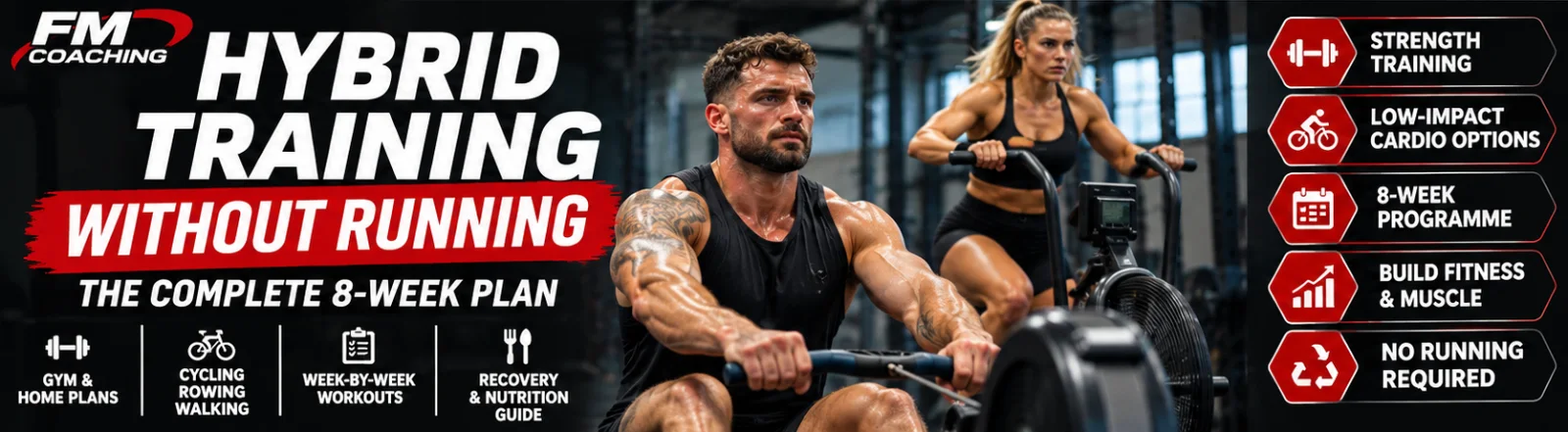
FM COACHING TRAINING STUDIO · NO-RUNNING HYBRID PROGRAMME · Evidence reviewed 3 November 2026
Yes—you can do hybrid training without running. Hybrid fitness means deliberately developing strength and cardiovascular endurance in the same programme; the cardio does not have to be a jog. A bike, rowing machine, swimming pool, elliptical, brisk walking route or suitable low-impact equipment can provide the endurance work. The key is choosing repeatable sessions you can progress, not copying an elite runner's schedule.
This guide gives you an 8-week hybrid training without running programme, a complete strength-session menu, two cardio templates, gym and home swaps, three- and four-day calendars, progress checkpoints, and modifications for beginners. It's designed for generally healthy adults, not a treatment plan for an injury or a substitute for physiotherapy.
Quick start: Pick two full-body strength days and one to two comfortable cardio days. Use the talk test for most aerobic sessions: at a moderate pace you can still speak in sentences. Record your gym exercises and one consistent cardio measure; increase challenge gradually only when you recover well.
What counts as hybrid training if you never run?
Hybrid training combines resistance work with purposeful aerobic conditioning, either on separate days or within the same workout. Running is popular because it is convenient, but it is not a compulsory ingredient. If your goal is an actual running race such as standard HYROX, you would eventually need appropriate running preparation; this guide is instead for general strength-and-cardio fitness without running.
The advantage of a no-running plan is choice. You can build a fitness routine around your preferences and available equipment. Choosing rowing or cycling may reduce impact exposure compared with running, but low impact does not mean zero injury risk, and every machine can be overdone. Adapt to your current health and ability.
For people specifically training toward the eight-run event format, read FM Coaching's HYROX coaching page. This is a different goal and the programme here does not claim to prepare someone for its running requirements.
The no-running cardio selector: choose what you'll repeat
- Exercise bike or outdoor cycling: easy to control effort and duration, but adjust saddle position and avoid hard rides just before your most demanding leg session.
- Rowing machine: combines legs, trunk and upper-body work; learn technique first and start with modest durations if unfamiliar. A rower is not automatically a recovery session.
- Elliptical/cross-trainer: a rhythm-based option with lower landing impact; adjust resistance and posture rather than clinging to the handles.
- Brisk walking or incline walking: accessible and useful for aerobic work. Increase speed or incline only as tolerated; a steep treadmill setting is not essential.
- Swimming or pool walking: useful for those who enjoy the water; swim safety, technique and access matter. Do not treat it as medically approved rehabilitation without advice.
- SkiErg or arm ergometer: an option when available, but assess shoulder comfort and overall effort. Upper-body cardio can still be hard.
How to choose: Pick one main aerobic method for the first four weeks so that you can compare your response. Change it if it is uncomfortable, boring or impractical. Pick a second option as a backup, not six machines to use every day.
Easy cardio versus intervals
Easy/moderate cardio is your foundation. Use a pace where speaking in short sentences remains comfortable, with an effort around 3–5 out of 10 for many people. This is a practical talk-test guide, not a laboratory determination of heart-rate zone 2.
Intervals are optional. If you have established a comfortable base and are recovering well, you can add modest quicker efforts and full easy recoveries. All-out sprints are not necessary for a beginner hybrid plan. Skip intervals if you feel unwell or have concerning symptoms.
Your eight-week hybrid training plan without running
Here is an original progression for generally healthy beginners. Timings are illustrative; if a week is too hard, repeat the previous one or reduce duration. These are sessions, not requirements to train seven days per week.
Week 1 — build a baseline
- Strength A: two sets per exercise, focusing on form.
- Strength B: two sets per exercise, non-consecutive with A if possible.
- Cardio 1: 15–20 minutes at comfortable conversational effort.
- Optional Cardio 2: a 10–15-minute easy walk, cycle or swim, if recovered.
- Record your choice of cardio machine, comfortable duration and effort. Do not chase distance records yet.
Week 2 — repeat before adding
- Repeat A and B with stable technique. Add a controlled repetition to an exercise if you can.
- Cardio 1: 20–25 minutes comfortable.
- Optional Cardio 2: 15–20 minutes comfortable.
- Identify one source of unnecessary fatigue: poor sleep, rushed warm-ups or intense cardio added too soon.
Week 3 — add controlled volume
- Keep strength A and B. For two main exercises, consider a third working set only if soreness and recovery are manageable.
- Cardio 1: 25–30 minutes, mostly conversational.
- Optional Cardio 2: 15–20 minutes, comfortable.
- Do not increase both cardio intensity and strength volume aggressively in the same week.
Week 4 — review, not a test of toughness
- Repeat comparable strength movements and look for steadier technique or extra controlled reps.
- Cardio 1: 25–30 minutes, consistent equipment and effort.
- Optional Cardio 2: 15–25 minutes easy.
- If fatigue has accumulated, reduce the total amount of work. Progress is not always linear.
Week 5 — build one purposeful interval session, if ready
- Strength A and B as before, maintaining recoverable volume.
- Cardio 1: 30 minutes easy-to-moderate.
- Optional Cardio 2 (only if well-recovered): after a warm-up, do 4 × 1 minute slightly faster than normal with 2 minutes easy between; cool down. Make quicker efforts controlled, not maximal.
- If you are still building a base, keep Cardio 2 easy instead. That's a legitimate plan.
Week 6 — slightly longer, not harder everywhere
- Add load to a lift only if all reps are smooth and you have a few good reps left.
- Cardio 1: 30–35 minutes comfortable, or stay at 25–30 if time or recovery is limited.
- Optional Cardio 2: 4–5 controlled one-minute quicker intervals with easy recovery, or 20 minutes easy.
- Keep at least one full rest day. If your legs are heavy all week, dial the cardio back.
Week 7 — consolidate strength and endurance
- Choose two quality strength sessions instead of adding random exhaustion circuits.
- Cardio 1: 35–40 minutes conversational for those ready; shorter is fine.
- Optional Cardio 2: 5 × 1 minute moderate-hard with 2 minutes easy, OR an easy session if training stress is high.
- Review sleep, hunger, soreness and enthusiasm. More training is only useful if you adapt to it.
Week 8 — repeat a simple benchmark
- Repeat a familiar set in strength A and strength B at the same load and compare controlled reps and technique with week 1.
- Choose the same cardio modality used in week 1. Compare how a comfortable 20-minute session feels. You may have improved ease or duration, but a specific gain is not guaranteed.
- Decide whether your next block should emphasise strength, aerobic fitness or keeping a balanced schedule.
- If you are not recovering, take a lighter week and begin again with smaller training demands.
Strength workout A: squat, push, pull and hinge
Warm up with five to ten minutes of comfortable movement and lighter practice reps. Use loads you can control; approximately two or three reps in reserve is a sensible starting point for many beginners.
- Goblet squat or leg press: 2–3 sets × 8–12 repetitions.
- Dumbbell chest press or stable incline push-up: 2–3 × 8–12.
- Seated cable row or supported dumbbell row: 2–3 × 8–12.
- Romanian deadlift: 2 × 8–10, learning the hip hinge without chasing maximal load.
- Dead bug or Pallof press: 2 × 8–12 per side, controlled.
Take enough rest to repeat good form. If time is short, prioritise the first four movements. This workout and its progression are original examples, not a certified treatment plan.
Strength workout B: posterior chain, pull, single-leg and shoulder
- Glute bridge or hip thrust: 2–3 × 8–12.
- Lat pulldown or assisted pull-up: 2–3 × 8–12.
- Supported step-up or split squat: 2 × 8–10 each side.
- Machine or dumbbell shoulder press: 2 × 8–12.
- Farmers carry or side plank: 2 controlled rounds, choosing a comfortable challenge.
Maintain upright positions and controlled movements. Avoid heavy loaded carries if grip, balance or posture is deteriorating. If your planned cardio leaves you unable to perform these lifts properly, reduce cardio stress rather than stacking more intense sessions.
Optional short strength C — not required
If you already tolerate three lifting days per week and want a little more strength work, use a 20–30-minute session of a squat variation, push-up, band row, glute bridge and light carry. Keep it easier than A or B at first. Beginners do not need this session to complete the eight-week plan.
Choose your calendar: three days or four
Three-day option — minimum viable hybrid week
- Monday — Strength A: 30–45 minutes at a manageable effort.
- Wednesday — Cardio 1: easy cycling, rowing, elliptical or brisk walking following the week-by-week duration above.
- Friday — Strength B: 30–45 minutes.
- Other days: optional comfortable activity or rest based on lifestyle and recovery. If you can only train three days, this is still a legitimate start.
Four-day option — more cardiovascular practice
- Monday — Strength A.
- Tuesday — Cardio 1: easy or moderate; the longer aerobic session of the week.
- Thursday — Strength B.
- Saturday — Cardio 2: a shorter easy session in weeks 1–4; optional controlled intervals in weeks 5–8 for those ready.
- Wednesday, Friday and Sunday: recovery or comfortable movement as preferred.
Schedule principle: When strength matters most, avoid placing very demanding leg cardio immediately before lower-body strength. If you combine them on one day, many people prefer quality lifting first and easier cardio second, but you should adjust for the priority and fatigue of that session. There is no magic separation interval for everyone.
No gym? The real home version
You do not need to buy an exercise bike and a complete dumbbell rack to become fitter. Start with what you own.
- Squat: sit-to-stand from a stable chair, then bodyweight or dumbbell goblet squats.
- Hinge: unloaded hip-hinge practice, then a light backpack or dumbbell Romanian deadlift.
- Push: wall push-up progressing to a securely supported incline push-up.
- Pull: a securely anchored resistance band row. Never attach a band to unstable furniture or a handle that may open.
- Glutes/core: floor bridges, bird dogs, dead bugs and controlled side planks.
- Cardio: brisk outdoor or indoor walking, stairs at a manageable pace, cycling if available or suitable low-impact dance movement. Do not jump if you want a low-impact plan.
If you work long shifts and need a shorter schedule, FM Coaching's 12-hour shift workout guide offers templates that prioritise recovery and realistic training time.
How to progress cardio when you don't track heart-rate zones
Use three repeatable notes: duration, talk-test effort and recovery. Your first-week benchmark might be '20 minutes cycling, conversational, finished feeling comfortable'. On week 3, if 25 minutes feels equally comfortable, that may be progress. Faster pace is optional, not mandatory. Watches estimate heart-rate zones differently; you do not need a premium device to train consistently.
Avoid false precision: Rowing metres, cycling watts, swimming lengths and treadmill kilometres are not interchangeable. Compare like with like on the same equipment with similar settings. A hard row is not necessarily equivalent to a hard run, and heart-rate responses differ by mode. Do not invent a conversion table claiming that five minutes of rowing equals a fixed distance of running.
Is it possible to build muscle and cardio fitness together?
Yes, many people can improve both with suitably planned training. The 2026 ACSM resistance-training position stand supports progressive resistance work, while WHO guidelines recommend both aerobic activity and strength exercise. The best balance depends on your baseline and recovery. A competitive powerlifter or endurance athlete may need more specialised sequencing than a beginner.
Research on concurrent training is nuanced, not a blanket 'cardio kills gains' rule. A systematic review and network meta-analysis explored differences between endurance modalities and strength or muscle outcomes; not every protocol or population responded the same way. Avoid promising a particular hypertrophy outcome from an eight-week no-running plan.
Recovery, food and sustainable hybrid fitness
Strength and cardio both create work for your body. Build in recovery days, get regular meals and adequate sleep, and don't continually add harder intervals because an app says you should. If your strength performance drops and legs stay sore, reduce total work before assuming you need more motivation.
For many healthy adults engaged in regular training, the ISSN protein review describes approximately 1.4–2.0 g/kg/day as a potentially useful protein range, with individual needs varying. You do not need an exact macro split to begin. Eat enough varied food and carbohydrates to support the sessions. Anyone with medical dietary needs should seek appropriately qualified guidance.
International adult health guidelines recommend working towards at least 150 minutes of moderate aerobic activity per week plus muscle-strengthening work on at least two days, with activity adapted to personal circumstances. Our sample eight-week programme may start below that aerobic goal deliberately for beginners; it is a progressive starting framework, not a claim that three short sessions automatically meet all public-health targets. Build additional comfortable activity over time if appropriate.
For a tailored, non-racing approach, FM Coaching's online personal training and muscle-building coaching can help you discuss how to balance strength and cardiovascular work.
The beginner's no-running hybrid training checklist
- I have picked a realistic number of training days.
- I have chosen cardio I enjoy and can access consistently.
- I can demonstrate my strength exercises with controlled technique.
- I know what 'comfortable' means using the talk test.
- I log duration, reps and loads instead of comparing myself with elite athletes.
- I can reduce a session when illness, pain or fatigue suggests I should.
- I have a way to adapt the plan for travel, childcare, shifts or equipment changes.
Red flags: Chest pain, unexplained fainting, significant breathlessness out of proportion to effort, or other worrying symptoms warrant medical assessment. Do not push through new or worsening pain. Existing injuries, disabilities, pregnancy and significant health conditions may require individual modifications. Low impact is not a medical clearance.
Hybrid training without running — FAQs
Can you do hybrid training without any running?
Yes. Combine structured strength training with aerobic methods such as cycling, rowing, walking, elliptical training or swimming. That qualifies as hybrid fitness in the broad training sense.
Is this the same as HYROX training without running?
No. A standard HYROX race includes repeated running sections. A no-running general fitness plan can build useful transferable qualities but does not fully prepare you for the running demands of that event.
What is the best cardio instead of running?
There is no universal best. Choose a modality you can access consistently and perform safely, such as cycling, brisk walking, rowing or swimming; comfort and recovery matter.
Can beginners start with three training days a week?
Yes. Two full-body strength sessions and one aerobic session is a manageable starting framework. You can add comfortable activity as fitness and schedule allow.
Should I cycle or row for low-impact hybrid training?
Either may work. Cycling generally needs less upper-body technique, while rowing adds technique demands and total-body effort. Choose based on ability, comfort and equipment.
How many minutes of cardio should I do each week?
Start with tolerable sessions and progress towards relevant public-health guidance rather than jumping to a large target on day one. Most healthy adults are encouraged to accumulate about 150 minutes moderate activity weekly alongside strength work.
Can I build muscle while doing hybrid training?
You may, especially if new to lifting, but outcomes vary. Progressive resistance work, adequate nutrition, and recovery are important; avoid treating cardio as guaranteed muscle loss or muscle gain.
Should I lift weights before or after cardio?
Prioritise the session component that matters most and protect technique. If strength is the priority and both occur together, many people lift before easy cardio; schedules vary.
Does brisk walking count as hybrid cardio?
Yes, if it provides suitable aerobic effort for you. The talk test can help you decide whether a walking pace is appropriately challenging.
Do I have to do HIIT?
No. Easy-to-moderate cardio is valuable, and intense intervals are optional. A beginner can complete all eight weeks without a single sprint.
Can I do this at home without machines?
Yes. Use safe bodyweight or band strength exercises and suitable walking or other accessible aerobic activity. Progress the same movement patterns consistently.
What should I do after week eight?
Review the lifts, cardio comfort and recovery. Continue the current routine, make one measured progression or move to an individualised programme based on your next goal.
Research sources and editorial note
This independent FM Coaching guide draws on ACSM 2026 resistance-training guidance, WHO activity guidance, ISSN protein guidance and a concurrent-training evidence review. The particular eight-week workouts are original example programming, not a published clinical trial. Real outcomes depend on health, prior training and adherence.
Interested in a tailored schedule rather than a generic template? Read FM Coaching's online personal trainer service for personal training and weekly check-ins. This is general educational information, not medical advice or a guarantee of results.
Questions and answers
Can you do hybrid training without any running?
Yes. Combine purposeful strength training with cycling, rowing, brisk walking, swimming or another suitable aerobic modality.
Is this the same as HYROX training without running?
No. Standard HYROX competition includes running; this is a general strength-and-cardio programme and does not replace race-specific run preparation.
What is the best cardio instead of running?
Choose a method you can safely and consistently perform. Cycling, rowing, walking, elliptical and swimming are common options.
Can a beginner start with three days per week?
Yes. Two full-body strength sessions and one aerobic session are a manageable starting point for many healthy beginners.
Should I cycle or row for low-impact hybrid training?
Either can work. Rowing demands technique and engages more muscles; cycling can be simpler to pace. Pick based on comfort and ability.
How long should cardio sessions be?
Start with a duration you tolerate, then progress gradually toward appropriate activity guidelines. There is no single required beginner duration.
Can you build muscle doing hybrid training?
Many people can improve muscle and cardio fitness together, but outcomes vary. Progressive lifting and recovery remain important.
Should I lift before cardio?
If lifting is your main priority and both occur in one session, quality strength work before easy cardio is often practical. Individual needs vary.
Does brisk walking count as cardio?
Yes, when walking raises breathing to a suitable moderate aerobic effort for the person.
Do I have to perform HIIT?
No. Intervals are optional; steady easy-to-moderate aerobic work can be effective without sprints.
Can I do hybrid training at home without machines?
Yes. Use safe bodyweight or band strength work with suitable walking or accessible cardio.
What should I do after week eight?
Repeat and compare your strength and cardio benchmarks, review recovery and choose your next training emphasis.