FM Coaching · Fitness Guides
HYROX Station Order 2026/27: All 8 Stations, Distances and Weights
The fixed 2026/27 HYROX station order with a run-before-each-station table, full weights and distances, Doubles and Relay differences, rulebook penalties and beginner training examples.
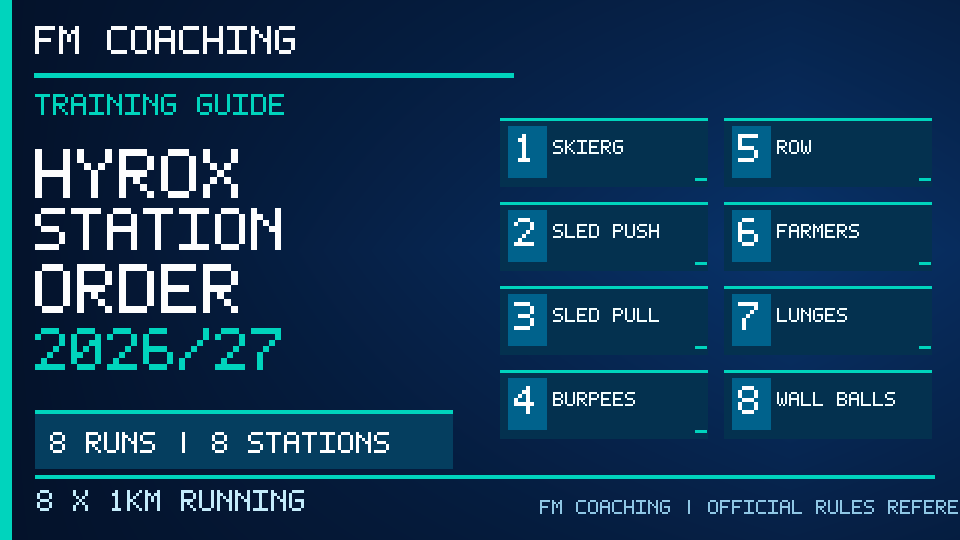
The HYROX station order is always SkiErg, sled push, sled pull, burpee broad jumps, rowing, farmers carry, sandbag lunges and wall balls. You run 1 km before each workout station, completing eight running segments and eight stations. That means 8 km of prescribed running plus the workout distances, with additional movement through the Roxzone. The order is fixed in the official HYROX Singles Rulebook for season 2026/27.
Save the sequence before race day: Run → SkiErg → Run → Sled Push → Run → Sled Pull → Run → Burpee Broad Jumps → Run → Row → Run → Farmers Carry → Run → Sandbag Lunges → Run → Wall Balls → Finish. All regular adult Singles divisions share this order. Weights change depending on Open or Pro, but the eight stations stay the same.
This page provides the order, exact movement distances, division weights, a simple race-day checklist and practical preparation suggestions. Official standards checked on 16 November 2026.
What is the HYROX station order in 2026/27?
Eight runs alternate with eight fixed exercise stations. The following table is the standard adult Singles sequence in all countries. The descriptions and official weights come from section 4.1 of the 2026/27 HYROX Singles rulebook.
| Sequence | Before the station | Exercise station | Required work |
|---|---|---|---|
| 1 | Run 1 km | SkiErg | 1,000 m |
| 2 | Run 1 km | Sled push | 50 m (4 × 12.5 m) |
| 3 | Run 1 km | Sled pull | 50 m (4 × 12.5 m) |
| 4 | Run 1 km | Burpee broad jumps | 80 m |
| 5 | Run 1 km | Row | 1,000 m |
| 6 | Run 1 km | Farmers carry | 200 m |
| 7 | Run 1 km | Sandbag lunges | 100 m |
| 8 | Run 1 km | Wall balls | 100 valid repetitions |
Remember the order as ski, push, pull, jump, row, carry, lunge, throw. The phrase is only a memory aid; the rulebook determines the actual race standard. Unlike a gym circuit, athletes cannot select a different station order.
How can you use the HYROX station order to plan your race pace?
Divide your target time into running, workout and transition budgets. For example, eight 1 km runs at an average of 5 minutes each account for 40 minutes. If your workout budget is 35 minutes and your transitions total 5 minutes, the illustrative finish time is 80 minutes. These are planning assumptions, not a prediction or prescribed pace.
Use the HYROX race predictor to explore different splits and the race analyser to compare a completed event with your target. For help adapting training to your weak stations, see HYROX coaching.
Do you run before or after each HYROX station?
You run the first kilometre before station one and another kilometre before each later station. After the eighth run, you complete wall balls and proceed to the finishing area. It is therefore incorrect to say the event starts on the SkiErg or that there is an extra 1 km run after wall balls.
Individual venues may divide a nominal 1 km split into multiple physical laps. The current Singles rulebook allows adjustments to the first or last lap due to arena layout while preserving the prescribed running distance across the event. Follow that venue's confirmed lap plan and judge instructions.
How many running kilometres are there in a HYROX race?
HYROX prescribes 8 km of running: eight runs of 1 km each. This does not mean your watch will show exactly 8.00 km for the whole race. The overall event also includes moving to stations in the Roxzone, the actual functional station distances and other venue-dependent movements. GPS measurements indoors may also be inaccurate.
The workout stations include 1,000 m on the SkiErg and 1,000 m on the rower; those are machine distances, not additional running kilometres. For pacing, it is useful to track your eight running splits separately from station and transition times. Read our HYROX running and pacing guide for repeatable effort planning.
What are the official HYROX station weights for women and men?
Running, SkiErg, burpee broad jump and rowing distances are standard across adult Singles; loaded stations vary by division. Sled masses below include the sled itself, while farmers carry weights are for each hand, not the combined pair. This table follows the 2026/27 Singles rulebook, section 4.1.
| Weighted station | Women Open | Men Open / Women Pro | Men Pro |
|---|---|---|---|
| Sled push (50 m) | 102 kg | 152 kg | 202 kg |
| Sled pull (50 m) | 78 kg | 103 kg | 153 kg |
| Farmers carry (200 m) | 2 × 16 kg | 2 × 24 kg | 2 × 32 kg |
| Sandbag lunges (100 m) | 10 kg | 20 kg | 30 kg |
| Wall balls (100 reps) | 4 kg | 6 kg | 9 kg |
Women's wall-ball target height is 2.70 m; men's is 3.00 m. So although Men Open and Women Pro share a 6 kg wall ball, they use different target heights. Always compare the 2026/27 rulebook with the race briefing if a venue or division provides updated technical instructions.
What is the first HYROX station after the opening run?
The first workout is the SkiErg for 1,000 metres. The machine records the station distance; athletes must complete it before moving to the next run. Your opening run is often tempting to race too fast, but SkiErg immediately tests your ability to work under cardiovascular load.
For training, learn steady pulling mechanics and avoid turning every SkiErg practice into a maximal sprint. Transitions matter: practise moving from a controlled run to the machine without unnecessary fiddling. Check the HYROX judges training page for official station guidance.
Which stations come second and third in HYROX?
The sled push is second and the sled pull is third. Both require 50 m of work, typically four 12.5 m lengths, but have different loads and technique requirements. The pull uses a rope and a marked Racers Box, while the push is performed directly against the sled.
Men Open push 152 kg but pull 103 kg; Women Open push 102 kg but pull 78 kg. The difference is deliberate. Don't confuse plates-only gym loading with the published total sled mass, and don't assume the same resistance across different turf surfaces. For detailed pull standards, read the HYROX sled pull weight guide.
When do you do burpee broad jumps in HYROX?
Burpee broad jumps are station four, after the fourth 1 km run. The prescribed work is 80 m, not a fixed number of repetitions. The judging standard includes a chest-to-floor burpee followed by the required broad-jump movement; covering distance efficiently never excuses improper movement.
Because the total is distance-based, athletes with different jump lengths will complete different numbers of repetitions. In practice, choose a rhythm that preserves technique, then introduce a run before the movement. For official current standards, consult section 8.4 of the Singles rulebook.
Is the HYROX rowing station before or after the farmers carry?
Rowing is station five; farmers carry follows at station six. Athletes row 1,000 m on the ergometer, complete another run and then carry kettlebells for 200 m. Separating these stations with running is part of the race design and should be included in realistic training simulations.
Women's Open carry 2 × 16 kg, Men Open and Women Pro carry 2 × 24 kg, and Men Pro carry 2 × 32 kg. Our farmers carry weight guide covers handling, resting rules, Doubles handovers and common penalties.
What is the seventh HYROX station and how heavy is the sandbag?
Station seven is 100 m of sandbag lunges. Women Open carry 10 kg, Men Open and Women Pro 20 kg, and Men Pro 30 kg. Athletes must meet the published lunge movement and equipment standards while completing the full marked course.
This station comes late enough that shorter lunges, incomplete extension and careless equipment handling become tempting. Train controlled movement after running, and prioritise completing legal repetitions over attempting to rush the final 100 m.
Are wall balls always the last HYROX station?
Yes. Wall balls are station eight, completed after the final 1 km run. Singles racers must achieve 100 valid wall-ball repetitions: 4 kg for Women Open, 6 kg for Men Open and Women Pro, or 9 kg for Men Pro. The women's target is 2.70 m, the men's target 3.00 m.
Fatigue and missed standards can turn the final station into a major time loss. The 2026/27 rulebook requires a proper squat, correct target strike and a valid starting position; a no-rep is not credited. Practise target accuracy and planned breaks rather than assuming every throw will count on race day.
Is the HYROX station order different for Doubles or Team Relay?
The eight exercise stations stay in the same sequence, but participants divide the work differently. In Doubles, both athletes run each 1 km segment together and share the station work, with one teammate working at a time. The total station distance or repetition requirement does not double merely because two athletes enter.
In Team Relay, a four-person team shares the eight runs and stations, with each team member allocated two runs and two stations under the Relay rules. Equipment loads and handover requirements differ by category. For the format-specific rules, use the official HYROX rulebook directory and our Mixed Doubles comparison.
Can you choose a different station order during a HYROX race?
No. HYROX prescribes a fixed sequence. The 2026/27 Singles rulebook says that completing a station out of order incurs a three-minute penalty; more than one out-of-order station can result in disqualification. A missed station or entire 1 km run is a serious incomplete-race infringement.
If you are unsure where to go, ask event staff instead of improvising. Always enter and exit the Roxzone via the prescribed routes, and follow the actual event's lane, lap and signage instructions.
How do you remember all eight HYROX stations on race day?
Use the eight-word sequence: ski, push, pull, jump, row, carry, lunge, throw. Then pair each word with one kilometre of running beforehand. That mnemonic is helpful in training because the fixed order should become familiar before your first event.
During a practice session, mark stations 1–8 on a card or phone note, and learn which two stations bookend the race (SkiErg and wall balls). You do not need to memorise every venue lap count weeks in advance; follow the event's final course map for those details.
What is a practical beginner HYROX workout that follows station order?
Start by practising the sequence at a scaled workload—not by attempting a full competitive simulation immediately. For an appropriately trained beginner, an example partial session is three to four rounds of an easy 400–600 m run followed by the corresponding station at a manageable load.
| Practice segment | Illustrative scaled workout | What to learn |
|---|---|---|
| Run → SkiErg | 400 m easy run + 250 m SkiErg | Settle breathing before machine work |
| Run → Sled push | 400 m easy run + 12.5 m controlled push | Leg drive and lane completion |
| Run → Sled pull | 400 m easy run + 12.5 m controlled pull | Legal stance and rope management |
| Run → Burpee broad jump | 400 m easy run + 10–20 m of compliant movement | Consistent technique under fatigue |
Only build toward the full eight-run, eight-station simulation when training history and recovery permit. The table is a coaching example, not an alternative competition format. For broader planning, see the beginner HYROX training framework.
What are the biggest race-day mistakes when following the HYROX station order?
The avoidable mistakes are missing a run lap, using the wrong Roxzone arch, going to the wrong station, choosing the wrong equipment and leaving a station incomplete. Even someone who knows the eight stations can make these errors when fatigued and surrounded by other athletes.
Before your wave, check the individual start time, complete event briefing, running-lap count and correct station map. During the race, count laps, follow signage, listen to judges and check each station's completion requirement. Be especially careful to complete 100 valid wall balls before leaving for the finish.
Where can you check the official HYROX station order and race weights for 2026/27?
Start at the official rulebook page. The 2026/27 Singles rulebook states the eight-run, eight-station concept on page 4 and lists the standard category weights and distances on page 8. Separate Doubles, Relay and Adaptive documents cover those formats.
This independent FM Coaching training guide was reviewed on 16 November 2026. For race calendars, coaching and further station information, explore the HYROX hub or online HYROX coaching. Official event organisers control final race instructions and results.
Two later stations deserve their own equipment check: use the sandbag lunge weights and rules to confirm the load for your division, then review wall ball weights and target heights before practising the final station.
Questions and answers
What are the eight HYROX stations in order?
SkiErg, sled push, sled pull, burpee broad jumps, rowing, farmers carry, sandbag lunges and wall balls.
Do you run before the first station in HYROX?
Yes. A 1 km run comes before station one, the SkiErg, and before every subsequent station, totalling 8 km of running.
How many HYROX stations and runs are there?
Eight exercise stations and eight 1 km runs in the prescribed sequence.
What is the fifth station in HYROX?
Rowing is station five and requires 1,000 m. A 1 km run precedes it.
What is the final station in HYROX?
Wall balls are station eight, after the eighth 1 km run. Singles racers must complete 100 valid repetitions.
Do Doubles and Singles complete HYROX stations in the same order?
Yes. The order stays the same, but in Doubles both athletes run together and divide the station work under partner-specific rules.