FM Coaching · Fitness Research
Aqua Pilates in 2026: Benefits, New Research, Exercises & What Works
Aqua Pilates is getting attention in 2026. We examine the small new clinical trial, explain shallow-water versus floating-board Pilates, and give practical exercises, safety tips and realistic expectations.
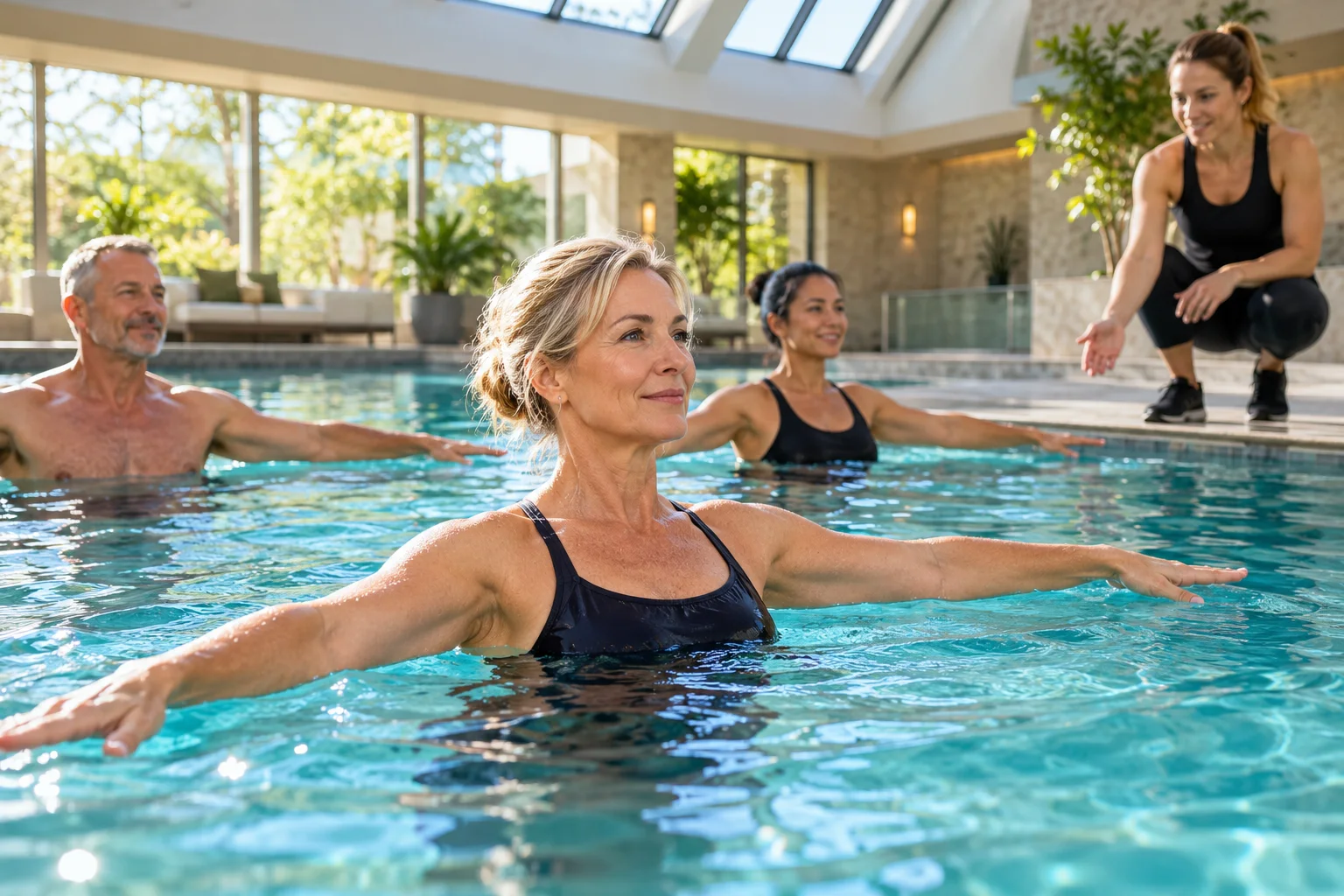
Published as a fitness research explainer | October 2026. Aqua Pilates is having a moment, but the name now describes two quite different workouts: controlled Pilates movements in a pool and Pilates-style exercises on a floating board. The distinction matters—especially when people quote new research as proof that every type of Aqua Pilates works in the same way.
Here's the useful version: Aqua Pilates may be a comfortable, enjoyable way to practice balance, trunk control and movement with the resistance of water. A September 2026 controlled study reported better postural and functional outcomes after a supervised 12-week programme in a small group of women aged 55–65. That is promising, not a guarantee of fat loss, injury rehabilitation or superiority to conventional Pilates. (2026 clinical study)
THE QUICK ANSWER — Aqua Pilates combines Pilates-inspired breathing, alignment and controlled movement with aquatic exercise. You do not need to be a strong swimmer for every shallow-water class, but you do need a safe supervised pool setting. Floating-board sessions demand extra balance and are a separate format.
In this guide: Two types · 2026 research · Benefits and limits · Exercises and a 30-minute session · Workout comparison · FAQs.
First, what exactly is Aqua Pilates?
In-water Aqua Pilates uses the principles associated with Pilates—control, alignment, breathing and coordinated trunk-and-limb movement—while standing, moving, sitting or floating in a pool. Some instructors use noodles or foam dumbbells; others use body weight and the water itself. It is related to aquatic exercise, but class formats and qualifications are not standardised worldwide.
Floating-board Pilates places the exerciser on a buoyant board. A shifting surface adds a different balance demand. The October 2026 InStyle trend story primarily described this floating-board version, whereas the September 2026 clinical study assessed a supervised aquatic Pilates programme, not a floating-board class.
| Feature | Shallow-water Aqua Pilates | Floating-board Pilates |
|---|---|---|
| Where you exercise | Mostly immersed in the pool | On a floating platform on top of the water |
| Main challenge | Move against water while maintaining control | Control position on an unstable floating surface |
| Typical beginner route | Instructor-led, feet supported, near pool wall | Supervised introductory class; falls into water possible |
| Direct evidence from 2026 trial? | Relevant to its supervised in-water approach | No: the trial did not test boards |
Why people are talking about it: Traditional aquatic exercise has been around for decades. Newer social content and a 5 October 2026 lifestyle report are bringing the floating-board format more attention. That is evidence of coverage, not proof of a specific worldwide search volume or health effect.
The September 2026 research: what actually happened?
The researchers enrolled 20 women aged 55–65 with thoracic kyphosis (an increased upper-back curve). Ten completed the aquatic programme and ten continued usual activity without an exercise programme. The intervention lasted 12 weeks, with two supervised 45-minute sessions each week at a light-to-moderate effort—24 sessions in total. The study was published on 16 September 2026 in the Journal of Functional Morphology and Kinesiology. (2026 clinical study)
| Outcome | In-water group | Control group | What it means |
|---|---|---|---|
| Average thoracic kyphosis angle | 42.6° at baseline → 40.7° at 12 weeks | 43.0° → 43.0° | Mean 1.9° reduction in the exercise group |
| Modified Physical Performance Test score | 24.3 → 28.7 | 24.0 → 23.8 | Better tested functional task performance |
| Physical activity questionnaire | Improved relative to control | No corresponding improvement | Self-report may include the supervised sessions |
Functional tasks included walking, handling a jacket and picking up objects. This matters more to everyday readers than a vague promise to “activate the core”. The trial reported statistically significant group differences, but statistical significance does not establish that every participant will notice a meaningful change.
Five limitations worth knowing before you share the headline
- Only 20 participants contributed to the two-group analysis. That is a small sample.
- Everyone was a woman aged 55–65 with thoracic kyphosis. These findings cannot automatically be applied to athletes, younger adults, pregnant people or all older people.
- Comparison was against no exercise, not land-based Pilates, swimming, resistance training or physiotherapy. Water's unique advantage was not isolated.
- The study lasted 12 weeks. Long-term durability and injury-prevention effects were not established.
- It did not measure fat loss, muscle hypertrophy or floating-board training. Those outcomes must not be presented as proven by this trial.
Editorial verdict: Aqua Pilates looks feasible for controlled movement and certain functional outcomes in the studied population. It is premature to call it the best Pilates format, a posture cure or a replacement for an individual rehabilitation plan. Read the full 2026 clinical study rather than relying on viral summaries.
Aqua Pilates benefits: separate proven, plausible and unproven claims
Much of what people call an “Aqua Pilates benefit” is supported by studies of aquatic exercise generally, not by large trials of Aqua Pilates as a named class. That distinction matters.
| Claim people search for | Best-supported interpretation | Evidence caution |
|---|---|---|
| Gentler on joints | Water buoyancy can reduce weight-bearing demands and make some movements more tolerable | Not risk-free; depth and technique affect loading |
| Better balance and daily function | Some aquatic-exercise reviews report improvements in older adults | Trials are heterogeneous; not exclusive to Pilates |
| Core and muscular endurance | Controlled water resistance can challenge stabilising muscles and coordination | No evidence all Aqua Pilates classes outperform progressive strength training |
| Pain relief in arthritis | Some aquatic-exercise studies report small improvements | Not a cure; individual assessment matters |
| Rapid fat loss or a flat stomach | It can be part of an active week | No special belly-fat effect has been demonstrated |
| Major muscle growth | Water provides resistance, particularly with greater movement speed or larger surfaces | Muscle gain needs sufficiently progressive loading; class alone may not provide it |
What broader research adds
A 2026 systematic review of 31 aquatic-training studies involving 1,702 older adults reported improvements in balance and strength relative to controls, with no clear overall advantage over land-based training. High between-study variation reduced certainty about the size of benefits. (2026 aquatic-training meta-analysis)
Another 2026 systematic review covering 15 studies of water-based aerobic exercise found improvements in cardiorespiratory fitness, strength and agility/dynamic balance against control groups; these were aquatic-aerobics findings, not Aqua Pilates-specific results. (2026 water-based aerobic exercise review)
For people with knee or hip osteoarthritis, a Cochrane review found relatively small, short-term improvements in pain and disability following aquatic exercise. A newer October 2026 knee-osteoarthritis meta-analysis judged the certainty of some knee-osteoarthritis findings low or very low, reminding us not to oversell the evidence.
Bottom line: choosing a movement you enjoy and can repeat is often more important than deciding that a pool workout is intrinsically superior to a gym or mat session.
Who is Aqua Pilates for—and who needs a different starting point?
- Beginners: an instructor-led shallow-water class can offer a supported way to practise controlled movement. Start where you can maintain footing and breathe comfortably.
- Adults over 50 or 60: balance, movement confidence and function may be useful goals. A good class allows different movement ranges and speeds.
- People with joint discomfort: the pool may feel more comfortable, but persistent pain, dizziness, neurological symptoms or recent injury deserve professional assessment.
- People who already lift weights: use Aqua Pilates for variety, mobility and lighter conditioning—not automatically as a substitute for heavy resistance work.
- People returning to exercise: start at low effort. Following surgery, illness, a fall or a medical restriction, get clearance from the relevant clinician before joining.
- Pregnancy: water exercise may be an option, but choose pregnancy-appropriate instruction and discuss relevant conditions or complications with your midwife. Avoid overheating and unstable board sessions with fall risk.
Aqua Pilates is not intended to diagnose, treat or reverse thoracic kyphosis, arthritis or any other condition. Physiotherapy and medical guidance take priority when needed.
Eight Aqua Pilates exercises to ask your instructor about
These examples adapt familiar movement principles to a shallow, supervised pool. They are general educational ideas, not the protocol used in the 2026 clinical trial. Use a stable depth, allow room from other swimmers and stop if you feel unsteady or unwell.
1. Water march with long spine
Stand tall with water around waist-to-chest height and lightly hold the wall if needed. Alternate slow knee lifts for 45–60 seconds while breathing normally. Focus: posture, gait rhythm and gentle core control. Easy option: smaller knee lifts.
2. Supported side leg lift
Facing the pool wall, keep a light grip and move one leg sideways without leaning your trunk. Perform 8–12 controlled repetitions on each side. Focus: hip control. Easy option: reduce range rather than moving faster.
3. Standing heel raises
With fingertips against the wall for support, raise and lower both heels slowly for 10–15 repetitions. Focus: calf strength and balance. Easy option: keep the heels low and maintain firm footing.
4. Water-resisted arm sweep
Stand upright with elbows softly bent and sweep your hands outward then inward through the water for 10–12 repetitions. Focus: smooth shoulder motion and resistance awareness. Easy option: keep arms lower and make a smaller arc.
5. Controlled trunk rotation
With hips facing forwards, turn gently through the upper body without forcing the spine or twisting sharply. Aim for 6–8 repetitions each side. Focus: coordination. Easy option: move through a pain-free smaller range.
6. Mini squat with reach
Set feet comfortably apart, bend the knees and hips slightly, then straighten while reaching the arms forwards. Do 8–12 controlled repetitions. Focus: sit-to-stand pattern and coordination. Easy option: very shallow depth.
7. Tandem stance near the wall
Position one foot just ahead of the other and hold 15–30 seconds per side with a secure handhold available. Focus: steady balance. Easy option: keep feet further apart.
8. Slow step-back and return
Step one foot backwards as far as comfortably controlled, then return to standing. Alternate for 8–10 repetitions each leg. Focus: trunk stability and hip control. Easy option: a shorter step with one hand on the wall.
Breathing tip: do not hold your breath to brace. Exhale gently during the more demanding part of a movement; keep breathing at a pace that allows conversation.
A realistic 30-minute beginner Aqua Pilates session
| Time | What to do | How it should feel |
|---|---|---|
| 0–5 min | Walk in place, small arm sweeps, relaxed breathing | Easy warm-up |
| 5–12 min | Side leg lifts, mini squats and heel raises | Controlled, not breathless |
| 12–19 min | Arm sweeps, gentle trunk rotations and water march | Light to moderate effort |
| 19–25 min | Supported balance holds and step-backs | Steady with hand support if needed |
| 25–30 min | Slow water walking and relaxed mobility | Return to easy effort |
Rest whenever technique or comfort begins to deteriorate. This example is not an individually prescribed rehabilitation programme and should be adapted to your fitness, health and pool conditions.
Four-week progression without rushing
- Week 1 — Familiarise: one 20–30-minute class or guided session; practise safe entry, footing and movement quality.
- Week 2 — Repeat: one or two sessions with similar exercises; add a few comfortable repetitions where appropriate.
- Week 3 — Build consistency: aim for two sessions if recovery and confidence allow; introduce slightly longer balance holds.
- Week 4 — Review: repeat easy movement tests such as smooth heel raises or a supported balance hold. Increase resistance or duration only if it remains controlled.
Do not assume that the 2026 trial's twice-weekly schedule is the optimal dose for everyone; it is simply the schedule that those investigators studied.
Aqua Pilates vs reformer Pilates, mat Pilates, swimming and aqua aerobics
| Workout | Main emphasis | Equipment / venue | Good reason to choose it |
|---|---|---|---|
| Shallow-water Aqua Pilates | Controlled movement with water support and resistance | Pool, sometimes noodles | Prefer supported lower-impact movement |
| Floating-board Pilates | Balance and control on an unstable platform | Pool plus specialist anchored or supervised board | Enjoy challenge and novelty; accept fall risk |
| Mat Pilates | Bodyweight control and movement technique | Mat and floor space | Prefer inexpensive, accessible practice |
| Reformer Pilates | Spring-assisted and resisted movement | Reformer machine, instructor | Want graded machine-based Pilates practice |
| Swimming | Propulsion, cardiovascular training and technique | Pool and swimming competence | Enjoy continuous aquatic exercise |
| Aqua aerobics | Rhythmic whole-body movement, often more continuous | Pool, optional equipment | Prefer a class with an aerobic emphasis |
Is Aqua Pilates better than reformer Pilates? There is no robust direct comparative evidence establishing a universal winner. Different people benefit from different styles, and instructor quality, accessibility and consistency may matter as much as format.
Can Aqua Pilates help with weight loss or belly fat?
A class can contribute to activity and may increase energy expenditure compared with sitting. But there is no reliable proof that Aqua Pilates specifically removes belly fat or that a particular number of sessions causes a predictable weight reduction. Overall energy balance, diet, weekly movement and consistency matter. For structured support, explore FM Coaching's fat-loss coaching and body-recomposition coaching.
Will it build muscle?
Some water-resisted exercises can develop muscular endurance or help a beginner become stronger. For substantial hypertrophy, exercises generally need to become more challenging over time. Someone with a muscle-building goal can enjoy Aqua Pilates while keeping appropriately programmed resistance sessions in their plan. Read about muscle-building coaching.
UK guidance recommends at least 150 minutes of moderate physical activity per week or an equivalent combination, plus muscle-strengthening activities on at least two days; a light Aqua Pilates class may not count as moderate intensity for every participant. (UK physical-activity guidance)
When will you notice results?
Think in terms of skills and consistency rather than dramatic transformations. You may notice that water movement feels easier or that balancing is less awkward after a few sessions; those are personal observations, not guaranteed outcomes. Formal functional changes in the small 2026 study were measured after 12 weeks, not after the first session.
| What to track | How to track it | What not to infer |
|---|---|---|
| Consistency | Sessions attended over four weeks | Attendance alone does not prove fat loss |
| Movement confidence | Can you maintain smoother control? | Confidence is not a clinical balance test |
| Comfort | How joints and muscles feel during and after class | Temporary relief does not diagnose or cure a condition |
| Strength goals | Progressive exercises inside and outside the pool | Water movement is not automatically optimal hypertrophy training |
Aqua Pilates safety: a checklist that matters more than the trend
- Choose a managed pool with appropriate supervision; tell the instructor about relevant health concerns.
- Ask which class you are booking: standing in water or balancing on a floating board. The second has a different fall and water-safety risk.
- Know the depth, entry/exit options, footing, temperature and whether flotation aids are offered.
- Stay close to support until you understand your balance in water; never practise unsupported while alone.
- Keep movements within a comfortable range. Stop with chest pain, faintness, unusual breathlessness, severe pain or any other alarming symptoms and seek appropriate help.
- If you have recent surgery, significant cardiovascular or neurological illness, uncontrolled symptoms or are undertaking rehabilitation, seek individual clearance rather than using a generic online routine.
- During pregnancy, choose suitable classes and seek advice from your midwife when appropriate; NHS pregnancy exercise guidance discusses how water-based activity can be adapted safely.
Questions worth asking a studio: Does the instructor have relevant qualifications? Is there a lifeguard or equivalent pool supervision? What is the maximum class size? Do you have a shallow-water beginners' option? Are there appropriate adaptations for mobility limitations or pregnancy? What is the cancellation policy?
Why this feature is different from a viral Aqua Pilates video
The important story is not that water magically changes Pilates. It is that two distinct formats are being discussed under one search term, while newer research supports only quite specific outcomes in quite specific people. Before making the workout a major part of your fitness plan, match the class type to your actual goal: movement confidence, variety, cardiovascular activity, mobility or progressive strength.
For a plan that combines enjoyable training with realistic progression, visit the FM Coaching fitness guides or ask about a 7-day online coaching trial. FM Coaching does not claim to operate a local pool class or provide aquatic rehabilitation treatment.
Aqua Pilates FAQs: 20 practical answers
1. What is Aqua Pilates?
Aqua Pilates adapts Pilates-inspired movement, breathing and trunk control to a water environment. Some classes take place in a shallow pool; others use floating boards, which are a distinct format.
2. Is Aqua Pilates different from water Pilates?
Often the names are used interchangeably. Always check the class description because some studios mean in-water exercise and others mean Pilates on a floating board.
3. Do you need to know how to swim to do Aqua Pilates?
Some instructor-led shallow-water classes accommodate non-swimmers who can stand securely, but safe entry, supervision and individual comfort are essential. A floating-board class may have greater water-safety demands.
4. What does the 2026 Aqua Pilates study show?
A small trial of 20 women aged 55–65 with thoracic kyphosis reported improved upper-back alignment and functional performance after 12 weeks of supervised aquatic Pilates versus no exercise.
5. Does Aqua Pilates improve posture?
The 2026 trial reported a modest change in thoracic curvature in its specific population. Evidence is not sufficient to promise posture correction for everyone.
6. Is Aqua Pilates good for weight loss?
It can add physical activity, but there is no robust evidence that Aqua Pilates itself causes a predictable amount of fat loss. Nutrition and total weekly activity also matter.
7. Does Aqua Pilates burn belly fat?
No exercise can selectively burn fat from one body area. Aqua Pilates is not a proven spot-reduction technique.
8. Is Aqua Pilates better than reformer Pilates?
No strong direct evidence establishes that it is universally better. They provide different movement environments and resistance challenges.
9. Can Aqua Pilates build muscle?
It can challenge muscles and muscular endurance, particularly for beginners. Significant hypertrophy usually requires progressive resistance training matched to the person.
10. Is Aqua Pilates good for older adults?
It may suit some older adults who enjoy supervised aquatic movement. Broader aquatic-exercise research suggests benefits for balance and function, but individual suitability varies.
11. Can people with arthritis try Aqua Pilates?
Some people find water-based exercise more comfortable. Studies of aquatic exercise show small short-term improvements for some osteoarthritis outcomes; seek advice for individual medical restrictions.
12. Can you do Aqua Pilates while pregnant?
Some adapted water exercise may be suitable during pregnancy. Speak to your midwife about any concerns and choose pregnancy-appropriate supervision; floating boards add fall risk.
13. How many times per week should I do Aqua Pilates?
One or two sessions can be a manageable starting point. The 2026 study used two 45-minute sessions weekly, but that does not establish the ideal schedule for everyone.
14. How long until Aqua Pilates works?
Comfort and confidence can change as you practise, but individual results vary. The 2026 trial measured its outcomes after 12 weeks and did not guarantee results for all populations.
15. What should I wear to Aqua Pilates?
Wear secure swimwear suitable for moving freely, and follow your pool rules for footwear and aids. For floating-board formats ask the instructor what clothing and safety equipment are appropriate.
16. What is the difference between Aqua Pilates and aqua aerobics?
Aqua Pilates usually emphasises deliberate alignment and controlled trunk-and-limb movements; aqua aerobics often includes more continuous rhythmic movement. Individual class formats overlap.
17. Can I do Aqua Pilates at home?
Only if you have safe access to a suitable pool and appropriate supervision; do not attempt pool-based exercise alone or on improvised floating equipment. Mat Pilates is more accessible for home practice.
18. Is Aqua Pilates a rehabilitation treatment?
A class may complement general activity, but it is not automatically physiotherapy or a substitute for a clinician-prescribed rehabilitation programme.
19. How do I choose a good Aqua Pilates class?
Confirm whether it is shallow-water or floating-board based, instructor training, available adaptations, pool supervision, accessible entry and water-safety arrangements.
20. Is floating-board Pilates what the 2026 trial tested?
No. The cited clinical trial studied supervised aquatic Pilates in women with thoracic kyphosis, not the floating-board format featured in some 2026 lifestyle reporting.
Evidence and reporting notes
Primary research: Passa P, Paschalis V, Gioftsidou A, Soultanakis H (2026). Aquatic Pilates Is Associated with Improved Spinal Alignment and Functional Performance in Women Aged 55–65 Years with Thoracic Kyphosis. Journal of Functional Morphology and Kinesiology 11(3):371. DOI: 10.3390/jfmk11030371.
Supporting evidence: 2026 review of aquatic training and fall-risk factors; 2026 systematic review of water-based aerobic exercise; Cochrane aquatic exercise review; 2026 knee-osteoarthritis evidence synthesis.
Original reporting basis: World Pilates Confederation overview, Total Pilates class description and InStyle's October 2026 floating-board trend feature. These are contextual sources, not clinical evidence.
Editorial standard: Information verified on 29 October 2026. The original images in this report are AI-generated illustrations of exercise settings, not photographs of the 2026 study participants. This is general fitness education and has not been independently clinically reviewed.
Sources and verification
- https://pmc.ncbi.nlm.nih.gov/articles/PMC13608577/
- https://pubmed.ncbi.nlm.nih.gov/42783665/
- https://pubmed.ncbi.nlm.nih.gov/42603704/
- https://pubmed.ncbi.nlm.nih.gov/41633352/
- https://www.cochrane.org/evidence/CD005523_aquatic-exercise-people-osteoarthritis-knee-or-hip
- https://www.frontiersin.org/journals/physiology/articles/10.3389/fphys.2026.1970396/abstract
- https://www.gov.uk/government/publications/physical-activity-guidelines-uk-chief-medical-officers-report/uk-chief-medical-officers-physical-activity-guidelines
- https://www.nhs.uk/pregnancy/keeping-well/exercise/
- https://worldpilatesconfederation.com/benefits-of-aqua-pilates/
- https://www.total-pilates.co.uk/aqua-pilates/
- https://www.instyle.de/instyle-sport/trend-workout-aqua-pilates-vorteile-2026