FM Coaching · Fitness Research
Creatine for Women and Menopause: What the New 2026 Studies Really Show
A 24 October 2026 creatine trial in 51 perimenopausal women found a sleep-consistency signal, not a proven brain-fog cure. We compare it with a larger review of strength and bone outcomes.
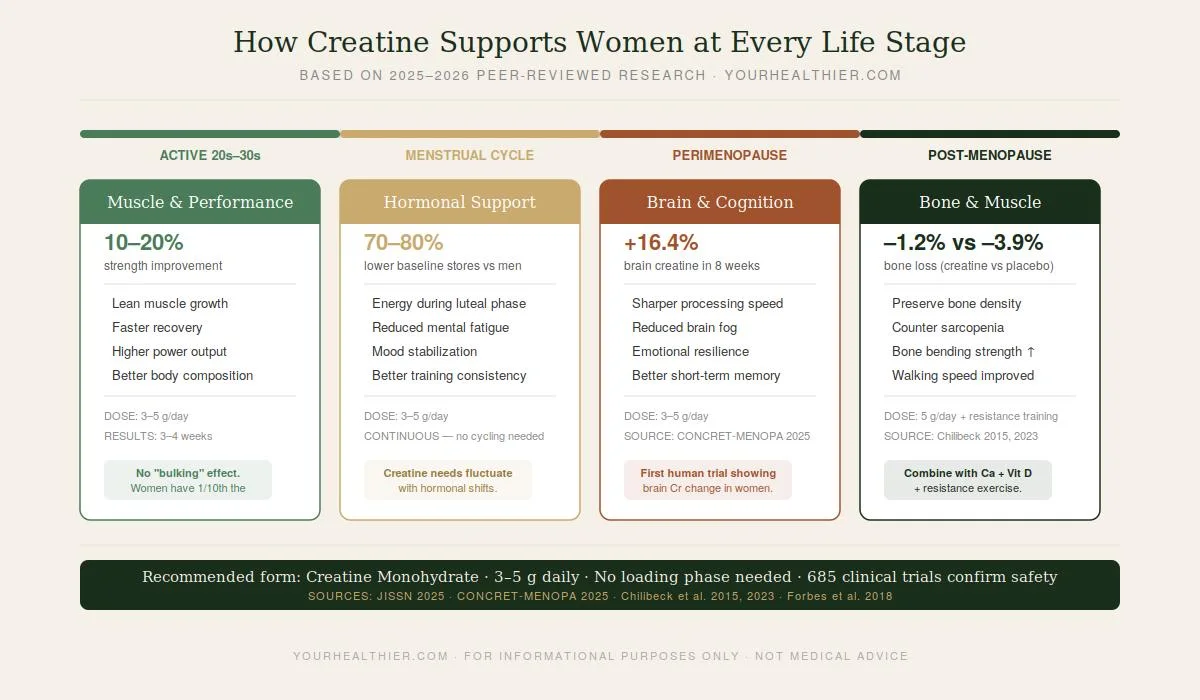
Creatine is having a moment in women's health—but a newly published trial offers a more interesting, and more limited, result than the viral promises. A study released online on 24 October 2026 found that perimenopausal women taking creatine monohydrate while completing resistance training had more consistent sleep and a higher prefrontal brain-oxygenation measurement than women taking a placebo and doing the same training. The study did not demonstrate superior cognitive-test performance, and it cannot establish that creatine is a treatment for brain fog, hot flushes or menopause itself.
FM Coaching Fitness Research | Evidence checked 28 October 2026 | By FM Coaching Editorial Team
Creatine is better known as a supplement used by strength athletes. Its new appeal to women in their 40s, 50s and beyond is understandable: menopause may coincide with disrupted sleep, changing body composition, concerns about muscle and bone health, and an overload of conflicting supplement advice. The useful question is not whether every woman should take creatine. It is which potential benefits have actually been tested in women at different stages of menopause, and which claims are still speculative.
The news in 30 seconds: what changed in October 2026?
The new European Journal of Applied Physiology study recruited 51 perimenopausal women, average age 46, into three groups. Eighteen were assigned creatine plus resistance training, 20 placebo plus the same training and 13 a non-training control. The two training groups completed resistance exercise twice per week over six weeks. The creatine group used a five-day loading protocol before a maintenance intake averaging about 4.5 g daily.
At six weeks, sleep consistency was 7.4 percentage points higher in the creatine group than in the placebo group after adjustment for baseline; this was a difference in the regularity of sleep timing, not proof of longer or universally better sleep. A functional near-infrared spectroscopy measure of prefrontal oxygenation also differed between groups. The cognitive task's reaction times improved over time, but there was no between-group advantage on those task results. Investigators also reported fewer self-reported days of temperature sensitivity in the creatine group; that is exploratory, not evidence that creatine reliably prevents hot flushes.
Study-at-a-glance
| Detail | October 2026 perimenopause trial |
|---|---|
| Journal and publication | European Journal of Applied Physiology; online 24 October 2026 |
| Participants | 51 perimenopausal women, mean age 46 ± 5 years |
| Groups | Creatine plus resistance training (18); placebo plus training (20); non-training control (13) |
| Intervention | Five-day 20 g/day loading phase, then about 4.5 g/day for six weeks; two progressive lifting sessions weekly |
| Key positive signals | Sleep consistency, prefrontal oxygenation, fewer temperature-sensitivity days |
| What it did not establish | A between-group improvement in measured cognitive performance or a proven treatment for menopause symptoms |
| Main limitation | Small, short, exploratory trial with several measured outcomes |
Source: Baker and colleagues, 2026. The intervention is a research protocol, not a personal dosing recommendation.
What the sleep result actually means
'Slept better' can refer to several different things: total hours, insomnia symptoms, number of awakenings, or how regular a person's sleep-and-wake times were. This experiment's reported significant finding was sleep consistency. The average baseline-adjusted between-group difference was +7.4 percentage points at week six (p = 0.015). That is a potentially useful signal, not evidence that creatine improves every dimension of sleep or that everyone will feel more rested.
The study used wearable data from WHOOP alongside daily symptom reports. Wearables offer practical monitoring, but their estimates are not identical to the full laboratory assessment of sleep. The trial also lasted just six weeks and did not test whether any improvement persisted after participants stopped supplementing. For someone with persistent insomnia, night sweats or fatigue, creatine should not replace a clinical assessment of the underlying cause.
What the 'brain oxygen' headline does—and doesn't—prove
The researchers used functional near-infrared spectroscopy to monitor a signal related to oxygenation in the front of the brain during a Stroop task. They reported a change of +0.32 ± 2.01% in the creatine group versus −1.62 ± 2.01% with placebo (p = 0.003). Those values describe a measured physiological signal, not a diagnosis, a clinically demonstrated improvement in memory, or proof of reduced brain fog.
The distinction matters because readers looking for 'creatine menopause brain fog' may see the word brain and assume cognitive benefit is already proven. It is not. The study's measured Stroop reaction times improved over time in both intervention groups, without evidence of an advantage specific to creatine. Other cognitive domains and longer-term outcomes still require larger, independently replicated studies.
Why this is not proof of a menopause cure
The new study tested creatine alongside exercise, not creatine as an alternative to exercise or menopause care. Both active groups trained twice weekly; the placebo comparison helps isolate a creatine-related difference on some measurements, but the non-training control cannot answer every question about symptoms, placebo effects and long-term clinical importance. The authors also described the analysis as exploratory.
The paper disclosed connections relevant to interpretation. One author has scientific advisory and equity relationships with creatine companies. A co-author employed by WHOOP exported and analysed the wearable data while blinded to treatment, and the wearable analyses were not independently repeated by a researcher without a WHOOP affiliation. These disclosures do not invalidate the study, but make independent replication particularly important. Read the full study abstract and declarations.
The bigger story: 2026 review of creatine in postmenopausal women
A separate systematic review and meta-analysis published in May 2026 looked at seven randomised controlled trials involving 608 postmenopausal women. It investigated outcomes that matter beyond the new sleep headline: lean mass, muscle strength, bone mineral density, physical function and safety.
The pooled results were modest but more directly relevant to lifting. Across the studies with usable data, women receiving creatine had an average 0.37 kg greater increase in lean mass (95% confidence interval +0.05 to +0.69 kg), and 7.5 kg more improvement in leg-press one-repetition maximum (95% confidence interval +2.2 to +12.8 kg) compared with placebo. The clearer effects appeared when creatine at roughly 5 g/day or more was paired with resistance training. Bone mineral density did not improve overall.
Do not read the numbers as personal guarantees. Studies differed in their programmes, lengths, doses and participants; lean mass measurements can include water and are not a pure measure of new contractile muscle tissue. The review's authors assessed much of the evidence as having some risk-of-bias concerns, and the review was not prospectively registered.
Evidence comparison: benefits, uncertainties and the quality of the data
| Question | What the studies suggest | How confident should a reader be? |
|---|---|---|
| Does creatine help strength training? | A small additional strength benefit in postmenopausal women training with resistance | Reasonable evidence for a modest average benefit |
| Does creatine increase lean mass? | The pooled average difference was around +0.37 kg | Modest benefit; lean mass includes water |
| Does it improve menopause-related sleep? | One small new perimenopause trial found improved sleep consistency | Preliminary, needs replication |
| Does it treat brain fog? | No superiority on the trial's cognitive-task performance | Not established |
| Does it prevent hot flushes? | Fewer self-reported temperature-sensitivity days in one trial | Exploratory, not established treatment |
| Does it protect bone density? | A large two-year trial and the 2026 review found no overall BMD benefit | Not supported as a bone-density treatment |
| Does it replace exercise or HRT? | Neither has been demonstrated | No |
Two different groups of women are represented. The October sleep study enrolled women in perimenopause, while the larger muscle-strength review centred on postmenopausal women, with average age around 62. Combining their findings into one blanket claim about all women aged 40–65 would be misleading.
What happened in the large two-year bone study?
It is tempting to conclude that anything improving muscle strength will automatically protect against osteoporosis. But one of the most informative experiments challenged that assumption. A two-year trial involving 237 postmenopausal women tested creatine against placebo alongside an exercise programme. It found no difference in bone mineral density at the femoral neck, hip or lumbar spine. Some geometric measures of hip bone structure were more favourable with creatine, but those are not equivalent to proving fewer fractures.
The practical implication is straightforward: progressive resistance activity, appropriate weight-bearing exercise, nutrition and professionally recommended bone-health care remain central. Creatine should not be sold as an osteoporosis treatment or substitute for prescribed therapies.
Creatine monohydrate, hydrochloride and 'menopause blends': what was studied?
Creatine monohydrate is the form used in the new October trial and most long-term strength-training research. It has a larger evidence base than newer marketing formulations. A separate small trial published online in 2025 and appearing in a 2026 journal issue studied creatine hydrochloride and ethyl ester in 36 perimenopausal and menopausal women and reported some promising preliminary measures, but the formulations, doses and outcomes were different. Those results should not be treated as confirmation that every expensive 'menopause creatine' blend outperforms ordinary monohydrate.
Some products include caffeine, herbs or other supplements. That can complicate medication interactions and makes it harder to understand which ingredient produces an effect. Where supplementation is appropriate, a straightforward, independently tested creatine monohydrate product is a simpler evidence-led starting point than an unverified hormone-targeting claim. FM Coaching does not endorse or prescribe a specific creatine brand.
How much creatine did the research use—and is loading necessary?
The October trial used 20 g per day for five days, followed by about 4.5 g/day. Many strength-training studies and sports-nutrition references use 3–5 g/day of creatine monohydrate, often without a loading phase. Loading fills muscle stores faster, but it is not necessary for everyone and may be less comfortable for people prone to gastrointestinal symptoms. Follow product instructions and seek professional advice if you have medical conditions or questions about medicines.
| Approach | What it means | Important limitation |
|---|---|---|
| Consistent daily intake | Common study and sports-nutrition pattern is 3–5 g/day | Not proof of individual benefit, and clinical suitability varies |
| Loading then maintenance | Research sometimes uses around 20 g/day split over 5–7 days, then maintenance | More likely to cause stomach upset; not required for most beginners |
| Taking it only on workout days | Inconsistent compared with most supplementation research | Daily consistency matters more than precise workout timing |
| High-dose 'brain support' protocols | Investigational or marketed for specific outcomes | No standard menopause brain-fog treatment dose established |
The strongest evidence here concerns a supplement paired with strength training, not a supplement that by itself reverses hormonal changes.
Could creatine make the scales go up or cause bloating?
Creatine can increase water stored within muscle, particularly early in supplementation. That may change body weight without being an increase in body fat. This is relevant to people trying to lose fat or following a body-composition programme: the scale may rise slightly while waist measurements, fitness or strength follow a different trend.
Some people experience digestive discomfort, particularly when taking large single doses. Splitting an intake or avoiding loading may be easier to tolerate. Persistent swelling, unexplained symptoms or rapid changes should not automatically be blamed on creatine; seek appropriate medical advice. It does not directly 'melt menopause belly fat', and it should not be marketed as a weight-loss medicine.
Kidney safety, blood tests and when to ask a clinician
In trials involving generally healthy adults, conventional creatine use has typically been well tolerated. The 2026 postmenopause review found no overall worsening of kidney-related measures. However, a study in healthy volunteers cannot establish safety for every person with kidney disease, abnormal kidney tests or complex medical treatment.
Creatine use can change serum creatinine measurements, which clinicians use in estimating kidney function. Tell your GP or healthcare team about supplements if blood tests are being interpreted. People with diagnosed kidney disease, unexplained renal abnormalities, significant chronic illness, or medications that raise kidney-related concerns should discuss creatine before starting. Pregnant or breastfeeding people should not assume that menopause research applies to them.
Unusual symptoms warrant individual clinical advice. Information here is educational, not a substitute for diagnosis, medication review or personalised nutritional care.
How to decide whether creatine is worth considering
A useful decision starts with the outcome, not the advertising.
- Your priority is lifting more confidently: evidence for resistance training is stronger than for treating menopause symptoms. Establish a sustainable routine first.
- Your priority is persistent brain fog or disrupted sleep: the October results are interesting but preliminary. Discuss troublesome symptoms and suitable options with a menopause-informed healthcare professional.
- Your priority is osteoporosis prevention: creatine is not a proven way to improve bone density. Ask about fracture risk and evidence-based bone-health strategies.
- You already lift and want a modest additional edge: creatine monohydrate may be worth discussing if there are no medical contraindications or practical concerns.
- You dislike supplements or cannot afford one: you can still make meaningful progress through training, adequate food, rest and appropriate healthcare.
The two-day strength programme that actually fits the evidence
The new perimenopause trial included twice-weekly progressive resistance sessions. It is not possible to reproduce the trial's exact supervised programme from the abstract alone, but a simple two-day full-body structure helps translate the overall idea into ordinary life. This is a general illustrative routine, not the trial protocol or a medical prescription. Adapt to ability, symptoms and any medical advice.
| Session A | Sets × repetitions | Purpose |
|---|---|---|
| Chair squat or goblet squat | 2–3 × 6–10 | Lower-body strength |
| Seated cable row or band row | 2–3 × 8–12 | Back and pulling strength |
| Incline press-up or chest press | 2 × 8–12 | Upper-body pushing |
| Hip hinge with dumbbells | 2 × 8–10 | Hip and posterior-chain control |
| Farmer carry or supported balance work | 2–3 short rounds | Grip and stability |
| Session B | Sets × repetitions | Purpose |
|---|---|---|
| Step-up or supported split squat | 2–3 × 6–10 each side | Single-leg strength |
| Lat pulldown or assisted pull | 2 × 8–12 | Upper-back strength |
| Dumbbell overhead press or alternative | 2 × 6–10 | Upper-body control |
| Glute bridge | 2–3 × 8–12 | Hip strength |
| Calf raise and light core work | 2 × 10–15 | Lower-leg and trunk function |
Start with manageable effort and learn the movements. Leave at least a day between demanding full-body sessions when possible. Track one or two useful metrics—repetitions, load, confidence or ease of daily tasks—and increase difficulty gradually when technique is sound. The NHS strength guidance advises muscle-strengthening activity on at least two days each week alongside aerobic movement.
What about walking, food and recovery?
Walking, regular meals and enough sleep can support a sustainable programme, but they should not be presented as a proven synergy specific to creatine. Include varied protein-rich foods and adequate energy to support activity; people with special dietary needs may benefit from a dietitian's individual assessment. Strength progress is usually better assessed over weeks and months, not from a single scale reading or one short course of supplements.
Women who want structured training can explore FM Coaching's muscle-building and strength coaching or practical fitness guides. FM Coaching offers exercise and nutrition-habit coaching; it does not prescribe creatine, assess renal disease or replace menopause healthcare.
Is creatine better than HRT for menopause symptoms?
No study cited here tested creatine as a replacement for hormone replacement therapy, and the 2026 systematic review found insufficient data to explain how HRT status changes a person's response to creatine. HRT is an individual medical decision based on symptoms, health history and risks. Creatine research and decisions about clinical menopause treatment answer different questions. If symptoms are affecting your quality of life, the NHS menopause treatment information is a more appropriate starting point than supplement advertising.
What the leading online guides often leave unclear
Readers can find useful general explanations from Bupa, Dr Stacy Sims and the Menopause Dietitian. Rather than reproduce their broad advice, the purpose of this report is narrower: explain the October 2026 trial, separate cognitive measurements from actual cognition, compare it against the May 2026 meta-analysis, show why the bone-density claim remains unsupported, and disclose the study's limitations and financial relationships.
This also means no single headline can answer everything. Research on peri- and postmenopausal women is improving, but future studies need larger, more diverse groups, longer follow-up, patient-important outcomes and independent confirmation.
The FM Coaching bottom line
Creatine monohydrate is a plausible adjunct to progressive strength training, with modest evidence for added lean mass and strength in postmenopausal women. The latest perimenopause trial adds interesting sleep-consistency and physiological signals—not a proven cure for brain fog, hot flushes or menopause. A product cannot replace a training programme, balanced nutrition or medical care, and not every woman needs to take one.
For women looking to improve strength, start with a repeatable plan. Make the decision about supplements separately, with appropriate medical advice when needed. That is a more useful conclusion than either a miracle-supplement headline or dismissing the research altogether.
Primary research and trusted sources
- Baker et al. — October 2026 perimenopausal randomised trial, European Journal of Applied Physiology.
- Naddafha et al. — May 2026 systematic review and meta-analysis of postmenopausal women.
- Chilibeck et al. — Two-year trial of creatine and postmenopausal bone health.
- Korovljev et al. — Exploratory perimenopause/menopause creatine HCl trial.
- International Society of Sports Nutrition position stand on creatine.
- NHS — Strength and flexibility activity.
- NHS — Menopause treatments.
Editorial note: Study results are reported as group averages and should not be interpreted as personalised predictions. This article was researched from published abstracts and accessible research texts; no author interview, clinical examination or independent medical review is claimed. Study details, disclosures and guidance should be checked again before publication.
Creatine for women and menopause: frequently asked questions
Does creatine help with menopause?
It may add modest strength and lean-mass benefits when combined with resistance training in postmenopausal women. A small 2026 perimenopause trial found a promising sleep-consistency signal, but creatine is not an established treatment for menopause symptoms.
What did the October 2026 creatine study find?
In 51 perimenopausal women, creatine plus twice-weekly resistance training was associated with higher sleep consistency and a different prefrontal oxygenation signal than placebo plus training. There was no between-group advantage on the cognitive task.
Can creatine get rid of menopause brain fog?
Not proven. The October 2026 trial measured a physiological brain-oxygenation difference but did not show superior cognitive-test performance with creatine. Persistent cognitive symptoms deserve clinical assessment.
Does creatine improve sleep during perimenopause?
One small six-week trial found a 7.4-percentage-point difference in sleep consistency compared with placebo. That does not establish improved sleep duration, clinical insomnia treatment or long-term benefit.
Can creatine stop hot flushes or night sweats?
No reliable clinical effect has been established. The latest small trial reported fewer self-reported temperature-sensitivity days, which requires independent replication.
Does creatine help women over 40 build muscle?
Studies involving postmenopausal women suggest small average gains in lean mass and strength when creatine is added to resistance training. The evidence is stronger for training outcomes than for menopause symptom relief.
Does creatine increase bone density after menopause?
The 2026 meta-analysis and a two-year trial did not find an overall improvement in bone mineral density. Creatine is not a replacement for established osteoporosis prevention or treatment.
What is the best creatine for menopause?
Creatine monohydrate has the most extensive research base. There is no convincing evidence that premium menopause-branded formulations consistently outperform basic monohydrate.
How much creatine do women normally take?
Common sports-nutrition studies use 3–5 g of creatine monohydrate daily. The October 2026 research used a five-day loading phase then about 4.5 g daily. This describes research and common practice, not individual medical advice.
Do women need to load creatine?
No. Loading raises muscle creatine stores faster, but consistent daily use without loading is also a common approach and may be gentler on digestion.
Should creatine be taken on rest days?
Most studies use regular daily supplementation; precise workout timing is less important than consistency. Anyone with a medical condition should discuss supplement use with their healthcare team.
Does creatine cause weight gain or menopause belly fat?
It may increase water stored inside muscle, which can temporarily affect scale weight. That is not the same as fat gain, and creatine is not a proven fat-loss treatment.
Does creatine cause bloating?
Some people experience stomach discomfort or bloating, especially with high single doses. Not everyone does; avoid assuming that new or persistent symptoms are harmless.
Is creatine safe for kidneys?
In studies of generally healthy participants, conventional use has not shown a consistent harmful kidney effect. People with diagnosed kidney disease, abnormal tests or relevant medications should obtain medical advice before using it.
Can creatine change a kidney blood test?
Creatine may affect serum creatinine measurements, which are used to estimate kidney function. Tell your healthcare professional about supplements when blood tests are being interpreted.
Can I take creatine alongside HRT?
The 2026 review found insufficient evidence to determine how HRT changes creatine response. Ask a qualified clinician about your own circumstances; creatine does not replace HRT or other menopause care.
Is creatine worthwhile without strength training?
For midlife muscle and strength goals, the clearest benefits in postmenopausal trials were seen alongside resistance exercise. Creatine alone is not a proven substitute for training.
Can creatine help women with osteoporosis?
It is not established as an osteoporosis treatment. Trials have not shown improved bone mineral density overall; seek specialist advice on bone health and fracture risk.
Is creatine suitable during pregnancy or breastfeeding?
Do not assume findings in peri- and postmenopausal women apply to pregnancy or breastfeeding. Ask a qualified maternity or healthcare professional before using supplements.
When will I notice a difference from creatine?
There is no guaranteed timetable. Training-related adaptations usually require weeks to months; the October sleep trial lasted six weeks, and average results cannot predict individual responses.
Sources and verification
- https://pubmed.ncbi.nlm.nih.gov/42926218/
- https://pubmed.ncbi.nlm.nih.gov/42141930/
- https://pmc.ncbi.nlm.nih.gov/articles/PMC13182165/
- https://pubmed.ncbi.nlm.nih.gov/37144634/
- https://pubmed.ncbi.nlm.nih.gov/40854087/
- https://pmc.ncbi.nlm.nih.gov/articles/PMC5469049/
- https://www.nhs.uk/live-well/exercise/how-to-improve-strength-flexibility/
- https://www.nhs.uk/conditions/menopause/treatment/
- https://www.bupa.co.uk/newsroom/ourviews/health-trends-for-2026
- https://www.drstacysims.com/newsletters/articles/posts/creatine-guide-for-active-women
- https://www.themenopausedietitian.co.uk/creatine-for-women-in-perimenopause-and-menopause/