FM Coaching · Fitness Research
Walking Pad Benefits in 2026: Do 7,000 Steps, Desk Walking and Fat Loss Claims Stack Up?
New 2026 cardiology guidance and walking research explain what walking pads can really do for steps, fat loss and office health—and where the popular claims go too far.
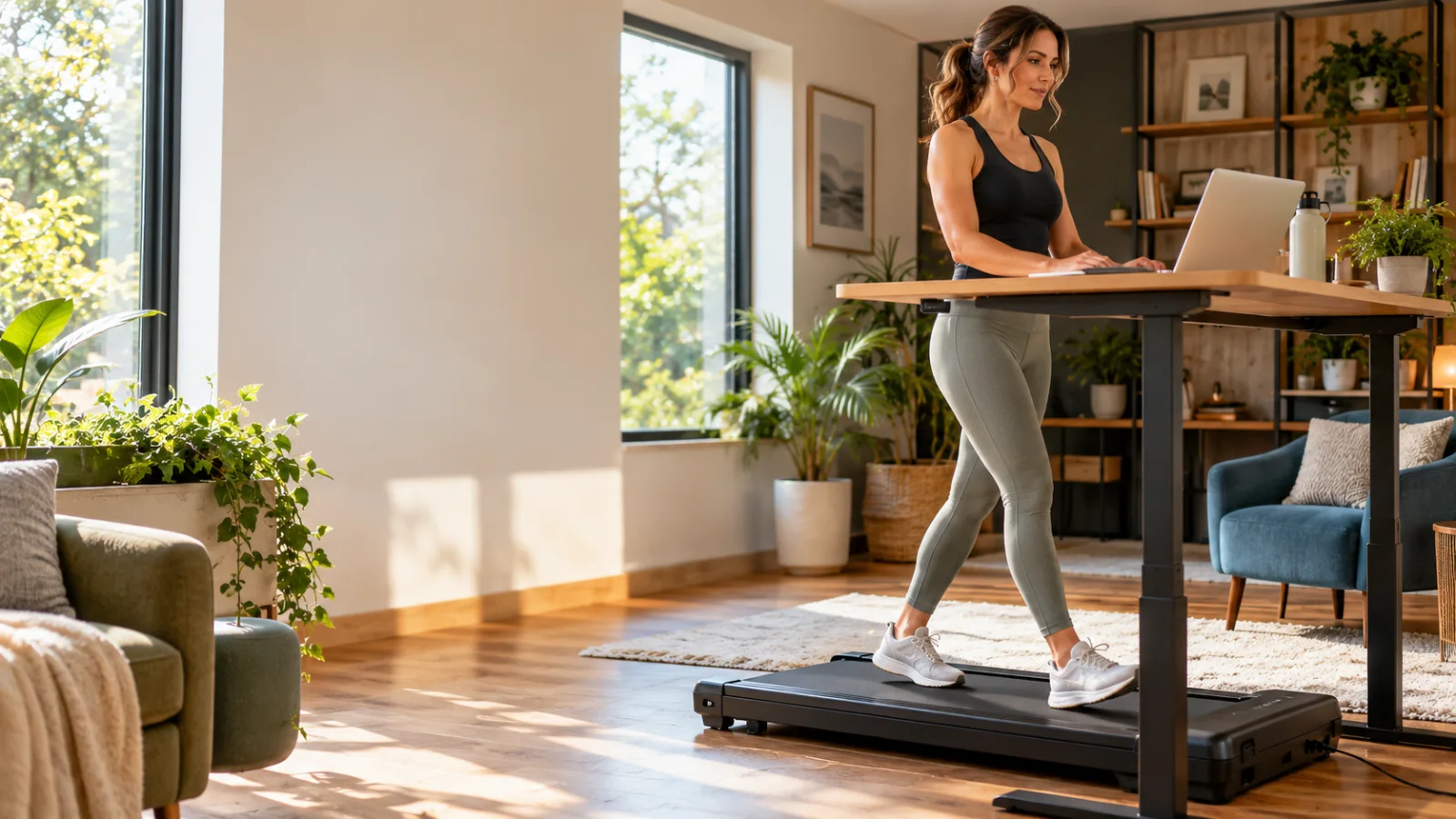
A walking pad promises a simple upgrade to a sedentary day: move the laptop, press start and turn time at home into steps. But a compact treadmill is not a shortcut to fitness, and it is not a substitute for everything else your body needs. New 2026 cardiovascular guidance, recent step-count research and controlled treadmill-desk studies make a more interesting case: walking pads can be useful when they help you replace sitting with movement you actually repeat.
The 20-second verdict
Are walking pads worth it? They can be, especially for people who work at a desk, live somewhere with difficult weather or struggle to fit walks into the day. They can increase movement and energy expenditure compared with sitting. But the published health benefits of walking come from activity, not a proven special advantage of a walking-pad machine. A walking pad will not automatically cause weight loss, and it does not replace strength training, outdoor activity or more intense exercise.
The number to remember: roughly 7,000 steps a day is a useful population-level reference point, not a medical prescription or a daily pass/fail test. The 2026 American College of Cardiology scientific statement discussed evidence showing meaningful health benefits at step counts below 10,000. The figure is primarily supported by observational step-count research, including a 2025 dose-response review; it is not the result of a walking-pad-specific trial.
Newsroom bottom line: Buy a walking pad to make walking easier to do—not because its belt has unique metabolic properties. The best walking routine is the one that fits safely into your life.
The news behind the trend: why 2026 research matters
The 7,000-step discussion has moved beyond social media
An October 2026 scientific statement from the American College of Cardiology reviewed exercise prescriptions for cardiovascular health. It summarised studies showing that approximately 7,000 daily steps are associated with clinically meaningful health benefits for many adults, while lower step counts also matter. A major 2025 systematic review of 57 studies, with 31 included in dose-response meta-analyses, reported that around 7,000 steps per day was associated with lower risks of several adverse outcomes than 2,000 steps per day.
That finding should not be mistaken for a trial in which scientists randomly assigned people to walking pads and proved they would prevent disease. Most step-count evidence is observational: people who walk more can differ in many ways from those who walk less. The association supports moving more, but cannot guarantee a particular benefit for an individual.
A separate April 2026 Nature Communications analysis using wearable data also found that higher step counts appeared to offset some health risks associated with very high sedentary time. Crucially, the study did not find that any step count fully cancelled the excess risk for coronary artery disease or heart failure. In other words, more steps do not make prolonged sitting irrelevant.
What actual treadmill-desk experiments show
A systematic review of 13 treadmill-desk studies involving 351 participants estimated that, in laboratory comparisons, using a treadmill desk increased energy expenditure by about 105 kcal per hour versus sitting. That is a pooled research result, not a personal calorie-burn promise: body size, pace, duration, machine settings and whether someone compensates by eating more will affect any real-world weight change.
Studies of active workstations also reveal a trade-off. Some research has found lower typing speed during walking compared with sitting, while complex cognitive tasks are not consistently worsened. That is why a walking pad may be most useful for listening calls, reading or routine admin rather than intricate spreadsheet work or anything requiring precise hand movements.
In a 2026 randomised crossover study of 18 sedentary young adults, hourly walking breaks improved glucose measurements during the nine-hour intervention period, but walking breaks alone did not significantly improve the main 26-hour glucose outcome. Alternating walking with simple resistance exercises produced the stronger 26-hour signal, although some findings weakened after accounting for energy expenditure. This was a small short-term study in young adults—not proof that a walking pad treats diabetes.
What the evidence actually supports
| Popular claim | What research supports | What it does not establish |
|---|---|---|
| A walking pad adds steps | It offers a practical way to walk indoors instead of staying seated | That everyone who buys one will use it consistently |
| It burns extra calories | Treadmill-desk studies show greater energy expenditure than sitting | A fixed calorie burn or guaranteed fat loss for every user |
| 7,000 steps is enough | Observational studies link around 7,000 steps with meaningful health benefits | A magic threshold or an individual guarantee |
| It cancels the harm of sitting | Replacing sitting with activity is useful | Complete removal of every risk of prolonged sitting |
| Walking while working improves productivity | It may make low-attention tasks more active | That typing and detailed work will be faster |
| A walking pad builds muscle | Walking trains endurance and lower-body movement | The same progressive muscle-building stimulus as resistance training |
Evidence ratings are deliberately conservative. The studies involve walking, active workstations and general step counts; relatively few trials isolate one modern consumer walking pad, specific home-office use patterns and long-term health outcomes.
The desk-to-door test: who actually benefits?
Instead of asking whether walking pads are 'good', ask what currently stops you from walking.
The home worker: You regularly lose two or three hours to seated calls. A quiet, stable pad may help convert one short call or listening session into movement. Start with ten minutes without working on the computer before attempting multitasking.
The parent with little spare time: You can walk indoors during a programme or while listening to an audiobook. You do not need to walk at a desk for the purchase to be useful.
The strength-training enthusiast: You already lift weights but rarely move between sessions. Gentle additional walking may help you stay active without scheduling another demanding workout. Adjust walking if it interferes with recovery or aggravates symptoms.
The person hoping to lose weight: A pad may increase activity and make a calorie deficit easier to sustain, but energy intake, sleep, consistency and the rest of your activity still matter. No device selectively burns belly fat.
The person with pain, balance problems or limited mobility: A compact pad with no handrail may be a poor first choice. Seek medical or rehabilitation guidance where needed and consider a stable treadmill with suitable supports, supervised walking or another accessible activity.
The 7-day walking-pad experiment — before you spend more money
This is an illustrative beginner schedule, not a validated clinical protocol. Choose a comfortable pace, use the machine only according to its instructions, and stop if you feel unwell. The aim is to test whether you like the habit and can repeat it.
| Day | Session | What to notice |
|---|---|---|
| Monday | 10-minute easy walk | Balance, belt length and footwear comfort |
| Tuesday | 10 minutes, with a few minutes standing still first | How it feels to transition safely on and off |
| Wednesday | Rest or an outdoor walk | Whether walking outdoors is easier or more enjoyable |
| Thursday | 2 × 10 minutes at an easy pace | Whether splitting sessions suits your day |
| Friday | 15–20 minutes, if comfortable | Whether you can maintain normal posture and breathing |
| Saturday | Outdoor walk, gym session or another favourite activity | Variety rather than dependence on one machine |
| Sunday | Review steps and enjoyment, not just calories | Whether you would willingly repeat it next week |
If 10 minutes feels too much, start smaller. If you already walk comfortably every day, the plan may be too easy; you can progress gradually. Do not hold a laptop or phone while learning to use a walking pad.
What can 20 minutes add to your step count?
Step rates vary, but at an illustrative 80–110 steps per minute, a 20-minute walk contributes around 1,600–2,200 steps. Two such sessions would mean roughly 3,200–4,400 additional steps if they are truly replacing sitting, not walking you would have done anyway. The machine's step counter and your wearable may disagree; use one consistent method to look at trends.
Example, not a personal target: Someone averaging 3,500 steps might experiment with an extra 15–20 minutes of easy walking and see where their own daily total lands. A person recovering from illness or managing a condition may need a different plan entirely.
Walking pad for weight loss: the maths most adverts skip
Walking generally uses more energy than sitting. But calories displayed on walking pads are estimates, not direct measurements. A 2021 treadmill-desk review's approximately 105 additional kcal per hour was a laboratory pooled estimate. It is not an assurance that a person walking for 30 minutes will create a particular weekly fat loss or that a daily walk will cancel out a large extra snack.
What helps in practice: record your overall weekly walking habits, be consistent with resistance training if appropriate, eat in a way you can sustain, and track changes over several weeks rather than expecting overnight scale changes. Higher daily movement can be part of a weight-management plan, but results depend on the total energy balance and other individual factors.
If your goal is fat loss while maintaining strength, see FM Coaching's fat-loss coaching and muscle-building coaching information. An evidence-based plan should fit activity around recovery and adequate nutrition, not turn every step into a punishment.
Walking pad vs treadmill vs walking outside
| Choice | Best reason to choose it | Main limitation |
|---|---|---|
| Walking pad | More walking at home or during suitable desk tasks; compact storage | Shorter deck; many models lack handrails or high speeds |
| Conventional treadmill | More speed options, structured cardio, often a sturdier rail system | More space, weight and often expense |
| Outdoor walking | No machine required; changing scenery and routes | Weather, travel, safety or accessibility may be barriers |
| Walking breaks without equipment | Free, adaptable, can interrupt sitting regularly | You must have suitable space and remember to take them |
The important comparison isn't which machine wins on paper. It is which approach you can use safely, regularly and without sacrificing other priorities. The 2026 step-count and movement research does not prove a consumer walking pad is superior to walking outside.
The purchase checklist most 'best walking pads' lists miss
Before buying, check the exact model's user weight limit, usable belt length and width, lowest and highest speed, emergency stop mechanism, child/pet safety advice, storage orientation, warranty, noise and ventilation requirements, and whether a handrail is available. Check that a desk, if used, allows relaxed shoulders, a comfortably visible screen and no need to lean forward or grab the laptop.
Try to avoid buying solely because a model claims a very high calorie burn, 'fat-burning mode' or a scientifically proven 10,000-step benefit. Consumer features are not clinical outcomes. Independent testing, such as Which?'s 2026 walking-pad assessment, can help with noise, stability, comfort and usability, but the choice still depends on your own space and circumstances.
A safety note: Keep children and pets away from the moving belt, follow the manufacturer's start-up and dismount instructions, and do not use a walking pad for running unless that exact machine is designed and rated for running. Avoid distracting calls, food preparation or carrying objects when you are not stable. If you feel chest discomfort, unusual breathlessness, faintness or dizziness, stop and obtain appropriate medical assessment.
The overlooked part of the story: walking is not strength training
The NHS advises adults to aim for around 150 minutes of moderate-intensity aerobic activity per week (or an equivalent mix) and to perform muscle-strengthening activities on at least two days. Gentle desk walking may not reach moderate intensity for everybody. A walking pad can complement this advice, not replace it.
For somebody who spends most of the day sitting, the sensible order might be: first, add short movement breaks; second, progress to more purposeful walking; third, keep or introduce suitable resistance training. You do not need to buy equipment to do any of those things.
A practical weekly balance
- Most workdays: a few short walking or movement breaks, indoors or outside.
- Two or more days: age- and ability-appropriate resistance training for major muscle groups.
- On suitable days: a walk brisk enough to increase breathing, if medically appropriate.
- Every week: adjust according to recovery, discomfort and real-life demands.
This is general information rather than a medical prescription. Specific exercise needs vary by age, fitness, disability, pregnancy status and health conditions.
An editorial check on six viral walking-pad claims
'You must get 10,000 steps.' No. A broad body of evidence suggests meaningful benefits below that figure. Individual capacity matters more than achieving a universal number.
'Walking pads melt belly fat.' No exercise machine chooses where your body loses fat. Sustainable energy balance matters.
'An hour on a walking pad burns 500 calories.' Possibly for some people at some intensities, but not a safe default claim for slow desk walking. Device figures can be inaccurate.
'Walking all day means sitting does not matter.' Not necessarily. The 2026 wearable study found that more steps did not fully offset certain risks associated with high sedentary time.
'You can work just as quickly while walking.' Sometimes, for some tasks. Research suggests typing performance can decline while walking, particularly when speed or task complexity increases.
'A walking pad replaces the gym.' Not if your goals include progressive strength, power or higher-intensity fitness. It is one convenient tool among several.
The FM Coaching conclusion
A walking pad is most compelling when it helps someone turn part of an otherwise inactive day into comfortable, repeatable movement. The 2026 research makes the health case for regular steps and sitting breaks, not for purchasing a particular machine. Take the seven-day experiment, notice whether it changes your habits, and keep strength work and enjoyable movement in the picture.
Next step: For a personalised approach to daily activity, training and sustainable body composition, explore FM Coaching. The article is educational and does not replace advice from your clinician.
Sources and how this report was prepared
This evidence explainer distinguishes research about step counts, interrupting sedentary time and treadmill desks. None should be represented as proof that a particular consumer walking pad prevents disease or guarantees weight loss.
- American College of Cardiology, Exercise Prescriptions for Cardiovascular Health in Adults: 2026 Scientific Statement.
- Daily steps and health outcomes in adults, The Lancet Public Health (2025).
- Zheng et al., Daily steps offset risks of sedentary behavior, Nature Communications (2026).
- Oye-Somefun et al., systematic review of treadmill desks (2021), PubMed.
- Ma et al., walking and resistance breaks randomised crossover study (2026), PubMed.
- Systematic review of active workstations and typing performance, PubMed.
- NHS physical activity guidelines for adults.
- Which? 2026 walking pad tests.
Editorial note: Written as a fitness news evidence explainer. No product has been independently tested by FM Coaching for this article. Research links were checked on 29 October 2026. Medical claims should be reviewed by a qualified professional before publication.
Frequently asked questions about walking pads
1. Are walking pads actually effective?
They can help you walk more and sit less. Effectiveness depends on whether you consistently use the machine and what outcome you want to improve. It is not inherently better than outdoor walking.
2. Is a walking pad good for weight loss?
It can contribute to greater daily energy expenditure, but it does not guarantee weight loss. Eating habits and total activity influence results.
3. How many steps should I do on a walking pad?
There is no special walking-pad target. Start with a comfortable amount and consider your existing daily steps, fitness and any medical advice. Around 7,000 steps a day is a useful research reference for many adults, not an obligation.
4. Do I need 10,000 steps a day?
No. Studies show benefits at lower step totals; 10,000 can be a reasonable goal for some but is not a universal minimum.
5. Is 20 minutes on a walking pad enough?
Twenty minutes can be a useful contribution, particularly if it replaces sitting. Whether it is enough depends on your overall routine and goals.
6. How many calories does a walking pad burn?
That varies by body size, walking speed and time. A treadmill-desk meta-analysis found an average laboratory increase of about 105 kcal per hour compared with sitting, not a guaranteed personal burn.
7. Can I use a walking pad every day?
Many people can walk daily at an appropriate level, but build gradually and reduce or stop if symptoms occur. Consider medical advice if you have relevant health concerns.
8. Is a walking pad better than a treadmill?
A walking pad can be better for space-saving and easy indoor walking; a conventional treadmill is often more suitable for running or faster structured sessions.
9. Are walking pads good for working from home?
They can be useful during calls, listening tasks and other appropriate activities. Start without multitasking, then assess whether walking affects concentration and typing.
10. Can you lose belly fat on a walking pad?
A walking pad cannot target abdominal fat specifically. Changes in fat mass depend on wider energy balance and individual factors.
11. Do walking pads build leg muscle?
Walking uses leg muscles, but for significant strength and muscle growth most people also need progressive resistance training.
12. Are walking pads suitable for beginners?
They can be, provided the machine is stable, the user can balance safely and the pace is comfortable. Handrail-free models may not suit everybody.
13. What speed should I use while working?
Begin very slowly and only speed up while maintaining normal posture and control. There is no universally safe desk-walking speed; follow the equipment instructions.
14. Can walking pads replace outdoor walking?
They can provide an indoor alternative, but outdoor walking offers other experiences such as varied surfaces and scenery. Neither needs to exclude the other.
15. Is walking on a pad the same as getting 7,000 outdoor steps?
Steps contribute to the daily total regardless of setting, though intensity, terrain and other features of activity may differ. Research does not prove that indoor and outdoor sessions are identical in every respect.
16. Will a walking pad improve blood sugar?
Walking and interrupting sitting can influence short-term glucose responses in research settings, but results depend on the protocol and population. A walking pad is not a diabetes treatment.
17. Can I use a walking pad if I have back or knee pain?
Possibly, but suitability depends on the cause and severity of symptoms. Seek personalised guidance if pain, balance or mobility is an issue, and stop if discomfort worsens.
18. Is a walking pad worth buying in 2026?
It may be worth it if you have a safe space, can afford it and believe you'll use it to replace sitting. If outdoor walks and free indoor movement breaks already work well for you, you may not need one.
Sources and verification
- https://www.jacc.org/doi/10.1016/j.jacc.2026.09.008
- https://www.sciencedirect.com/science/article/pii/S2468266725001641
- https://www.nature.com/articles/s41467-026-71652-0
- https://pubmed.ncbi.nlm.nih.gov/34774020/
- https://pubmed.ncbi.nlm.nih.gov/42017059/
- https://pubmed.ncbi.nlm.nih.gov/32116273/
- https://www.nhs.uk/live-well/exercise/physical-activity-guidelines-for-adults-aged-19-to-64/
- https://www.which.co.uk/reviews/treadmills/article/best-walking-pads-and-under-desk-treadmills-aBRuS2F2n9V2