FM Coaching · Fitness Guides
Bodybuilding Cutting Diet: Lose Fat While Preserving Muscle
A sustainable bodybuilder-focused cutting framework with evidence-based protein and training targets, meal examples and clear health safeguards.
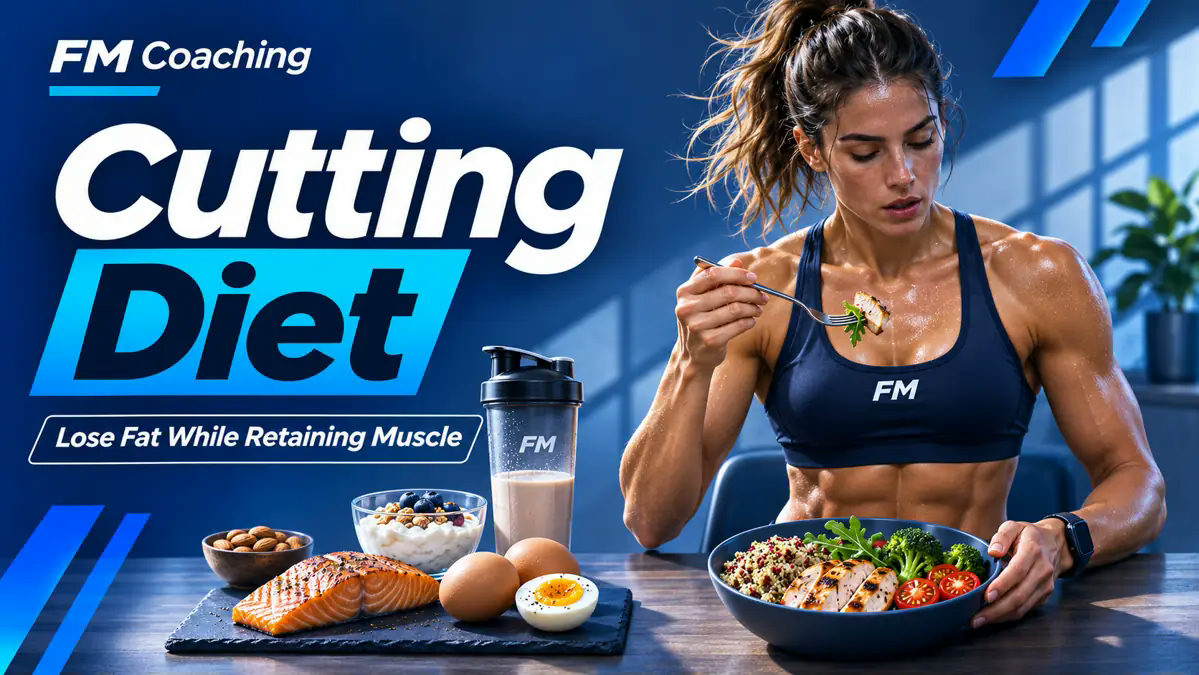
A successful cut does not just make the scale go down. It aims to reduce body fat while keeping training performance, muscular tissue and day-to-day health as intact as possible. Losing weight fast and arriving exhausted, weaker and flat is not a useful definition of bodybuilding progress.
This guide explains the order in which to set calories, protein, carbohydrates, fats and training. It is an educational framework for adults, not a prescription for a specific person or a contest-ready dehydration strategy.
What is a bodybuilding cutting diet?
A cutting diet is an eating approach designed to produce a sustained, manageable energy deficit while supporting muscle retention with adequate protein and resistance training. It usually follows a muscle-gaining phase or a period at maintenance. Unlike an unstructured crash diet, the plan includes explicit monitoring of performance, recovery, food quality and bodyweight trends.
Cutting for general physique goals is different from reaching very low body-fat levels for competition. Those extreme endpoints require specialist support and can carry health risks.
How do you calculate calories for a bodybuilding cut?
Start with your own maintenance pattern, not an arbitrary calorie number from social media. Ideally, compare a few weeks of average body weight with your typical intake and activity to estimate the energy level at which weight stays approximately stable. Then use a small to moderate deficit and reassess your trend over two or three weeks.
For illustration only: someone whose observed maintenance intake is 2,500 kcal might test a 250–400 kcal daily reduction, producing a starting range around 2,100–2,250 kcal. Another person could have a radically different maintenance level. These are arithmetic examples, not recommendations to eat the displayed intake.
The 2026 ISSN position stand on weight reduction stresses individualising deficit size and protecting lean mass. It also warns that very-low-energy and low-energy diets can increase nutritional problems and lean tissue loss; their short-term results should not be presented as superior long-term bodybuilding practice.
How much protein do bodybuilders need when cutting?
Adequate protein and continued resistance training are two of the most important muscle-retention tools. The latest ISSN review reports that approximately 1.6–2.2 g protein/kg bodyweight/day with resistance training may support muscle maintenance in many adults. Some lean, experienced athletes dieting hard may need individually assessed higher amounts. Kidney disease or other medical conditions require different advice.
| Illustrative bodyweight | 1.6 g/kg | 2.2 g/kg |
|---|---|---|
| 60 kg (132 lb) | 96 g/day | 132 g/day |
| 75 kg (165 lb) | 120 g/day | 165 g/day |
| 90 kg (198 lb) | 144 g/day | 198 g/day |
These are mathematical reference values, not personalised daily prescriptions. Distribute protein across meals you enjoy and can sustain. Protein powder is optional; fish, eggs, poultry, yoghurt, tofu, tempeh and legumes can all contribute.
How should you split carbohydrates and fats when cutting?
After setting an appropriate total energy intake and protein level, choose sufficient dietary fat and use remaining energy for carbohydrate. There is no single bodybuilder-perfect carbohydrate percentage. If hard gym sessions deteriorate, allocating more of your remaining energy to carbohydrate may improve training comfort. If you prefer a different balance and it supports good nutrition, that can work too.
For understanding macro arithmetic: 150 g protein contributes roughly 600 kcal; 65 g fat contributes about 585 kcal; 200 g carbohydrate contributes approximately 800 kcal. Their theoretical total is 1,985 kcal before food-label rounding. That example illustrates calculation only, and does not establish an appropriate calorie target for the reader.
What can you eat on a bodybuilding cutting diet?
Build satisfying meals around a protein source, vegetables or fruit, a fibre-rich carbohydrate where useful, and a measured fat source. You can include foods you like. Cutting is not a requirement to live on dry chicken and broccoli.
| Meal | Illustrative choice | Easy substitution |
|---|---|---|
| Breakfast | Greek yoghurt, oats, berries and seeds | Fortified soy yoghurt, oats and fruit |
| Lunch | Chicken, rice and crunchy vegetables | Tofu, rice and mixed vegetables |
| Afternoon | Fruit, cottage cheese and wholegrain toast | Hummus and chickpea wrap |
| Dinner | Salmon, potatoes and green vegetables | Bean chilli with potatoes or rice |
Adjust serving sizes and preparation methods to individual energy needs. The table deliberately does not pretend that a generic portion has an exact calorie value in every country; food composition and cooking oils vary.
Can you follow a 7-day cutting diet without repeating every meal?
Yes. Use a simple three-part rotation that gives variety without complex meal prep: breakfast alternates between yoghurt/oats, eggs/toast and tofu scramble; lunch rotates chicken-rice bowls, tuna or bean wraps and lentil soup; dinner alternates fish with potatoes, turkey or soy mince chilli, and tofu stir-fry. Use leftovers for busy days and swap vegetables, grains and seasonings. Add snacks according to hunger, training and actual calorie needs.
Rather than prescribing seven identical calorie totals, this method lets you build a sustainable week around your own maintenance estimate and appropriate deficit.
Should you lift heavy while cutting?
Keep resistance training. The goal is not to turn every lifting session into calorie-burning cardio. Preserve challenging but controlled compound and isolation work, reduce nonessential sets if recovery suffers, and monitor performance over several weeks. The ACSM 2026 training overview supports progressive resistance work and does not require constant training to failure.
A three-day full-body or four-day upper/lower split may help protect strength. Keep one or two repetitions in reserve on your most demanding movements when fatigued. Sudden rapid strength loss can be a signal to review calories, sleep, programme volume or health rather than automatically adding more cardio.
How much cardio should bodybuilders do during a cut?
Choose an amount that supports energy expenditure and cardiovascular fitness without overwhelming leg recovery. Brisk walking and modest steady-state sessions may be easier to sustain than frequent maximal intervals. Keep daily activity reasonably consistent when judging a weight trend. More cardio is not always better if it increases hunger or reduces training performance.
How fast should you lose weight while keeping muscle?
The ISSN 2026 statement discusses roughly 0.5–1% bodyweight per week as an athletic research reference, with a more conservative pace often sensible for lean individuals. In practice, water, menstrual-cycle changes, sodium intake, muscle glycogen and digestion can conceal progress temporarily. Judge several weekly averages rather than reacting to one morning's reading.
For example, 0.5% of 80 kg is 0.4 kg/week; this is arithmetic, not a promise or mandatory loss rate. If you are already very lean, competing, or showing signs of low energy availability, a deficit may be inappropriate.
What is a six-week bodybuilding cutting checklist?
| Period | Focus | Review |
|---|---|---|
| Week 1 | Establish maintenance estimate, regular meals and baseline lifts | Confirm feasible schedule and food intake |
| Week 2 | Maintain adequate protein and normal training | Compare weekly averages without reacting to daily noise |
| Week 3 | Keep stable activity and check sleep, energy and strength | Review whether deficit is actually modest |
| Week 4 | Assess trends and food adherence | Change only one variable if progress genuinely stalls |
| Week 5 | Protect training quality and rest days | Review hunger, mood and injuries |
| Week 6 | Decide whether to continue or maintain | Prioritise health and muscle retention |
Do not use this table as a demand to continue cutting for six weeks if recovery or health deteriorates. Stop and seek professional support for persistent dizziness, fainting, missed menstrual periods, obsessive food restriction or other concerning symptoms.
What makes a cutting diet unsafe or ineffective?
- Choosing a calorie target based solely on height or a celebrity's intake.
- Replacing proper meals with supplements or relying on dehydrating tactics.
- Removing most carbohydrates despite heavy training and low energy.
- Combining aggressive food restriction with excessive cardio.
- Ignoring repeated injuries, fatigue or persistent low mood.
- Assuming losing more weight always improves a bodybuilding physique.
The IOC relative-energy-deficiency consensus documents how prolonged inadequate energy intake can harm health and performance in men and women.
Bodybuilding cutting diet FAQs
Is a mini-cut better than a long cut?
Not universally. Your starting body composition, competition timeline and recovery determine whether a brief moderate phase or longer gradual approach is more suitable. See recomp vs mini-cut vs lean bulk.
Do fat burners preserve muscle?
They are not a substitute for nutrition and resistance training, and some products carry safety risks. Avoid claims of effortless fat loss.
Should I eliminate sweets completely?
No. Overall dietary pattern, enough nutrients and consistent energy intake matter. A rigid forbidden-food approach is often unnecessary.
Can I bulk and cut at the same time?
Some people can experience body recomposition, particularly beginners or those returning to training, but it is not equally productive for everyone. Read our recomposition after weight loss guide.
For personalised fat-loss coaching, visit FM Coaching to explore the seven-day free trial and training support.
Research and sources
- ISSN 2026 weight reduction position stand
- Evidence review: natural bodybuilding contest preparation
- ACSM 2026 resistance training position stand
- IOC 2023 REDs consensus statement
Educational content only. No single calorie target or weight-loss pace suits every person. People with chronic illness, pregnancy, eating disorders or a history of low energy availability require individual medical and dietetic support.
Questions and answers
How do I cut body fat without losing muscle?
Use a manageable calorie deficit, continue progressive resistance training, consume sufficient protein, and monitor strength and recovery. Some lean mass loss is still possible.
How much protein should I eat when cutting?
The ISSN 2026 position stand describes 1.6–2.2 g/kg/day as a useful range for many resistance-trained adults; lean competitive athletes in deficits may require individualised higher amounts.
How quickly should bodybuilders lose weight?
Athletic guidance often discusses approximately 0.5–1% of body weight weekly, with slower loss preferable for some leaner people. Never impose this rate without considering health and energy availability.
Should I stop lifting heavy when cutting?
No. Keep resistance training with appropriate intensity and adjust volume if recovery deteriorates; the goal is to preserve useful training stimulus.
Are zero-carb cutting diets better?
No diet has a universal advantage. With comparable energy and protein, dietary carbohydrate-to-fat ratio can be adjusted for training performance and personal preference.
Can I cut on very low calories?
Extremely restrictive diets raise nutritional and lean-mass risks and are not a general bodybuilding recommendation. Seek qualified medical guidance where appropriate.