FM Coaching · Fitness Guides
HYROX Relay Running Order 2026/27: Who Does Each Station?
A four-person HYROX Relay team can choose who completes each of the eight run-and-workout legs. Learn the fixed race sequence, two example allocations, transition rules and how to choose your strongest order.
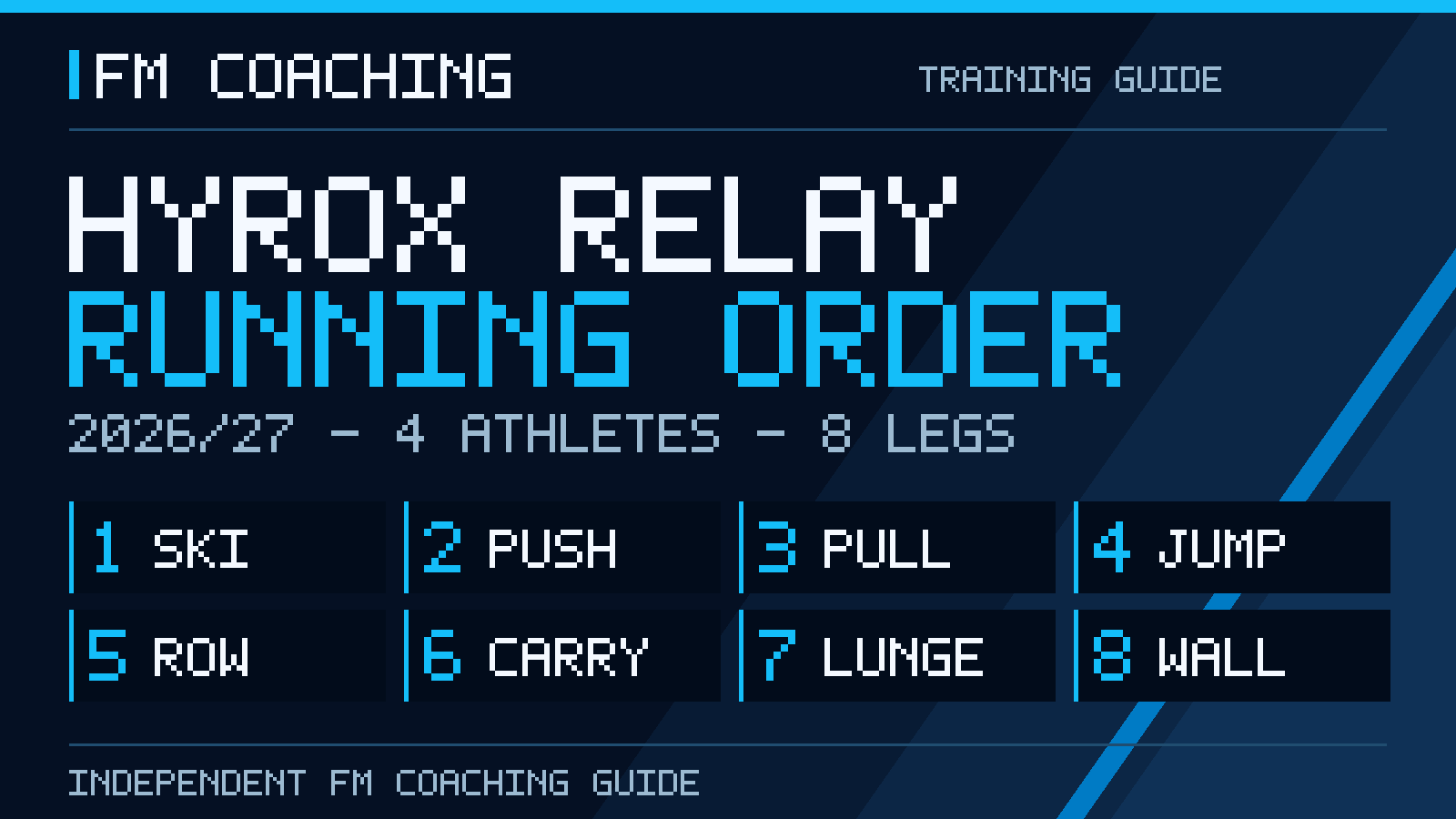
Your HYROX Relay team chooses which two legs each athlete completes; the eight-station race sequence cannot be rearranged. In the standard 2026/27 four-person Relay, every teammate is responsible for two nominal 1 km runs and their two associated full workouts. Each leg starts with the run. You can allocate adjacent legs to one athlete or separate their two efforts, depending on your team's strengths.
Rules checked 24 November 2026 against the official 2026/27 Relay rulebook, particularly sections 4.1, 5.1, 5.3.1 and 6.8.1. The examples below are independent coaching suggestions for standard Relay, not Elite Invitational or other race formats.
What is the HYROX Relay running order?
The eight legs are fixed. Use the following table to assign an athlete to each leg before race day. The columns show two valid example rotations, not an official required team order.
| Leg | Run then workout | Paired | Rotating |
|---|---|---|---|
| 1 | 1 km + SkiErg 1,000 m | A | A |
| 2 | 1 km + sled push 50 m | A | B |
| 3 | 1 km + sled pull 50 m | B | C |
| 4 | 1 km + burpee broad jumps 80 m | B | D |
| 5 | 1 km + row 1,000 m | C | A |
| 6 | 1 km + farmers carry 200 m | C | B |
| 7 | 1 km + sandbag lunges 100 m | D | C |
| 8 | 1 km + 100 wall balls | D | D |
Each column assigns exactly two complete legs to A, B, C and D. For the broader race sequence, see our HYROX station order guide; the present guide concentrates on how the Relay team divides that work.
How far does each HYROX Relay team member run?
The prescribed running distance is 2 km per teammate and 8 km across the team. Movement to and from workout areas, the relay exchange and the finish adds further travel. A venue may divide a run into several physical laps. Check the race map and count the laps assigned to your leg rather than relying on an indoor GPS watch. The first runner should know the start approach, and the final runner should know the wall-ball finish procedure.
Can you choose your own HYROX Relay stations?
Yes, provided everyone takes responsibility for two complete legs in the fixed race sequence. A teammate who selects the sled pull also takes the run immediately before it. Relay is not Doubles: you cannot send a fast runner out for the kilometre and substitute a stronger athlete at the workout, or divide a single station into short shifts. Choose your assignments as complete run-and-workout combinations. Section 5 of the Relay rulebook is the controlling reference.
Is it better to do back-to-back HYROX Relay legs or rotate?
Adjacent legs simplify team organisation but expose the same athlete to another running effort before they have properly recovered from the first workout. A rotating approach gives athletes time between their efforts but requires everyone to be ready for more exchanges. Test both rather than assuming one is always quicker. For example, pair SkiErg and rowing for an athlete with strong machine technique, or separate sled push and farmers carry for a strong athlete who recovers better between legs. The table's paired allocation may work for a balanced team; the rotating version is one way to spread fatigue. Neither is automatically fastest.
How do HYROX Relay changeovers work in 2026/27?
The Relay rulebook specifies an exchange inside the marked Transition Zone, with the outgoing and incoming athletes making a high-five. The next teammate should arrive shortly before their turn and the outgoing runner should clear the zone promptly. A racer assigned consecutive legs must still travel through the Transition Zone between them so their timing is registered. Do not shortcut straight from the station onto the next run. The general HYROX help-centre wording also refers to chip or baton transfers; it differs from the detailed season rulebook. Confirm the timing equipment and precise handoff instructions at your own event briefing rather than assuming a chip must be transferred. Follow the venue's race crew.
How do you decide who should take the sleds, burpees and wall balls?
Time each runner over a controlled kilometre followed by a candidate workout. Record the combined result, any no-reps or stops and how well they recover. Use division-appropriate equipment and consistent conditions. A strong sled athlete who loses substantial time on the preceding run may not be the best total-leg choice. A dependable wall-ball athlete who maintains squat depth and target accuracy under fatigue is often a sensible anchor candidate.
For a simple illustrative comparison, Athlete A might complete the run and sled push in 7:00 and run plus row in 8:00; Athlete B might complete those legs in 8:00 and 7:20 respectively. Assigning A the push and B the row gives a combined 14:20 instead of 16:00. This is a hypothetical example, not measured athlete performance. Repeat the test at sustainable effort and account for the other six legs and recovery between assignments.
How should mixed HYROX Relay teams allocate stations?
The standard mixed team comprises two women and two men. Use the applicable female or male loads in section 4.1 of the official Relay rulebook when testing each athlete. Do not import Singles Pro weights into your Relay plan. Consider each person's combined split, legal movement consistency and recovery rather than automatically giving every loaded station to the men. Each athlete still needs exactly two legs.
Do all four HYROX Relay members finish together?
Yes. Under section 6.8.1 the three inactive teammates approach the designated Relay entrance by spectator routes when the last runner begins leg eight, wait until that runner starts wall balls, then enter to support them. The assigned racer completes the 100 valid repetitions; after that, the four teammates proceed together to the finish. Supporting the final athlete does not mean sharing their repetitions.
What should each Relay teammate check before their first leg?
Write down each athlete's assigned leg numbers and the workout following each run. Review the venue's lap count, transition-zone instructions and timing arrangements as a team. Our running laps guide explains the difference between course laps and running segments, while the timing chip guide covers general registration and chip checks. Relay-specific equipment and handoff instructions take priority over Singles guidance. Confirm the exact arrangements with race staff.
How can you rehearse your Relay running order before race day?
Start with a scaled team session: eight easy 400 m run segments, each followed by a short, manageable portion of the corresponding workout. Assign the legs using your chosen rotation. Mark a mock transition area and practise the exchange after each completed leg. Increase workload only as your training history and recovery allow. Record combined leg times, handoff delays and technical errors; adjust the plan if one athlete repeatedly struggles to recover. A missed station or incomplete workout can invalidate a competitive result, so rehearse movement standards before chasing speed. For a tailored programme, explore FM Coaching's HYROX online coaching. Always check the official rulebook directory again before competing.