Sumo Squats: The Complete Guide to Proper Form, Muscles Worked and Benefits
Find a stance you can control, understand the muscles involved and build a lower-body routine you can progress.
Sumo squats, explained
Sumo squats are a wide-stance squat with the toes turned comfortably outward. They train the quadriceps, glutes and hip adductors while the trunk helps stabilise the movement. Use a stance and depth you can control, with steady foot contact and coordinated hip and knee bending. Beginners can start with bodyweight; experienced lifters can add resistance without forcing extra width.
- Movement
- Wide-stance squat
- Main muscles
- Quads, glutes and adductors
- Equipment
- Bodyweight, dumbbell, kettlebell or barbell
- Starting level
- Beginner, with an appropriate setup
What are sumo squats?
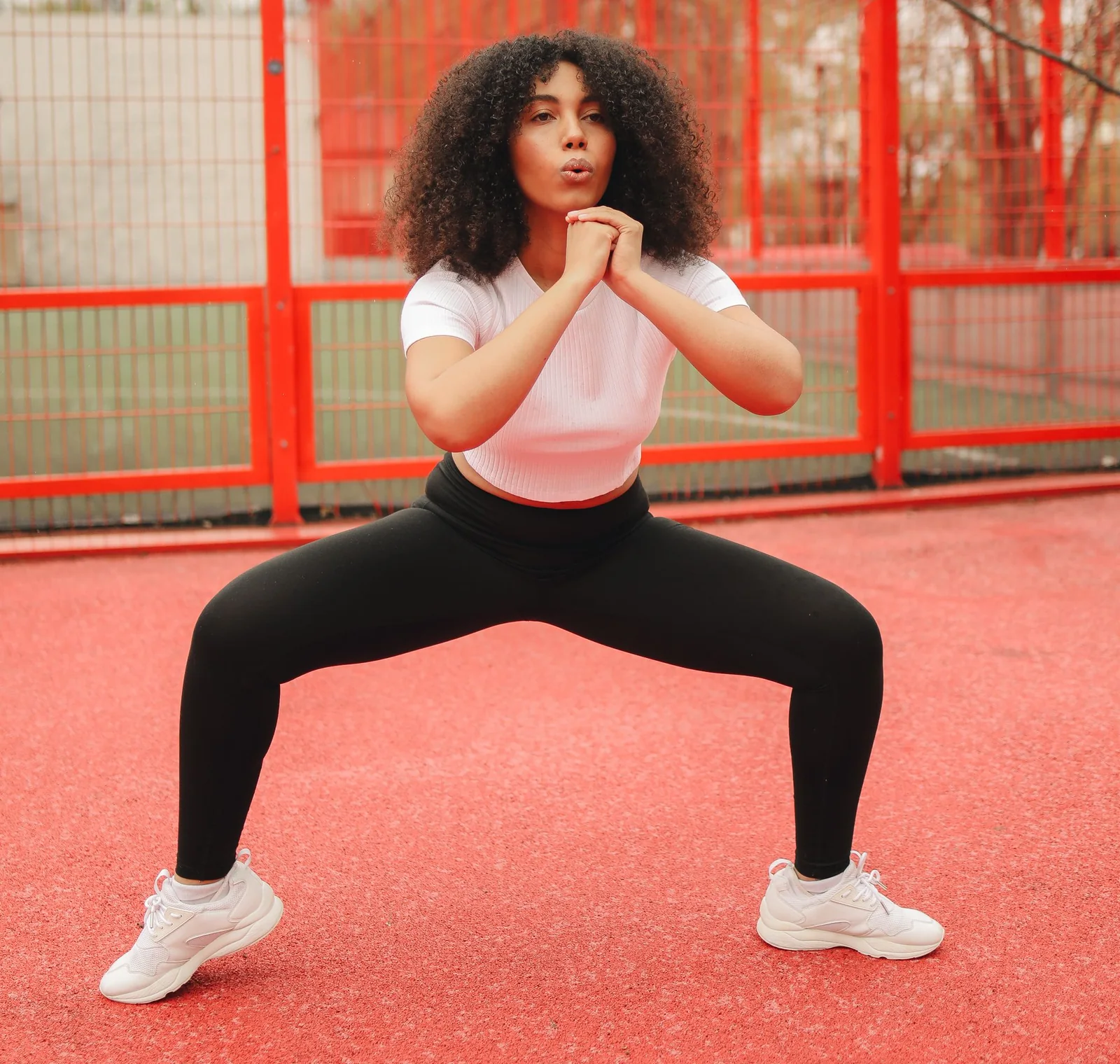
A sumo squat is a squat performed with a wider stance and outward-facing toes. You still bend and straighten both hips and knees. The width changes how your hips move and how you organise balance; it does not turn the movement into an inner-thigh isolation exercise.
“Wide” is relative to your usual squat. Leg proportions, hip structure, available movement and the position of the weight all influence a comfortable setup. Start only a little wider than shoulder width, then experiment in small increments. There is no compulsory distance between your feet or universal 45-degree toe angle.
A study of 42 novice and experienced squatters found that stance and foot angle changed joint motion and loading. It supports testing combinations thoughtfully, rather than copying an extreme stance from a photograph.[1]
How to do sumo squats: eight steps
Learn with bodyweight on a firm, clear surface. Use a light load only when you can repeat the movement comfortably.
- Select your width. Stand slightly wider than your normal squat. Make a few shallow practice repetitions. Bring your feet closer if the position feels stretched, pinched or difficult to balance.
- Turn your toes out comfortably. Let the knees bend in roughly the same direction as the toes. Do not wrench the feet outward while keeping the knees pointing straight ahead.
- Prepare your trunk. Take a comfortable breath and gently brace around your middle. Keep ribs and pelvis organised rather than flaring the chest. Look ahead or slightly downward.
- Lower through hips and knees together. Let your hips travel down between your legs while your knees bend. Some forward torso lean is normal; “upright” does not mean perfectly vertical.
- Keep the whole foot connected. Maintain contact through the heel and the bases of the big and little toes. Follow the general direction of your toes with your knees without forcibly pushing them as wide as possible.
- Choose a controlled depth. Descend only as far as you can stay balanced and comfortable. Do not force parallel or maximum depth if your feet lift, your position changes abruptly or you feel pain.
- Stand up smoothly. Push through the floor and straighten hips and knees together. For light practice, breathe out as you rise. Reset your breath between repetitions; avoid prolonged breath-holding.
- Finish tall. Return to your starting position without leaning backwards or thrusting the hips forward. Check your balance, then repeat at a pace you can control.

Sharp pain, persistent discomfort or hip pinching is a reason to stop that version. Try a smaller width or a different squat, and seek individual guidance from an appropriately qualified professional if symptoms persist. This guide is general exercise education, not injury assessment.
Sumo squat muscles worked
The main movement contributors are the quadriceps, gluteus maximus and hip adductors, with other muscles helping control the movement.

- Quadriceps: extend the knees as you rise and help control knee bending during the descent.
- Gluteus maximus: helps extend the hips. Its demand depends on depth, load and the way you move.
- Hip adductors: contribute to hip control; parts of the adductor magnus also assist hip extension. A wider stance changes their working position, but does not isolate every inner-thigh muscle.
- Hamstrings: contribute to the movement, but a squat is not a complete substitute for dedicated hip-hinge or knee-flexion training. A squat-depth training study found no significant hamstring growth in either group.[4]
- Trunk stabilisers: abdominal and back muscles help maintain control of the torso and pelvis. The exercise is not primarily an abdominal isolation movement.
What are the benefits?
Sumo squats can provide a useful way to train lower-body strength and muscle, practise coordinated hip and knee movement and include the adductors within a compound exercise. Bodyweight, dumbbell and kettlebell options make the pattern accessible at home as well as in a gym.
The benefit comes from a suitable, progressive training challenge. A wide stance is an option for finding a comfortable movement, not proof of greater muscle growth, superior balance or reduced injury risk. Resistance training has broad benefits, but those findings should not be presented as unique to this variation.[5]
It also cannot selectively burn inner-thigh fat. If body-fat reduction is your aim, look at the wider routine in our sustainable fat-loss guide or explore personalised fat-loss coaching.
Sumo squat vs regular squat
“Regular” usually means your comfortable conventional stance; it is not one precise foot position. Compare the versions using the same implement before assuming a difference comes from stance alone.

| Feature | Regular squat | Sumo squat |
|---|---|---|
| Stance | Your usual comfortable width | Wider, with comfortable toe-out |
| Mechanics | Hip and knee bending; torso angle varies | Same basic pattern, with more hip abduction |
| Muscles | Quads, glutes and adductors; trunk support | The same broad groups; demands vary with setup |
| Equipment | Bodyweight, goblet, dumbbell or barbell | The same options, including a hanging load |
| Practical advantage | A familiar baseline to practise and progress | Another stance to test; room for a weight between the legs |
| Mobility demands | Depth and loading influence hip and ankle movement | Requires tolerance of a wider, turned-out hip position |
| Who may prefer it? | Someone who controls their usual stance well | Someone who finds the wider position comfortable and repeatable |
Find your best sumo squat stance
Use this simple decision guide before choosing a working weight. It is an observation exercise, not a test that diagnoses tight or weak muscles.
- Start with five slow bodyweight repetitions. Try a modestly wider stance, comfortable toe-out and a manageable depth.
- Feet steady and movement comfortable? Keep that setup. Note where your feet are so you can reproduce it next time.
- Heels lift or balance shifts? Reduce depth, then test a slightly narrower width. Change one thing at a time; do not force your feet flat under a heavy load.
- Knees and toes feel mismatched? Adjust width or toe angle slightly and repeat. Look for smooth tracking, not a rigid pose.
- Hips pinch or discomfort increases? Stop that setup. Choose another comfortable squat and get individual advice if the problem continues.
- Bodyweight feels repeatable? Try a light goblet hold or hanging weight. Keep whichever allows the clearest movement; return to bodyweight if control deteriorates.
Stable, comfortable repetitions
Repeat the same range
Keep several good reps available
Only when useful to your goal
Download the one-page technique checklist and training log (PDF)
A programme that fits the way you train
Need help choosing exercises and progressing them? FM Coaching offers personalised training, progress tracking and individual guidance.
Explore personalised muscle-building coaching ↗Seven useful sumo squat variations
1. Bodyweight sumo squat
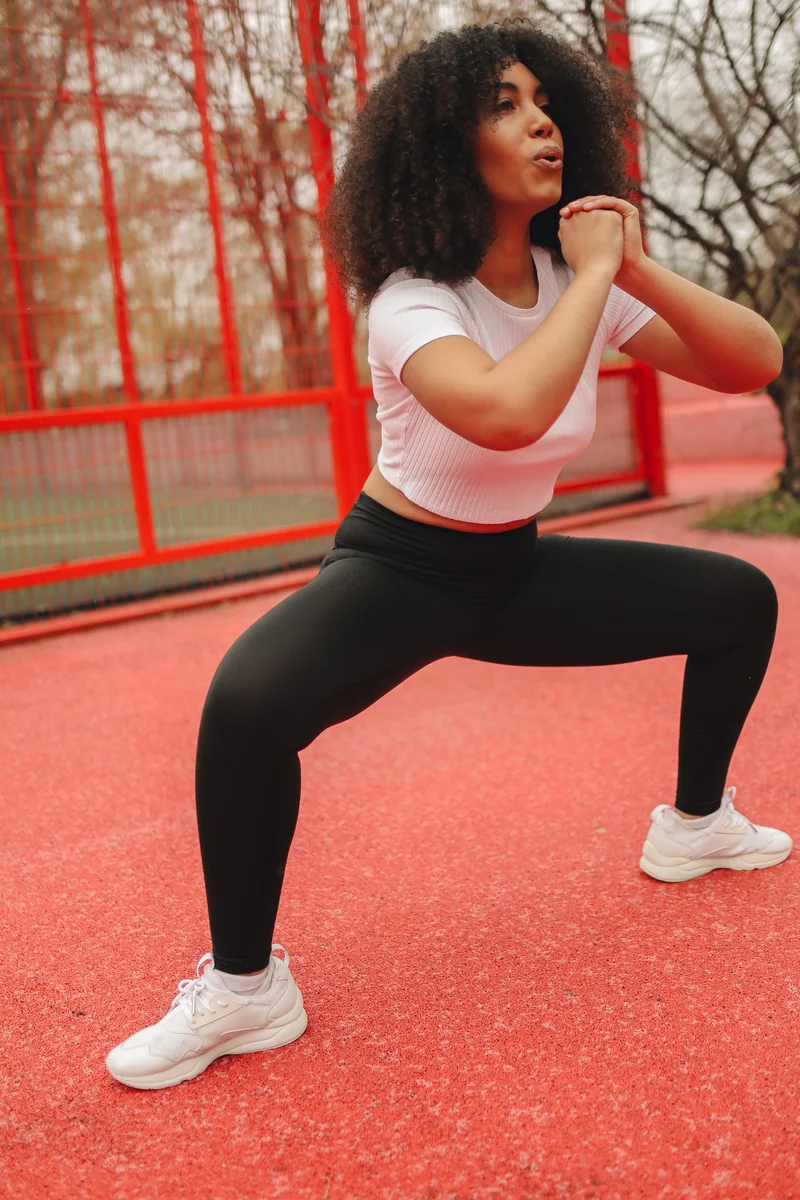
Keep hands in front for balance. Practise an unhurried descent and repeatable depth. This is a useful starting point, although stronger lifters may need resistance for a challenging working set.
2. Dumbbell sumo squat
Hold one dumbbell securely with both hands between your legs, arms long. Keep it close to your centre rather than swinging forwards. Select an implement with a secure grip; do not hold a loose adjustable plate assembly.
3. Kettlebell sumo squat
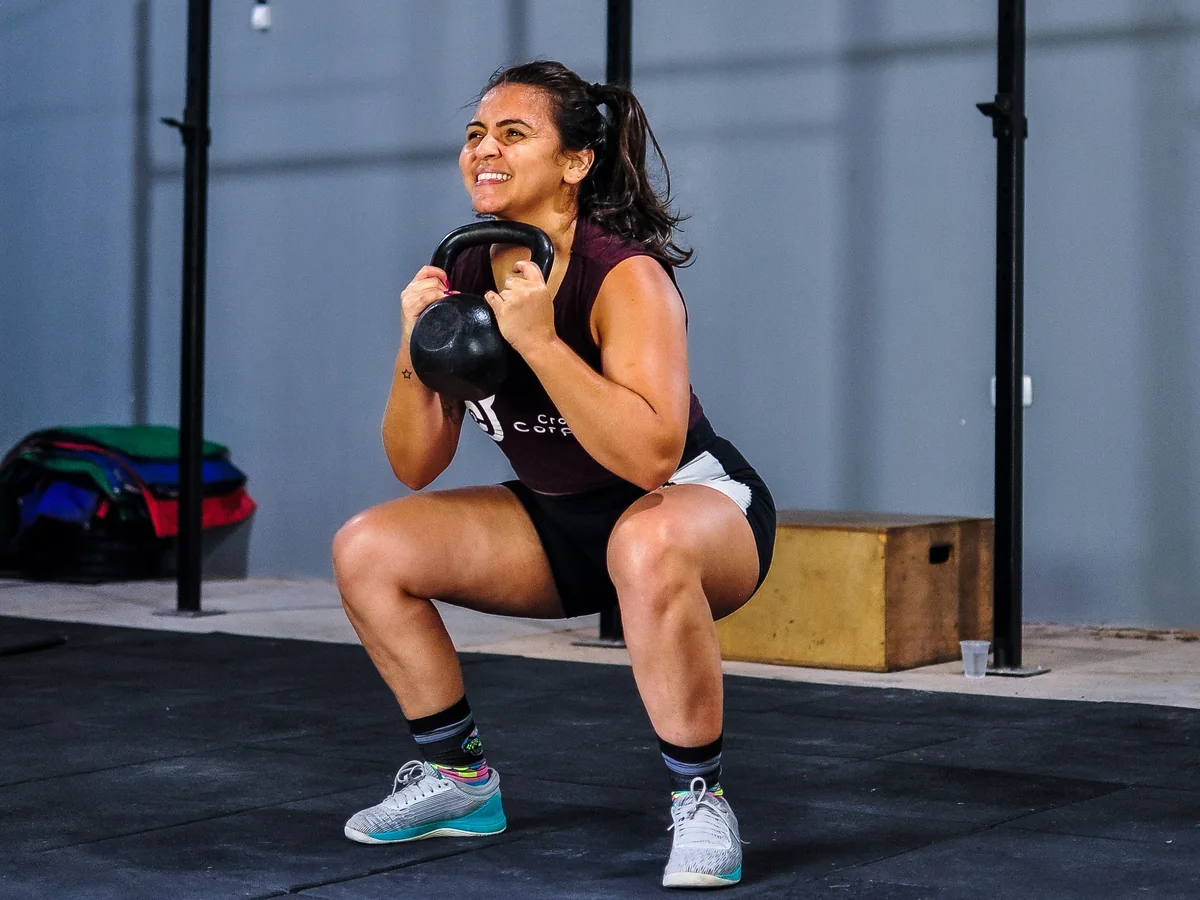
Hold the handle with both hands and let the bell hang between the legs. Its size may limit clearance. The weight touching the floor is not a depth target: stop before contact disrupts your position or choose a goblet hold.
4. Goblet-style sumo squat
Hold a dumbbell or kettlebell close to your chest. Moving the load higher changes balance and may remove the floor-clearance problem. Keep the weight manageable and avoid letting the arms drag the torso forwards.
5. Barbell wide-stance squat
This requires suitable equipment and experience with barbell squatting. Use a rack with correctly positioned safety supports, practise the unrack and begin with a manageable load. A barbell is optional; it is not the necessary destination for every beginner.
6. Paused sumo squat
Pause briefly at a controlled, comfortable depth without relaxing or bouncing. Reduce the load if needed. The pause helps you practise position; it is not evidence of uniquely greater muscle growth.
7. Tempo sumo squat
Try a deliberate two- to three-second lowering phase, then stand smoothly. Count consistently so sessions remain comparable. A slower repetition changes the challenge; longer is not always better.
Seven common mistakes—and useful corrections
- Going wider than you can control. If balance or comfort worsens, bring the feet in slightly. Maximum width is not the goal.
- Rolling onto the edges of the feet. Reset whole-foot contact, reduce load and test a smaller stance or depth. Avoid deliberately shifting all pressure into the heels.
- Dropping quickly into the bottom. Slow the descent so you can stop or reverse it deliberately. Reduce the weight if every repetition depends on a bounce.
- Forcing knee position. Aim for a smooth path broadly aligned with the toes. If the knees move abruptly and control is lost, adjust the stance or load rather than pushing them out as hard as possible.
- Exaggerating spinal movement. Keep a controlled torso position. Avoid lifting the chest by arching excessively, or leaning back at the top.
- Chasing an unsuitable depth. Use a range you can repeat comfortably. Change the hold if a hanging weight hits the floor before you reach it.
- Loading before learning. If repetitions shorten, feet shift or you rush, reduce the weight. Earn progression through consistent repetitions, not by changing the movement to finish the set.

Are sumo squats good for glute growth?
They can contribute, but the evidence does not establish them as the best glute exercise for everyone. In a small 2009 study, six experienced lifters showed higher gluteus maximus electrical activity in the widest back-squat stance under some loads.[2] A 2026 study of 18 participants found no squat-parameter combination consistently favoured muscle activation overall.[3]
These were acute barbell studies, not long-term comparisons of dumbbell sumo squats against every other glute exercise. EMG measures electrical activity during the task; it does not directly measure subsequent muscle growth.
Depth also matters in context. A ten-week study involving 17 men found greater glute and adductor growth with full than half squats, but it did not compare sumo with conventional stance.[4] That supports considering usable range, not forcing painful depth.
Choose a comfortable variation, make the working sets challenging, build a manageable weekly volume and progress over time. Combine it with complementary exercises such as a hip thrust or bridge and a Romanian deadlift. Our glute-training guide explains how to organise those roles without filling every session with similar squats.
Example lower-body workouts
These are illustrative sessions for generally healthy adults, not individually prescribed programmes. Choose the version that fits your experience, warm up with easy movement and lighter practice sets, and start conservatively. Keep roughly two or three good repetitions available at the end of each working set.
| Exercise | Sets × reps | Rest | Progress when ready |
|---|---|---|---|
| Bodyweight or light sumo squat | 2 × 8–12 | 90–120 sec | Repeat 12 controlled reps, then add a little resistance |
| Light Romanian deadlift or hinge practice | 2 × 8–10 | 90–120 sec | Keep the same comfortable range before adding load |
| Floor glute bridge | 2 × 10–15 | 60–90 sec | Add repetitions without arching the lower back |
| Supported calf raise | 2 × 10–15 | 60–90 sec | Use a repeatable range; progress resistance gradually |
| Exercise | Sets × reps | Rest | Progress when ready |
|---|---|---|---|
| Dumbbell or kettlebell sumo squat | 3 × 8–12 | 2–3 min | Add load after all sets reach the top of the range |
| Romanian deadlift | 2–3 × 8–10 | 2–3 min | Keep the hinge and range consistent |
| Supported split squat | 2 × 8–10 each side | 90–120 sec | Add reps before making the load heavier |
| Leg curl | 2 × 10–15 | 60–90 sec | Progress with controlled knee flexion |
Rest longer if you need it to maintain quality. These tables cover lower-body work: include upper-body training elsewhere. Avoid adding the entire example on top of an already demanding leg programme.
How to programme and progress sumo squats
One or two sumo-squat sessions per week can fit within a balanced routine. The wider recommendation is regular resistance training across the major muscle groups, commonly on at least two days weekly; it is not a requirement to perform sumo squats every session.[5] Space demanding leg sessions so you can recover and move well.
Record the implement, load, repetitions, stance and depth. Increase one variable at a time. If you reach the top of your chosen repetition range with consistent technique and a little effort in reserve, try the smallest practical load increase. Training to complete failure is not necessary for every set.[5]
With limited equipment, add controlled repetitions within a sensible range or try a pause before seeking heavier weights. Persistent soreness, falling performance or worsening discomfort suggests the programme needs adjusting. Learn more about building muscle with progressive training.
Sumo squat FAQs
Are sumo squats better for glutes?
Not universally. They train the glutes, but comfortable range, effort, progression and your overall programme matter more than the label. Acute activation findings do not establish a guaranteed growth advantage.
Do sumo squats work the inner thighs?
Yes, the hip adductors contribute. They work alongside the quads and glutes rather than in isolation, and training them does not selectively remove inner-thigh fat.
Can beginners do sumo squats?
Yes, if a modestly wider bodyweight stance feels comfortable and controlled. Begin with a manageable depth, then add resistance gradually. A conventional squat is also a valid starting option.
How wide should your stance be?
Start a little wider than your usual stance. Adjust in small steps until your feet stay stable and your hips and knees move comfortably. There is no ideal measurement for everyone.
Are dumbbell sumo squats effective?
They can be a useful strength and muscle-building exercise when sufficiently challenging and progressed. Grip and floor clearance may become limiting factors; a goblet hold or another squat can help.
Why do sumo squats feel uncomfortable?
Width, toe angle, depth and load may not suit you. Try a smaller, lighter version, but do not train through sharp or persistent pain. Discomfort alone cannot identify a particular injury or mobility problem.
How many sets and repetitions should I do?
Two sets of 8–12 controlled repetitions are a practical starting example, not a universal prescription. Adjust to your experience, other leg exercises, goals and recovery.
Can sumo squats replace ordinary squats?
They can replace a general squat exercise if they fit your goals and feel comfortable. If you compete in or need to improve a specific squat, practise that required variation too.
Key coaching takeaways
- Choose a wider stance you can control—not the widest possible stance.
- Keep your feet stable and let hips and knees bend together.
- Use the range your body and equipment allow comfortably.
- Judge progress using repeatable repetitions, not soreness or an imagined activation score.
- Combine squats with other movement patterns and enough recovery.
Want a training programme built around your goals?
FM Coaching combines personalised training, nutrition guidance, progress tracking and individual support. You can message through the app at any time, with response expectations agreed with your coach and calls by arrangement. Explore the current 7-day free trial.

Frankie Mcfarlane
Frankie is the Level 4-trained personal trainer behind FM Coaching. His background includes five years as part of the British powerlifting team, past bench press records and experience competing in NABBA bodybuilding shows.
This guide combines source-based exercise education with practical programming examples; it does not report a new experiment or individual clinical assessment. Read Frankie's coaching background.
Research and references
Studies below address different questions. Back-squat mechanics and electrical activity do not automatically establish long-term results for every sumo-squat variation. The workouts and Technique Lab are practical examples, not the protocols from these studies.
- Lorenzetti S et al. (2018). How to squat? Effects of various stance widths, foot placement angles and level of experience on knee, hip and trunk motion and loading. BMC Sports Science, Medicine and Rehabilitation, 10:14. DOI: 10.1186/s13102-018-0103-7.
- Paoli A, Marcolin G, Petrone N. (2009). The effect of stance width on the electromyographical activity of eight superficial thigh muscles during back squat with different bar loads. Journal of Strength and Conditioning Research, 23(1):246–250. DOI: 10.1519/JSC.0b013e3181876811.
- Lee CXY, Crossman AJ, Kedgley AE. (2026). The effects of bar positioning, stance width, repetition, and load on muscle activity during the barbell back squat. PLOS ONE, 21(8):e0354893. DOI: 10.1371/journal.pone.0354893.
- Kubo K, Ikebukuro T, Yata H. (2019). Effects of squat training with different depths on lower limb muscle volumes. European Journal of Applied Physiology, 119:1933–1942. DOI: 10.1007/s00421-019-04181-y.
- Currier BS, D'Souza AC, Fiatarone Singh MA et al. (2026). ACSM Position Stand: Resistance Training Prescription for Muscle Function, Hypertrophy, and Physical Performance in Healthy Adults: An Overview of Reviews. Medicine & Science in Sports & Exercise, 58(4):851–872. DOI: 10.1249/MSS.0000000000003897.
Published by FM Coaching. Photographs are licensed stock exercise examples, not FM Coaching clients or endorsements. Original diagrams simplify movement and anatomy for explanation. Pexels image licence. Questions or corrections? Contact FM Coaching on WhatsApp.