New GLP-1 Weight-Loss Study Finds Support May Reduce Weight Regain After Stopping Injections

A small randomised pilot found less estimated weight regain with a digital programme or medically tailored meals over four months. The findings are preliminary and do not show that medication or clinical care can be replaced.
One of the biggest questions surrounding GLP-1 weight-loss medications is what happens when people stop taking them.
Medicines such as semaglutide (Wegovy) and tirzepatide (Mounjaro) can help eligible patients lose weight as part of clinician-led obesity treatment. Tirzepatide acts on both GIP and GLP-1 receptors; it is often discussed alongside GLP-1 medicines.
However, maintaining those results after medication is discontinued remains a significant challenge.
Research published on 7 October 2026 in Obesity Science & Practice suggests two forms of structured support could help reduce weight regain during the first four months after treatment ends.
The small randomised trial, involving 39 adults who had previously lost weight while taking GLP-1-based medication, compared usual care with a digital behavioural programme and a service supplying medically tailored meals.
Participants receiving either intervention experienced substantially less estimated weight regain than those receiving usual care.
The findings are promising, although the trial was designed primarily to explore feasibility, adherence and satisfaction rather than establish definitive treatment effectiveness.
The study at a glance
- Design: randomised pilot, 39 adults.
- Follow-up: four months after stopping treatment.
- Support tested: digital wellness app or medically tailored meals versus usual care.
- Evidence: exploratory weight outcomes; larger trials are needed.
What did the new GLP-1 study discover?
Researchers from institutions including Tufts University and UT Southwestern Medical Center examined whether additional support could help adults maintain weight loss after discontinuing GLP-1-based treatment.
Participants were divided into three groups.
One group received usual care.
A second group received access to a digital behavioural weight-management application.
The third group received medically tailored meals designed by nutrition professionals.
Participants' weights were monitored over four months using connected weighing scales.
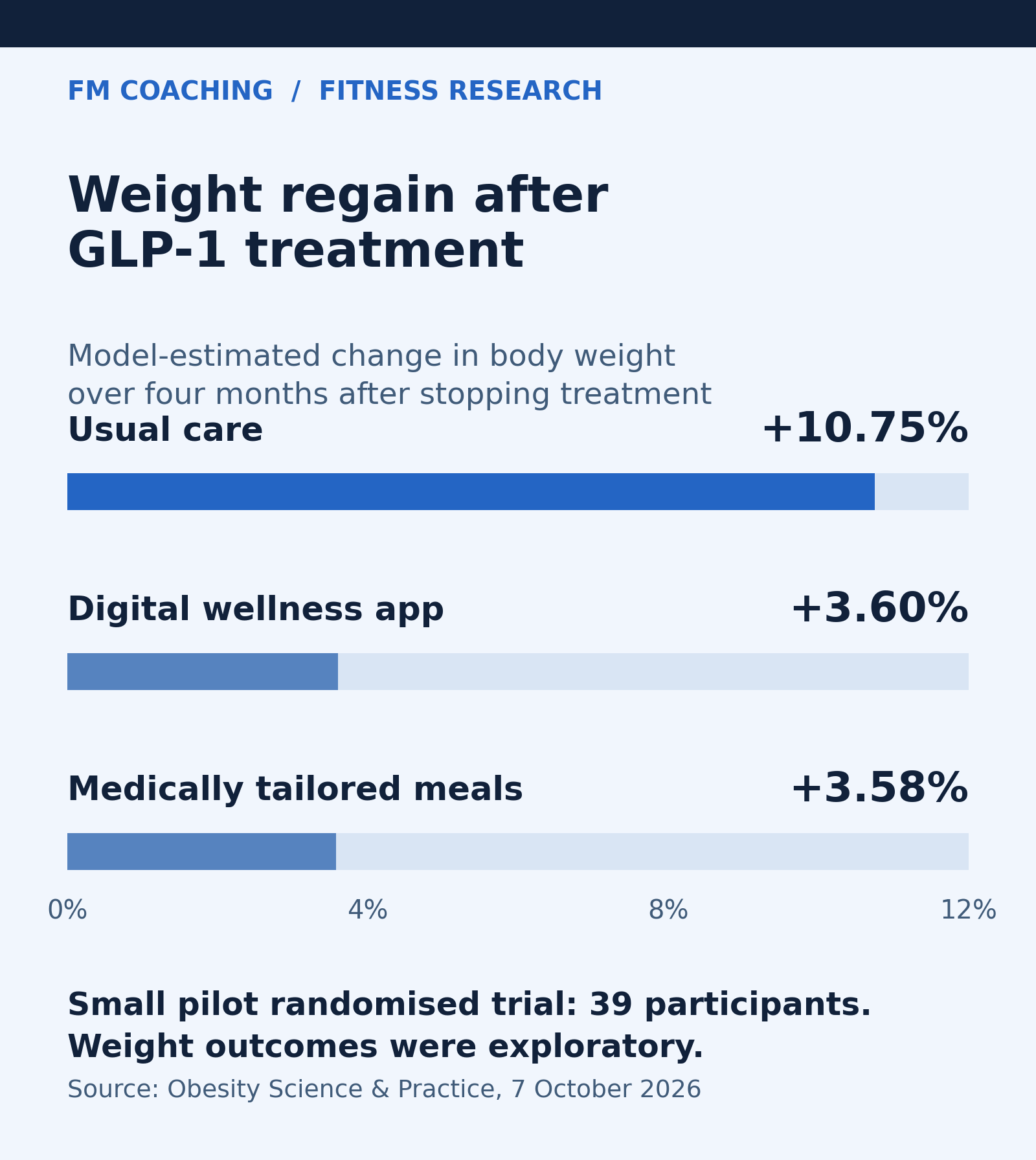
At the end of the study, researchers calculated the following model-estimated changes in body weight.
| Study group | Estimated body-weight change | 95% confidence interval |
|---|---|---|
| Usual care (n=14) | +10.75% | +7.03% to +14.47% |
| Digital wellness app (n=12) | +3.60% | +0.08% to +7.11% |
| Medically tailored meals (n=13) | +3.58% | +0.19% to +6.96% |
These figures represent estimated percentages of body weight gained during the four-month follow-up period, not the percentage of previous weight loss regained.
The paper reports a model-based difference of 7.16 percentage points less weight regain for the wellness application group than for usual care (95% confidence interval: 2.04 to 12.27 percentage points less).
For medically tailored meals, the reported model-based difference was 7.17 percentage points less weight regain (95% confidence interval: 2.14 to 12.20 percentage points less). These are differences between percentages, not kilograms or the proportion of earlier weight loss regained; rounded group estimates may not subtract to the exact reported contrast.
Both differences were statistically significant in the study's exploratory weight analysis.
However, the results must be interpreted cautiously because of the small sample size, short follow-up and exploratory design.
The study does not prove that these approaches will prevent weight regain in the wider population.
How was the research conducted?
The trial enrolled 39 adults who had previously lost more than 10% of their body weight using GLP-1-based medication.
All participants had stopped treatment within the previous 30 days.
At the start of the trial, the participants had lost an average of approximately 18.1% of their body weight during their earlier medication treatment.
Their average age was approximately 50 years, and their average body mass index was 31.4.
The researchers randomly assigned participants to three groups:
Group one: Usual care
Fourteen participants continued with whatever care their healthcare provider normally offered.
This could vary between participants and was not a standardised weight-maintenance programme provided by the study team.
Group two: Digital behavioural support
Twelve participants received access to Noom, a digital weight-management application.
The programme provides tools such as weight tracking, food logging, behavioural lessons and strategies for managing eating habits.
Participants were encouraged to engage with the application regularly.
Group three: Medically tailored meals
Thirteen participants received a service providing 10 prepared meals per week.
The meals were designed to support nutritional needs and reduce the practical burden of planning and preparing food.
The researchers monitored participants over four months using Bluetooth-enabled scales and questionnaires.
Thirty-four of the 39 participants completed a final study weigh-in.
The interventions were provided through research funding rather than purchased by the participants.
Why can people regain weight after stopping GLP-1 medication?
GLP-1 receptor agonists influence pathways involved in appetite regulation and feelings of fullness.
Some newer weight-loss medications, including tirzepatide, also act on other hormonal pathways involved in appetite and metabolic regulation.
During treatment, these effects can help patients reduce energy intake and achieve weight loss.
When treatment ends, appetite and other physiological pressures favouring weight regain can return.
Previous research has shown that regaining weight after stopping obesity medication is a substantial clinical concern.
A systematic review and meta-analysis published in The BMJ on 7 January 2026 examined 37 studies involving 9,341 participants.
Across the weight-management medications assessed, researchers estimated an average regain of approximately 0.4 kilograms per month after treatment stopped.
Rates varied by medication type and study conditions.
For newer incretin-based treatments, the review estimated faster average regain, although long-term projections involved uncertainty.
These findings help explain why obesity is increasingly treated as a long-term condition requiring ongoing care rather than a problem that can always be permanently resolved through a short course of medication.
Could meal planning and behavioural support make a difference?

The new October study raises an important question: can structured support help people navigate the transition away from medication?
The researchers tested two different approaches.
The digital application aimed to encourage behaviours such as monitoring food intake, identifying eating triggers and managing everyday decisions affecting energy balance.
Medically tailored meals offered another form of structure by reducing the effort required to plan and prepare some meals.
Both approaches were associated with less weight regain than usual care over the four-month follow-up period.
The researchers suggest that support focused on eating behaviours and the food environment may help people manage some of the challenges associated with stopping treatment.
However, the trial did not establish which individual components were responsible for the apparent benefit.
It also did not directly test personal training, one-to-one fitness coaching or exercise programmes as treatments for preventing GLP-1-related weight regain.
The findings therefore should not be presented as proof that fitness coaching alone produces equivalent results.
Did the study find improvements in diet quality or wellbeing?
Not all outcomes showed clear differences between the groups.
The researchers also assessed factors including:
- Diet quality
- Self-reported health
- Perceived adherence to the assigned care
- Satisfaction with the support provided
These measures did not show statistically significant differences between the intervention groups and usual care.
Participants assigned to the digital application reported using it approximately 2.8 days per week on average.
Those receiving medically tailored meals reported consuming approximately 8.1 of the supplied meals per week on average.
These findings highlight the importance of understanding how people actually engage with support programmes.
Providing an intervention does not automatically mean every participant uses it as intended.
What are the limitations of the new research?
Although the findings are encouraging, several important limitations must be considered.
1. The study was small.
Only 39 people were randomised, which limits confidence in how widely the results apply.
2. Follow-up lasted four months.
The research cannot establish whether the differences would persist after one year, two years or longer.
3. Weight was an exploratory outcome.
The study's primary focus concerned feasibility, adherence and satisfaction. It was not designed as a definitive large-scale effectiveness trial.
4. Participants received different previous treatments.
The trial included people who had used different GLP-1-based medication regimens. It was not designed to establish separate results for every individual drug.
5. Usual care was variable.
The control group continued care determined by individual healthcare providers, making the comparison relevant to real-world settings but less standardised.
6. Researchers could not fully blind participants.
People knew whether they were receiving an application, prepared meals or usual care.
The findings support further investigation rather than a universal recommendation.
A larger, longer-term trial would help determine whether these approaches produce consistent benefits across different populations and clinical settings.
What does this mean for people taking Wegovy or Mounjaro?
The research may be especially relevant to people considering their long-term treatment plans.
However, it does not suggest that people should discontinue prescribed medication to try a diet plan or smartphone application instead.
For some patients, continuing obesity medication may be an appropriate long-term medical strategy.
Treatment decisions depend on individual circumstances, treatment response, side effects and clinical advice.
In the UK, NICE recommends continued support with diet and physical activity when someone chooses to stop tirzepatide after losing weight.
The Medicines and Healthcare products Regulatory Agency (MHRA) also advises people to consult their prescriber before making changes to GLP-1 treatment.
Anyone thinking about stopping, restarting or changing medication should discuss the decision with an appropriately qualified healthcare professional.
Where does strength training fit into long-term weight management?

Although the new study did not specifically test resistance training, physical activity remains an important part of general health and long-term weight management.
Strength training can help build or maintain muscular strength, while regular movement supports cardiovascular health, mobility and physical function.
People losing substantial amounts of weight may benefit from individualised advice on physical activity and nutrition appropriate to their circumstances.
Exercise programmes should be adapted to an individual's ability, health, treatment and recovery needs.
For someone receiving medical obesity treatment, a fitness coach can potentially provide support with exercise planning and maintaining an active lifestyle.
However, fitness coaching is complementary to medical treatment, not a substitute for prescribing, medication monitoring or clinical nutrition care.
The October trial should not be interpreted as evidence that strength training can independently stop medication-related weight regain.
Why this study matters for the future of obesity treatment
The growing use of GLP-1-based medications has created new questions about long-term support.
Effective weight reduction during treatment is only one part of managing obesity.
Healthcare professionals and researchers are also investigating what people need when their circumstances change, whether because of medication access, tolerability, individual preference or clinical decisions.
The October 2026 trial suggests that practical support may have a role during this transition.
The research team reported that the interventions were associated with a slower return of body weight despite participants no longer receiving their previous medication treatment.
Further studies will need to establish whether those early differences are maintained and how support programmes can be integrated with clinical obesity care.
The authors reported support from a UT Southwestern Nutrition Obesity Research Center pilot grant funded through NIH/NIDDK, and a UT Southwestern community-based research award. Lead author Kelseanna Hollis-Hansen later received Noom funding for a follow-up trial, after this pilot had been completed and submitted for publication.
That subsequent funding was disclosed as a potential interest, while the authors stated that Noom had not influenced the reported pilot study.
Co-author Ildiko Lingvay also disclosed research funding and advisory or consulting relationships with pharmaceutical and healthcare companies. The full declarations appear in the paper’s funding and conflicts-of-interest sections. These disclosures help readers assess research involving commercial programmes.
Can weight regain after GLP-1 treatment be reduced?
The latest findings suggest that structured support could help some people limit early weight regain after stopping GLP-1-based medication.
Over four months, participants assigned to a digital weight-management programme or medically tailored meals regained substantially less weight, on average, than participants receiving usual care.
But this was a small pilot study.
It does not establish that either intervention will reliably prevent weight regain, replace obesity medication or deliver the same outcomes for every person.
What it does provide is an encouraging direction for future research into long-term weight management.
Researchers are investigating both weight loss during treatment and the support people need to maintain health when treatment changes.
For patients, the most appropriate approach remains a personalised plan developed with qualified healthcare professionals.
About FM Coaching
FM Coaching provides personalised online fitness coaching focused on fat loss, strength training, muscle building and sustainable lifestyle habits.
Our coaching services can help clients develop structured exercise routines and build consistency with their fitness goals.
Medical treatment, medication decisions and clinical nutrition requirements should be managed by appropriately qualified healthcare professionals.
Explore our coaching services:
Personalised Online Fat-Loss Coaching
Online Muscle-Building Coaching
Editorial disclosure: This article is independent reporting based on published research. FM Coaching did not conduct the study, interview its researchers or participate in the clinical trial.
Official sources
- Hollis-Hansen and colleagues — Preventing Weight Regain After GLP-1 Therapy Discontinuation: A Pilot Randomized Controlled Trial. Obesity Science & Practice, 7 October 2026. DOI: 10.1002/osp4.70194
- West and colleagues — Weight regain after cessation of medication for weight management: systematic review and meta-analysis. The BMJ, 7 January 2026. DOI: 10.1136/bmj-2025-085304
- NICE — Prescribing, reviewing and stopping tirzepatide
- MHRA — GLP-1 medicines for weight loss and diabetes: what you need to know
Published by FM Coaching. Read our editorial standards and corrections policy, or about the author.